Showing posts with label LPDDR. Show all posts

Thursday, April 9, 2015

DRAM Market Consolidation=> 32% Growth, All Time High Revenue

6+ DRAM vendors in 2001
Worldwide semiconductor revenue grew 7.9% in 2014, led by DRAM 32% increases;

"memory market was the best performer for the second year in a row, growing 16.6 percent, meaning the rest of the market only achieved 4.9 percent growth," said Andrew Norwood, research vice president at Gartner. "As a group, DRAM vendors performed best, lifted by the booming DRAM market, which saw revenue increase 32 percent to $46.1 billion, surpassing the all-time high of $41.8 billion set in 1995." (more in the article below).  

The consolidation in the number of memory manufacturers from 20+ in the early 90s to 3 vendors help to firm DRAM memory chip price. Due to the limited number of vendors and the high cost of new fabs will keep the floor under DRAM chip costs in the future.


More about fab consolidation in my blog from March 2012 – Moore's Law End? (Next semiconductors gen. cost $10 billion)


Ron
Insightful, timely, and accurate semiconductor consulting.

Semiconductor information and news at - http://www.maltiel-consulting.com/


Worldwide Semiconductor Revenue Grew 7.9 Percent in 2014, According to Final Results by Gartner

Booming DRAM Market Sees Revenue Increase 32 Percent During 2014
Worldwide semiconductor revenue totaled $340.3 billion in 2014, a 7.9 percent increase from 2013 revenue of $315.4 billion, according to final results by Gartner, Inc. The top 25 semiconductor vendors' combined revenue increased 11.7 percent, which was more than the overall industry's growth. The top 25 vendors accounted for 72.4 percent of total market revenue, up from 69.9 percent in 2013.
"2014 saw all device categories post positive growth, unlike in 2013, when application-specific integrated circuits (ASIC), discretes and microcomponents all declined. The memory market was the best performer for the second year in a row, growing 16.6 percent, meaning the rest of the market only achieved 4.9 percent growth," said Andrew Norwood, research vice president at Gartner. "As a group, DRAM vendors performed best, lifted by the booming DRAM market, which saw revenue increase 32 percent to $46.1 billion, surpassing the all-time high of $41.8 billion set in 1995."
Intel saw a return to growth after two years of revenue decline, as PC production recovered, with sales up 7.7 percent (see Table 1). The company retained the No. 1 market share position for the 23rd consecutive year by capturing 15.4 percent of the market, which was down slightly on the previous year.
2014 saw significantly more merger and acquisition (M&A) activity among the major semiconductor vendors than the previous year, with some announced deals still to close in 2015. Among the most significant deals was Avago Technologies' acquisition of LSI, propelling the company into the top 25 semiconductor vendors for the first time. MStar Semiconductor was merged with MediaTek after a prolonged merger, and ON Semiconductor acquired Aptina Imaging. After adjusting for closed M&A activity, the top 25 semiconductor vendors grew at 9.1 percent.Source: Gartner (March 2015)
Additional information is provided in the Gartner report "Market Share Analysis: Semiconductors, Worldwide, 2014."

Monday, May 20, 2013

20% of Tablet Application Processor Grabbed by Chinese Vendors

"Strategy Analytics is reporting an interesting snippet from its market research; that in 2012 Chinese vendors grabbed 20 percent volume share of the tablet application processor market between them. That's in a market that by value grew 83 percent year-on-year to reach $2.7 billion, the firm reckons. So even if those Chinese vendors were selling at the low-end of the pricing spectrum"

See March 213 Tablets are the New Mobile

 "Apple had about 48 percent revenue share of the tablet processor market in 2012, although clearly their devices are captive in the iPad. Nvidia, Texas Instruments, Samsung and Qualcomm made up Strategy Analytics' top-five ranking of vendors. Strategy Analytics reckons Nvidia led the non-iPad tablet market with 27 percent revenue share in 2012 having scored high-profile design wins in the Google Nexus 7 and the Microsoft Surface RT."

Ron
Insightful, timely, and accurate semiconductor consulting.
Semiconductor information and news at - http://www.maltiel-consulting.com/


London Calling: Did Allwinner outsell Intel, Qualcomm?
Peter Clarke, 5/8/2013 11:07 AM EDT
http://www.eetimes.com/electronics-blogs/other/4413656/London-Calling-Did-Allwinner-outsell-Intel-Qualcomm

It may seem strange but in 2012 Chinese chip vendor Allwinner probably sold more processors for tablet computers than Intel and Qualcomm together.
It may seem strange but Chinese chip vendor Allwinner Technologies Co. Ltd. (Zhuhai, China) probably sold more application processors for tablet computers in 2012 than Intel and Qualcomm put together.

The numbers for annual sales of smartphones and tablet computers are growing fast and we think we know who the winners are: the likes of Apple, Samsung, Nvidia, Qualcomm and so on, right? But Strategy Analytics is reporting an interesting snippet from its market research; that in 2012 Chinese vendors grabbed 20 percent volume share of the tablet application processor market between them. That's in a market that by value grew 83 percent year-on-year to reach $2.7 billion, the firm reckons. So even if those Chinese vendors were selling at the low-end of the pricing spectrum this is not chicken feed.

Sravann Kundojjala, senior analyst with Strategy Analytics, pointed out that the Chinese vendors are selling dual-core ARM chips at $4 or $5 and quad-cores at $8 or $9, less than half what Nvidia is selling its equivalent chips for and so probably the Chinese vendors, while significant in volume, do not yet have 10 percent of the market by value. 

Strategy Analytics reckons Apple had about 48 percent revenue share of the tablet processor market in 2012, although clearly their devices are captive in the iPad. Nvidia, Texas Instruments, Samsung and Qualcomm made up Strategy Analytics' top-five ranking of vendors. Strategy Analytics reckons Nvidia led the non-iPad tablet market with 27 percent revenue share in 2012 having scored high-profile design wins in the Google Nexus 7 and the Microsoft Surface RT.

So who are these Chinese tablet processor vendors? Strategy Analytics would like you buy a $6,999 report to find out their take on it.


The Chinese are coming

But we can try and guess who might be on Strategy Analytics' list. It probably includes: Allwinner Technology, Rockchip, Amlogic, Infotmic, Ingenic, Hi-Silicon, NuFront. It may include Via Technologies Inc. – a long time vendor of x86 chips and more recently of ARM processors – although Via is based in Taipei, Taiwan, and so may or may not have been included in the Chinese category.

Hi-Silicon, which is effectively part of Huawei, may have won business with its parent, although it is equally possible that such captive sales could have been missed. Ingenic is MIPS licensee with a reputation for being one company that has figured out to make most Android apps run smoothly on MIPS. Nufront is one of our less likely contenders. 

In fact we reckon that the first three names on our list – Allwinner, Rockchip and Amlogic – are probably responsible for more than half the Chinese supply of tablet processors in 2012. Allwinner clearly has the lion's share, according to supply chain checks made by my colleague Junko Yoshida; maybe nearly half the supply of Chinese tablet processors on its own. This would make it responsible for nearly 10 percent of the global supply by volume. The rest of the Chinese suppliers are part of a long list of much smaller suppliers. Interestingly in the previous year Rockchip was in a similar Chinese market-leading situation. The market changes and swings happen very fast in China.

Even more interesting is that Allwinner is therefore likely to have outsold Intel and Qualcomm put together. Strategy Analytics reckons Intel and Qualcomm missed the tablet processor boat in 2012 and captured less than 5 percent volume share in the tablet applications processor market. Stuart Robinson, director of the Strategy Analytics' handset component service, said that any success for these two in tablets will depend on Microsoft and whether its Windows tablet operating system can gain market acceptance.

Things can change rapidly in a fast-growing market but we suggest keeping an eye on Allwinner and its smaller competitors, Intel and Qualcomm.

Friday, March 22, 2013

Tablets are the New Mobile


Tablets are the new mobile, the slide deck in the article shows the growth of mobile, tablets in the Apple and Android eco-sphere. there are many other slide at the link below. The future of mobile follows the trajectory of April 15, 2009 Mobile Computing the Next Big Market.

Ron

Insightful, timely, and accurate semiconductor consulting.Semiconductor information and news at - www.maltiel-consulting.com

Future Of Mobile [SLIDE DECK]


Henry Blodget and Alex Cocotas | Mar. 21, 2013, 11:37 AM

Read more: http://www.businessinsider.com/the-future-of-mobile-slide-deck-2013-3?op=1#ixzz2OHIaEnKc

To kick off the conference, our BI Intelligence team—Marcelo BallvĂ©, Alex Cocotas, and I—put together a deck on the current trends in mobile. We looked closely at the growth of smartphone and tablet adoption, the platform wars, and how consumers are actually using their devices.
See more 


Monday, March 4, 2013

Storage Memory Tipping Point

The storage tipping point is upon us
Ambuj Goyal 2/27/2013 2:01 AM EST
www.eetimes.com/electronics-blogs/other/4407874/storage-tipping-point-upon-us

Keeping pace with the onslaught of Big Data requires a revolutionary approach to storage. It’s well known that the performance of computing has advanced at a much faster rate than the systems that store and retrieve the information they generate.


For many, this game of catch-up has existed since the first digital storage systems were introduced more than 50 years ago. At the time, the concern was no longer about the performance of computing, but about creating a digital storage system that could keep up with it.

Thus began the subsequent watershed moves from paper punch cards to magnetic tape and then hard disk drives—moments that revolutionized computing and ultimately the world in which we live.

Today we find ourselves at another critical technological juncture that once again is demanding a revolutionary approach to storage—an approach that will help it keep pace with not only computing, but with the information onslaught of Big Data.
To understand where the storage industry is headed, one need only look to the reason that computing has historically outpaced it. Unlike the storage industry, computing has continually leveraged and advanced semiconductor trends while storage systems have remained mechanical, with motorized wheels of tape or spinning disks. In fact, computing shifted from mechanical devices more than a hundred years ago, while digital storage, for the most part, remains tethered to technologies born out of the 1950’s.

Not any longer. We are at the tipping point of a new era of computer storage that will witness entire systems based on flash semiconductor memory to handle fast moving, operational data in real-time. Though flash has been utilized in a variety of capacities over the past 30 years and in hybrid storage systems over the past several years, complete flash systems will dominate the landscape in the coming months and years.

All-flash systems will not only provide exponential performance gains over mechanical and hybrid systems, they will help organizations dramatically lower data center energy consumption rates due to their inherent low power-consuming memory and lack of moving parts—no small feat. According to a 2011 study by Stanford University, data centers account for 2 percent of all the electricity consumed in the U.S.

Improved performance, reliability, and durability

To be sure, such systems will be the storage platform of choice to handle ever-growing and increasingly critical workloads such as credit card processing, stock exchange transactions, manufacturing and order processing systems. Even app stores on the web are starting to use flash-only storage.

Such attributes as improved performance, reliability, and durability make flash systems desirable today, but virtually mandatory for the future. That’s because the tsunami of Big Data shows no sign of receding. Researchers predict that the digital universe—all the digital information created around the world—will hit 8 zettabytes by 2015. That’s about all the data found in the U.S. Library of Congress times 800 million.

Today we find ourselves at a tipping point of computer storage, once again, where the challenges of computing are no longer at issue but, rather the storing and retrieving of the information they generate and share.

Through our acquisition of Texas Memory Systems last fall, we have systems that can store almost 24 terabytes of storage in a unit the size of a pizza box, and that provide access to data 100 times faster than mechanical storage. If we were to stack 42 such pizza boxes in a rack, it would provide 1 petabyte of storage, which is more storage than any single operational application requires.
The industry is moving rapidly in the direction of all-flash storage for operational information. Such systems will not only help organizations respond to, and exploit the challenges of Big Data today and tomorrow, but once again will change the future of computing and the possibly the world along with it.
Ambuj Goyal is general manager of IBM System Storage & Networking.

Wednesday, February 20, 2013

ISSCC 2013: Memory, High-performance Digital, and Wireless trends


Solid State Technology published three articles summarizing ISSCC 2013  technology trends. They "see progressive scaling in embedded SRAM, DRAM, and floating-gate based Flash... However, due to the major scaling challenges...continued increase in the use of smart algorithms and error-correction techniques...we see logic processes adopting FinFET devices.

"The relentless march of process technology brings more integration and performance. IBM’s System z processor leads the charge at ISSCC 2013 clocking in at 5.7GHz and with 2.75B transistors."

"Data rates for modern wireless standards are increasing rapidly and this is evident from the trend of cellular standards.The data rate has increased 100X over the last decade and another 10X is projected in the next five years"


Ron
Insightful, timely, and accurate semiconductor consulting.
Semiconductor information and news at - http://www.maltiel-consulting.com/


Wednesday, January 30, 2013

Where is DRAM Innovation?


The article, Hynix 30 nm DRAM layout, process integration adapt to change ,  discusses advances in DRAM memory at Hynix. DRAM memory has not been able to shrink the memory cell as quickly as flash memory. Leading edge flash memory products with dimensions around 20nm or less are being introduced to production, while DRAM memory is still above 30nm (see figure 4 in the article below).


While flash memory has a key advantage of keeping the information even without power, there is still a place for DRAM memory. Many of the process technology advances are being implemented at a slower rate in DRAM production. However major memory cell and circuit improvements are not being pursued. For example, storing multiple bites in one physical flash memory cell has been done for several years. There are 3-bit-per-cell (TLC) NAND and 2-bit-per-cell (MLC) flash available in the market, but there is no DRAM product with multiple bits in the same cell.

Ron

Insightful, timely, and accurate semiconductor consulting.
Semiconductor information and news at - http://www.maltiel-consulting.com/


Thursday, January 3, 2013

Flash Memory Growth & Sales Surpass DRAM


See in August 2012 Flash Memory Sales Surpass DRAM  , and DRAM Market Plateau/ Flash NAND Growing

While the NOR market size is not growing as fast as NAND market it is still big enough to make the combined flash market bigger than DRAM market.

More on NOR market in a previous comments Flash NOR Memory Revival and in my May 2007 article on Long Term Trends in the NOR and NAND Markets

Ron


http://www.maltiel-consulting.com/


Flash overtakes DRAM
David Manners,   Thursday 20 December 2012 10:09

The flash memory market will grow 2% to $30bn in 2012, overtaking the $28bn DRAM market for the first time, says IC Insights.

With the exception of 2010, the DRAM and flash memory markets have been growing closer in size to each other for several years but demand for flash used in portable media devices, coupled with two years of weaker demand and price erosion for commodity DRAM used in personal computers, will finally be enough to push total flash sales beyond those for DRAM this year, says IC Insights.

Among portable media devices, smartphone shipments are projected to finish the year up 55% to 750 million units and shipments of tablet computers are forecast to rise 80% to 117 million units.

Through 2017, the flash memory market is expected to widen its lead over DRAM. In fact, IC Insights forecasts the NAND flash memory market alone will be larger than the DRAM market beginning in 2013.

Among more than 30 product segments classified by WSTS, NAND flash is forecast to have the third-highest average annual growth rate through 2017, trailing only the market growth rates for tablet processors and cellphone application processors.
NAND flash sales are forecast to increase 14% annually from 2012-2017, growing to $53bn at the end of the forecast period while the DRAM market is forecast to grow 9% annually over this same time.

Thursday, October 25, 2012

Mobile DRAM Takes Over

"mobile DRAM commanded more than 26 percent of all DRAM revenue during the second quarter—a significant improvement from 19 percent the same time a year ago, and from 11 percent two years ago in 2010.
This is attributed to 2 reasons:
1. Share of mobile DRAM bit shipments is now at 17.8 percent, up from 7.9 percent in the first quarter.
2. The price of mobile DRAM has fallen less than that of its commodity cousin and its pricing is overall less vulnerable given the segments it plays in."(from Mobile DRAM Market Grows, Samsung Domination Continues)

Ron
www.maltiel-consulting.com


Mobile DRAM revenues up in 2nd Quarter

Thursday, October 18, 2012


Mobile DRAM revenues rose to the highest level yet in the second quarter of 2012 Revenues amounted to US$1.85 billion in the second quarter, up from US$1.83 billion in the first.

Two reasons account for mobile DRAM's rising market clout. First, mobile DRAM's share of total DRAM bit shipments is now at 17.8%, up from 7.9% in the first quarter.

Second, the price of mobile DRAM has fallen less than that of itsd cousin, commodity DRAM, IHS noted. While commodity DRAM historically has been subject to great swings in pricing—with the product losing as much as half of its value from the second to the fourth quarter last year alone—mobile DRAM pricing is less vulnerable, falling 10% per quarter on average.

Mobile DRAM also tends to be priced according to manufacturing cost, not based on the general balance between supply and demand. As a result, DRAM companies are able to earn a more reasonable margin for their mobile memory products—unlike in commodity DRAM, where negative margins are frequently the rule.

Samsung Electronics continued its unshakable hold at the top of the mobile DRAM market in the second quarter of 2012, with sales of US$1.1 billion, or a remarkable 61% of the global mobile DRAM market.

With the success of smartphones such as the Galaxy S3, the South Korean electronics titan also is now one of the world's largest consumers of mobile DRAM. Samsung enjoyed a 3% improvement in sales during the quarter, and its year-to-year growth was even more impressive at 35%.

SK Hynix was No. 2 behind Samsung with sales of US$362 million, down from US$366 million in the first quarter and from US$377 million the same time a year ago.

Elpida Memory snagged a 13% share based on mobile DRAM revenues of US$245 million in the second quarter of 2012, while Micron Technology saw its share amount to 4% in light of US$79 million in revenues.
By: DocMemory

Tuesday, October 2, 2012

DRAM Market Plateau/ Flash NAND Growing

While the PC market is slowing as the article below discusses, the Tablet and iPad are new markets that should offer growth opportunities for both Flash NAND and DRAM.

The key reason that DRAM is slowing while NAND (and NOR) are growing faster is due to the inherent advantages of Flash vs. DRAM.


We can already see that Flash Memory Sales Surpass DRAM  additional reasons were mentioned in the March 2012 article When will Flash Memory Market be 2x of DRAMs


Ron
http://www.maltiel-consulting.com/


DRAM Makers Continue to Suffer as DRAM Price Falls

http://www.xbitlabs.com/news/memory/display/20121032152632_DRAM_Makers_Continue_to_Suffer_as_DRAM_Price_Falls.html
4GB DDR3 DRAM Module's Price Drops to $16.25

by Anton Shilov 10/01/2012 

Dynamic random access memory (DRAM) market monitoring company DRAMeXchange claims that as notebook shipments show signs of weakening and Windows 8 looks unlikely to stimulate PC shipments, second-half September contract price continues on a downtrend.

Average transaction price per 4GB DDR module fell from $17.25 to 16.25, with a low of $16, close to the lowest price reached during the second half of 2011. Average 2GB module price, on the other hand, has dropped to $9.25, a 5.13% decrease compared to the first half of the month. As 4GB modules have replaced 2GB modules as the market mainstream, 4GB price drops have become more apparent.

At press time, one untested [eTT] 2Gb DDR3 chip price cost $0.683 on average in Taiwan's spot market, 2Gb DDR3 1333MHz/1600MHz chip's price was approximately $0.844, whereas 4Gb DDR3 1600MHz memory IC was priced at $2.545 on average on the spot market.

From the market perspective, DRAM average selling price has been plummeting at an increasing rate since July, reflecting not only weaker-than-expected seasonal demand, but also the fact that supply-side adjustments were not as effective as hoped. Using 4GB module price as the basis of calculation, 2Gb chip price has plunged to a low of $0.84, arriving at spot price levels. Looking at the spot market, as purchasing is weak, module makers are less eager to restock inventory. Both contract and spot prices reflect price negotiation difficulties, and transaction volume has been much lower than last quarter, clear indication that both module makers and PC OEMs have high stock levels; thus, buying momentum is not likely to pick up in the short term. In the absence of large-scale production cuts, TrendForce expects contract price will remain on a downtrend.

As the PC market has matured in recent years, in addition to the fact that the global economy is expected to worsen in the second half of this year, TrendForce forecasts PC shipments will see -3.9% growth for 2012. Furthermore, as consumers’ limited budgets and changing preferences steer them towards other mobile devices, smartphones and tablets are experiencing high growth while the PC market suffers. It is clear that PC demand is not as it was; the category is no longer the market mainstream, as shown by the fact that the 2012 PC DRAM shipment ratio has fallen below 50% for the first time.

On side, although makers are beginning to favor non-commodity DRAM production, PC DRAM supply is still in excess, which indicates restoring the supply-demand balance can no longer be achieved via production adjustments. A portion of commodity DRAM capacity must be permanently reduced if industry supply levels are to be lowered. According to TrendForce data, 2HSept. 4GB module price is approaching last year’s low, and is already below every DRAM maker’s total cost (based on mainstream 30nm process). Losses from commodity DRAM are not decreasing, and price is expected to continue falling in the short term unless large-scale capacity cuts are initiated.

Thursday, August 2, 2012

Samsung, Hynix, Micron DRAM Monopoly?

Micron acquisition of Elpida will have some digestion pains. However the decreasing number of DRAM manufacturers to just 3 dominating manufacturers will have a strong long term affect on prices, availability and power of the three vendors.

From the article below-
"1. Samsung  400,000 wafer starts per month (40.8% share)
2. Micron’s buyout of Elpida to boost its DRAM production volume...370,000 wafer starts per month (24.8% share)
3. Hynix Semiconductor ...300,000 wafer starts per month...(24.2% share)"

The article below discuss the likely digestion pains of Micron integrating Elpida “Micron’s previous acquisitions in years past of specialty memory makers Numonyx and Inotera presented unanticipated surprises, and in some ways Micron is still digesting those purchases.

Adding Elpida to the mix is unlikely to hasten the rest of the complicated integration process that Micron still needs to do with its earlier buyouts.”


Ron


Risks Come with Rewards in Micron’s Purchase of Elpida

http://www.isuppli.com/Memory-and-Storage/News/Pages/Risks-Come-with-Rewards-in-Microns-Purchase-of-Elpida.aspx?utm_source=iSi&utm_medium=SN&utm_campaign=/?utm_source=iSi&utm_medium=SN&utm_campaign=MEMORY_RA
July 23, 2012 ,  Mike Howard

Micron Technology Inc.’s recent purchase of bankrupt Japanese entity Elpida Memory Inc. is a bold move not without risk, even though Micron will emerge from the acquisition considerably larger with more than double its original manufacturing capacity for dynamic random access memory (DRAM), according to an IHS iSuppli DRAM Market Brief from information and analysis provider IHS (NYSE: IHS).

U.S.-based Micron’s buyout of Elpida on July 2 is expected to boost the Idaho firm’s DRAM production volume to approximately 370,000 wafer starts per month over the long term, up a notable 131 percent from 160,000 wafer starts prior to the purchase. The new-found capacity by the only U.S. memory manufacturer allows it to leapfrog perennial second-placed Hynix Semiconductor of South Korea, which now will become the third-ranked player in the global DRAM industry, with about 300,000 wafer starts per month.
Both Hynix and Micron will continue to trail DRAM market leader Samsung Electronics, also of

South Korea, which leads with 400,000 wafer starts per month, as shown in the figure below. Based on first quarter rankings, the Micron acquisition will boost its standing to 24.8 percent share of the DRAM space, behind Samsung’s 40.8 percent portion but ahead of Hynix’s 24.2 percent share of market.


“Several key components make the Micron-Elpida deal appear to be a smart move, but integration could prove challenging or even messy if details are not worked out carefully enough,” said Mike Howard, senior principal analyst for DRAM & memory at IHS. “Micron’s previous acquisitions in years past of specialty memory makers Numonyx and Inotera presented unanticipated surprises, and in some ways Micron is still digesting those purchases. Adding Elpida to the mix is unlikely to hasten the rest of the complicated integration process that Micron still needs to do with its earlier buyouts.”
Moreover, the transfer of technology entailed by the deal with Elpida—a competitor on roughly the same scale as Micron—may prove costly and time consuming.
“All this means that while Micron has put a tremendous amount of work into the acquisition, the real work lies ahead, IHS believes,” Howard added.
Micron Structures Acquisition Transaction Shrewdly

Among the intriguing facets of the Elpida deal are the purchase price of the transaction, the way payments will be made and how the payments will be funded.

In terms of the price, the total purchase cost of Elpida to Micron is $2.5 billion, of which $750.0 million is to be paid in cash. The cash portion of the payment is intended for Elpida assets and will be due at the close of the deal, expected sometime in 2013. The cash payment won’t necessarily reduce the cash balance of Micron, as it will gain access to all of Elpida’s cash and current assets on the bankrupt company’s balance sheet. Elpida at the end of December 2011 had approximately $1.4 billion in assets.
The other part of the purchase price is the remaining balance of $1.75 billion. This part of the payment, which does not start until December 2014 and will continue to 2019, is paid out in interest-free installments—a terrific boon to Micron, considering that interest payments could have easily approached 5 percent.

Lastly, of keen interest to DRAM market watchers and prognosticators is that the deal also calls for the payments to come from the free cash flow of a restructured Elpida, which will now turn into a Micron subsidiary. If Elpida is not cash-flow positive in its new role as Micron offspring, then no payments will have to be made by the parent company. By structuring the deal this way, Micron has insulated itself from any drastic downturns in the DRAM market or from being upended by larger macroeconomic events beyond its control.
In a separate but related deal, Micron also purchased Taiwanese maker Powerchip Semiconductor’s minority interest in Rexchip Electronics, in which Elpida had majority two-thirds share. The deal for $330 million gives Micron an overwhelming 89 percent ownership share of Rexchip, which has a cost competitive, leading-edge manufacturing plant in Taiwan. The Rexchip facility formed a very attractive component of the entire Elpida deal, and Micron’s concurrent purchase of both Elpida and Rexchip gives the U.S. memory maker an even stronger edge in the tightly held DRAM space.

Friday, June 8, 2012

Cloud Storage, Servers Drive IC Demand

DRAM manufacturers such as Samsung, Hynix, and Micron will benefit from the new demand for storage and servers (see below).

Intel benefited from it last quarter. Intel, which also supplies chips to the slow-growing PC market, increased its revenues by 20%. They had more than $10 billion in revenues from ICs sold to data centers, for servers, storage products, and networking. It is likely that databases and cloud servers (20% of sales, 3x PC segment growth) added to Intel's growth in 2011.


Ron


DRAM troubles come to an end, key to success is cloud storage

http://electronicsfeed.com/news/2373
Staff Editor


According to TrendForce, this year’s biggest DRAM industry event, the announcement that Japanese manufacturer Elpida will join hands with U.S. maker Micron, marks the end of a perfectly competitive market as Samsung, Hynix, and the new Micron team become the three main players in an oligopolistic market.

Share on linkedinShare on printShare on emailMore Sharing Services10 hours ago DRAMeXchange, a research division of TrendForce, indicates there is hope for DRAM price recovery, forecasting a 15% decrease in yearly DRAM revenue and a 30% yearly bit shipment increase in 2012. 1Gb average selling price is expected to fall by around 30% this year, an improvement over last year’s 50% decrease.


The future of the DRAM market will see a transition from PC DRAM to server and mobile DRAM, important for the cloud storage sector, and it would be prudent for Taiwanese makers to speed up production integration to lower the risk of overreliance on PC DRAM.


Unable to Withstand Rise of Mobile Sector, DRAM Makers’Profits Decrease as Prices Fall


In 2008, the DRAM industry was hit hard by the global financial crisis – German memory maker Qimonda withdrew from the market, and Taiwanese DRAM manufacturers saw capacity cuts of nearly 60%. As the economy gradually recovered, demand exceeded supply, giving DRAM makers a year and a half of good business – DRAM average selling price rose by 8.9% in 2010.


Bit output increased as well, and DRAM industry value grew by 72.8% compared to 2009. In 2011, DRAM production increased by 50% over the previous year, as manufacturers continued to advance two generations of process technology a year. With the rise of smartphones and tablet PCs, PC DRAM was in severe oversupply in 2011, with a 50% decrease in average selling price compared to 2010, and a 24.6% decrease in DRAM industry value.


Aside from industry leader Samsung, none of the memory manufacturers came away without losses, and only a handful of makers remain in the once populated industry.


Samsung Safe with Strength in Technology Migration and Product Mix


TrendForce indicates, bit growth is no longer the key to profitability. Continued technology migration is necessary, but a flexible product mix is a must to cater to the constantly changing demands of the market. For instance, in the first quarter of 2012, Samsung not only dominated the mobile DRAM sector with nearly 60% market share, but the maker was also the most aggressive in transitioning to 30nm process technology in the mobile DRAM sector.


The Korean heavyweight was the only DRAM manufacturers to see profits in 1Q12, an indication that technology migration is not the only prerequisite to profitability – proper product mix is a necessity as well.


In conclusion, in the coming oligopolistic market era DRAM makers will need to be reborn to enjoy the fruits of their labor once again, and only improving product diversification and increasing added value will bring profitability.


Read more: http://electronicsfeed.com/news/2373

Thursday, June 7, 2012

Intel, Google and Smartphones


The article below raises an important point. Intel can get ahead in the smart phone market by working closely together with Google on next generation mobile phones.

Both can benefit by combining Intel's advanced processing and design prowess with Google's software and hardware capabilities.


See more about Intel, Google, and mobile phones in the enterprise market at Intel to Target Enterprise by Including vPro in Smartphones


Ron


Intel Chips on Android based Motorola and Lenovo Smart Phones
http://nucleation.blogspot.com/2012/01/intel-chips-on-android-based-motorola.html?m=1


Intel Chips on Android based Motorola and Lenovo Smart Phones Intel has made an announcement at Consumer Electronics Show (CES) that Motorola Mobility and Lenovo will use their new chip designed for mobile devices on upcoming Android based smart phones. Intel even demoed its own prototype smart phone built using the new chip Medfield.

Medfield chip will help Intel in entering the mobile process sector, dominated by Arm Holdings. This is Intel's second attempt to have their chips on smart phones. In CES 2010, LG had announced a tie up with Intel, which never found light. This time Intel has even announced some rough shipping dates. Lenovo would launch a Medfield-based phone by July in China and Motorola in second half this year.


Designed to balance processing power against energy use the chip helps in maximising battery life. With Intel's well-established 32-nanometre technology, the chip packs C86-architecture central processing unit (CPU), RAM Memory, storage and graphics processing unit all onto the same chip. The prototype unit that Intel demoed in CES could deliver eight hours of 3G voice calls, six hours of 1080p video decoding or five hours of 3G internet browsing.


In an interview given to BBC, Intel's Ultra Mobility Group General Manager told, "Battery life on this platform is not the best in the mobile market, but it is by far not the worst. We are very effective and good at some tasks and sort of in the middle of the pack at others. Essentially, we think you can build a Smartphone based upon our processor with an ordinary sized battery that you see in today's smart phones that will provide a great experience. There will be no battery life issue on our platform."


Intel claims to have taken steps to prevent existing Android apps from being incompatible or slow on its chips.

Intel says that it has developed a technology to tackle 25% of apps designed specifically to run on ARM-based processors.

These applications may consume more power than applications developed for Intel chips. This power consumption will not be so noticeable by end users. Intel is planning to use the chip in tablets at a later stage. However, for now Intel is promoting a Clover Trail processor for tablets running the upcoming Windows 8 system. There have been discussions in Intel to move into mobile manufacturing sector also. That may happen only in distant future. For the success of Intel, it is important for them to crack a way into the mobile device market. With the advent of new technologies, gap between smart phones and tablets versus PCs and laptops will become narrow. Manufacturers have started experimenting ARM-based laptops running Linux Operating system.
To be on the run, Intel needs to grow its business at a significant rate and must participate in this market.

Thursday, May 17, 2012

Flash, DRAM Memory Impact Smartphone Design

Reducing  power consumption and heat production is key for long operation time of battery between charges.  Memory chip  design plays a major role in increasing it.   The article below discuss three different approaches to achieve long battery life.

Ron Maltiel


Semiconductor memory plays a large role in smartphone design says Matti Floman of Nokia | Denali Memory Report

http://denalimemoryreport.wordpress.com/2012/05/16/semiconductor-memory-plays-a-large-role-in-smartphone-design-says-matti-floman-of-nokia/

“There’s no real difference between PCs and mobile phones today,” said Matti Floman from Nokia who gave the first keynote speech at last week’s JEDEC Mobile Forum. There is no difference in the types of applications run; there’s no difference in performance; there’s no difference in connectivity. Because smartphones now offer the sort of universal, run-any-app abilities of PCs, they are rapidly moving down the phone hierarchy, penetrating the broad mobile phone subscriber market and pushing out phones with lesser abilities such as feature phones.

Although user expectations are not different between PCs and phones, there’s certainly a difference in terms of hardware design. It’s not easy to make powerful memory that doesn’t consume lots of power, said Floman. In addition, phones need to fit more and more memory capacity into smaller and smaller volumes to make room for more battery in the phone—to accommodate users’ desire for more time between battery charges. Smartphone form factors are also evolving, said Floman. The favored form factor these days is a thin phone with a large display.

Semiconductor memory requirements to accommodate these design characteristics include:

■Scalability (in terms of capacity, performance, and functionality), because no one can see five years ahead
■More bandwidth
■New packages (to accommodate 3D IC assembly and thermal issues)
■Lower power consumption
■Scalable modules
■Standards

Then Floman focused on what’s really important now: power. “Power is the focus of the future,” he said. Power consumption is limited by battery capacity and the heat tolerance of stacked packages, because whether or not the mobile phone makers are using 3D IC assembly, they are already stacking die. Here’s an image Floman used to show the evolution of 3D stacking in smartphone design. Floman noted that the maximum operating temperature for NAND Flash devices is 85° C and that DRAMs are limited to 105° C. Die stacking compounds the problem of heat dissipation.

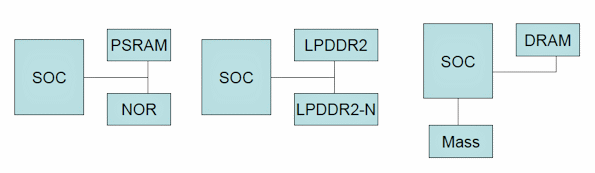
One of the most interesting slides that Floman presented at the JEDEC Mobile Forum, in my opinion, was an image that showed three processor/memory architectures for mobile phones.

The graphic looked like this:


The two architectures on the left are execute-in-place (XIP) architectures. The leftmost architecture employs pseudo-static RAM and NOR Flash as memory and executes operating-system code directly from the NOR Flash memory. The middle architecture replaces the pseudo-static RAM and NOR Flash memory with LPDDR2 SDRAM and LPDDR2-N Non-Volatile Flash memory. It’s still an execute-in-place architecture but the memory components are newer and deliver more performance with better capacity.

The architecture on the right is a shadowing architecture where the OS code is stored in a mass-storage device (NAND Flash memory) and the code is first transferred to DRAM and then executed. High-end smartphones use this architecture.


These architectural designs will hold unless a new type of memory with both fast read/write times and non-volatile storage become commercially available in the required capacities and the required cost per bit. If that happens, the smartphone will only need one memory type—perhaps that might be magnetic RAM (MRAM) or Memristor-based memory. But that’s not the situation today.

The best possible performance, said Floman, will come from Wide I/O DRAM while the UFS (Universal Flash Storage) standard appears to be poised to become the next commonly used storage medium for smartphone design. UFS “will be the next generation mass memory” for smartphones, said Floman.

All of this evolution has but a single purpose. “You will not buy your next phone from the same manufacturer unless it provides new functions,” Floman said as he concluded his keynote speech.