Showing posts with label server. Show all posts

Thursday, May 12, 2016

3D Semiconductor Evolution

http://www.3dincites.com/2016/01/2015-retrospective-outlook-2016-3d-nand-flash-one-upmanship/
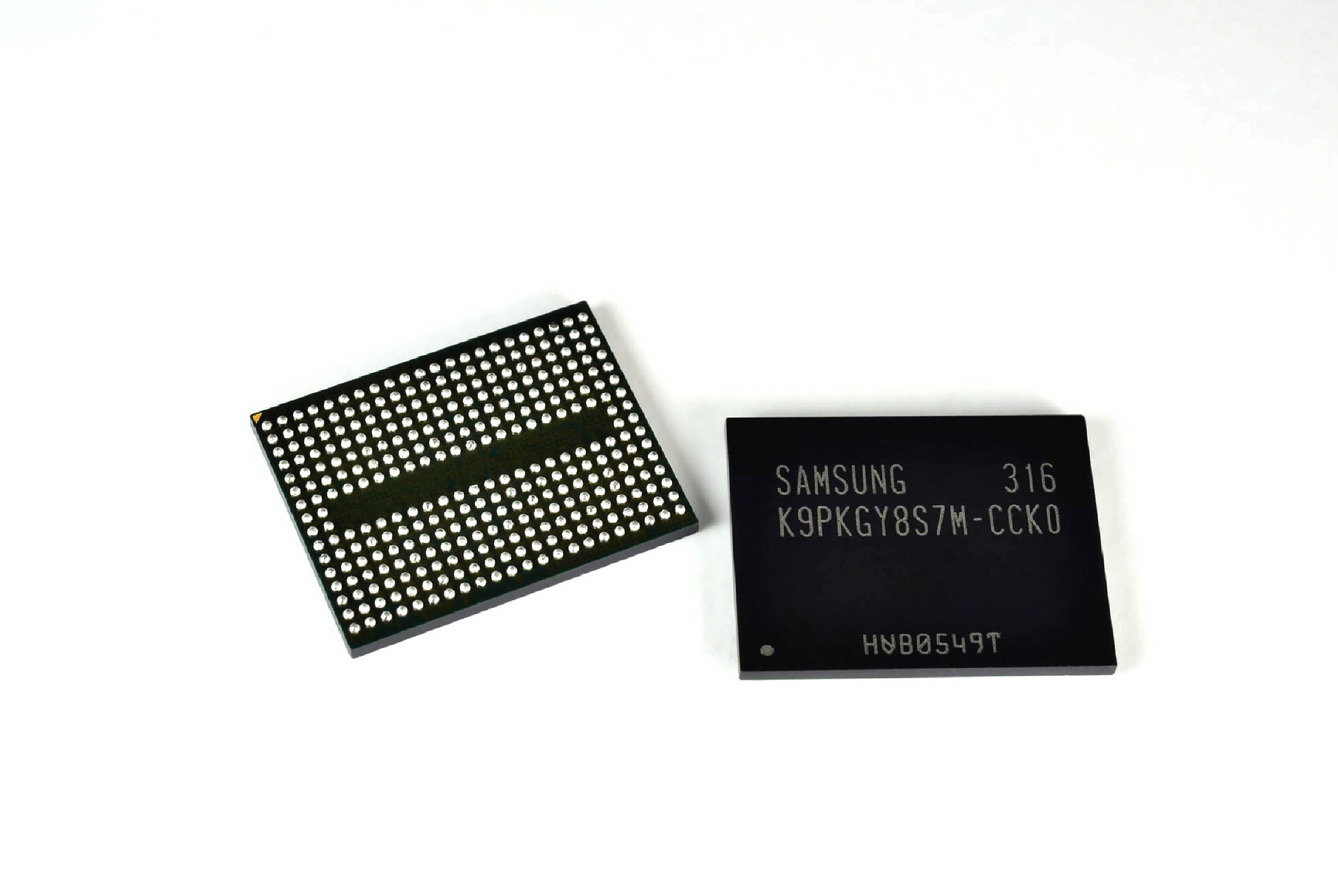
Semiconductor companies have been building 3D devices (which are  vertical circuits above the silicon die edge surface) for the last couple years. They have been going in the vertical direction due to the complexity of shrinking the devices (see 2012  Moore's Law Slowwwing ). Samsung has been making 3D V-NAND since 2013 (see Samsung’s 1Tb SSD: 3D Vertical NAND ). Samsung is now using its vertical layer manufacturing know-how to increase its market share in V-NAND and DRAM. More about Samsung's progress below.

Ron
Insightful, timely, and accurate semiconductor consulting.
Semiconductor information and news at - http://www.maltiel-consulting.com/


As tide turns against chip industry, Samsung forges ahead of rivals


By Se Young Lee
Apr. 26, 2016, 7:02 PM Thomson Reuters

SEOUL (Reuters) - Gloom may be settling over much of the world's semiconductor industry but Samsung Electronics Co Ltd is expected to cope better than most due to its strong technological edge, enabling it to boost market share for some key products and possibly even lift revenue.
A plunge in PC sales and slower growth for smartphones globally has hit the sector hard, prompting Intel Corp to say this month it would cut up to 12,000 jobs.
Qualcomm has said fiscal third-quarter chip shipments could fall as much as 22 percent, while SK Hynix Inc on Tuesday reported a 65 percent slide in quarterly operating income - its weakest result in three years.
Samsung, which reports its first-quarter earnings on Thursday, is also hurting. Chip profits - which accounted for just under half of its overall 2015 operating income - are widely expected to fall, with some analysts predicting a drop of more than 10 percent in January-March from a year earlier.
But if its rivals are getting pummeled, the South Korean tech giant is merely bruised and is in many ways benefiting as clients shift towards premium power-conserving DRAM chips for smartphones, as well as solid-state drives for data storage using 3D NAND chips.
"The technological gap between Samsung and its competitors in fields such as DRAM and NAND has been widening lately, which helps the company avoid the rate of profit decline seen at other firms," said Song Myung-sub, an analyst at HI Investment & Securities.
Even with a first-quarter drop of around 10 percent, Samsung's chip operating profit is expected to be nearly five times that of SK Hynix.
The world's No. 2 chipmaker also happens to run the world's biggest smartphone business, giving it a captive customer for its chips that none of its rivals have.
"This is a safehouse they can go to," said Avril Wu, an analyst at research firm Trendforce.
Healthy initial sales for Samsung's new flagship Galaxy S7 smartphones are expected to be the main driver of first-quarter operating profit, which the firm has said likely rose 10.4 percent from a year earlier to 6.6 trillion won ($5.8 billion).

DOMINANT POSITION
Of its key products, analysts are most upbeat about Samsung's NAND chip prospects. Samsung was the first to mass produce NAND flash chips using a technology called 3D NAND, helping it assume a dominant position in higher-margin products such as solid-state hard drives for computers and servers.
BNP Paribas expects the South Korean firm's NAND revenue to climb 16 percent and NAND operating profit to jump 69 percent this year. Shipments will also likely outpace the industry average, allowing Samsung to seize more market share, it said in a report.
The technology is already contributing to Samsung's profits, analysts say, adding that this is not the case for main NAND rivals Toshiba Corp, SK Hynix and Micron Technology Inc which are estimated to be as much as three years behind.
Investors and analysts also point to Samsung's superior production technology for DRAM chips, saying the firm is ahead of its closest rivals by at least a year. It can mass produce smaller chips than rivals, which boosts performance and conserves power as well as increasing the number that can be made from a single wafer.
Samsung commanded 58 percent of the mobile DRAM market as of the fourth quarter of 2015, according to TrendForce. Mobile DRAM revenue also accounted for more than half of Samsung's overall DRAM sales for October-March, TrendForce's data shows.

(Reporting by Se Young Lee; Editing by Edwina Gibbs)

Wednesday, November 12, 2014

Samsung 3D Process Pioneers Next Gen Semiconductor Devices

Samsung is leading the semiconductor industry with a two year leads in development of 3D NAND (see the article below).


The basic 3D process could be applied to other technologies beside flash such as DRAM memory or logic. It enable increasing the number of the transistors on each dies without the need to shrink the design rules below 20nm.

It is a key advantages since you do not need to develop the very difficult EUV photolitography.

More about 3D NAND in August 2013 blog - Samsung’s 1Tb SSD: 3D Vertical NAND

It make sense for Samsung to apply 3D Flash first to enterprise SSD, where the growth rate is +40%.

See also Applied Materials development work on advance patterning  - Applied Materials Develops Advanced Patterning Solution for Memory Devices


Ron
Insightful, timely, and accurate semiconductor consulting.
Semiconductor information and news at - http://www.maltiel-consulting.com/


samsung_hwaseong_2optimized.jpg

An aerial view of Samsung's Hwaseong plant.
10 NOVEMBER 2014
Samsung Electronics is working to strengthen its position in the SSD market by increasing the profitability of its semiconductor memory business.
According to industry sources on Nov. 9, Samsung established a strategy to choose 3-bit V-NAND-based SSD as a new growth engine of its semiconductor memory business.
Since the productivity of 3-bit V-NAND is twice as high as 10 nm class planar NAND flash, the V-NAND is superior in price competitiveness, data processing speed, durability, and power efficiency. Thus, if the 3-bit V-NAND is featured in SSDs, it will increase the performance and price competitiveness of SSDs.
After its success in having a system to mass produce 3-bit V-NAND at the company's semiconductor plant in Hwaseong City near Seoul early last month, the Korean chip maker started to prepare for mass production at its 3D V-NAND production facility in Xian, China.
Considering that it normally takes six months to expand a mass production system to other plants, the industry anticipates that 3-bit V-NAND will be mass produced starting in May or April of next year.
The semiconductor plant in Hwaseong City produces mainly planar NAND flash for mobile devices, and thus it manufactures less than 100,000 V-NAND 300 mm wafers per month.
In contrast, the 3D V-NAND production facility in Xian, which commenced full operations in May, manufactures 300,000 to 400,000 sheets each month. However, the facility is considered to have capacity to produce more than 700,000 sheets.
Samsung aims to strengthen its dominant position in the market by increasing its share in the SSD market through the use of 3-bit V-NAND in SSDs.
The Korean company revealed that it will feature 3-bit V-NAND in SSDs starting next year at a conference call, following its announcement of results for the third quarter at the end of October.
Samsung's decision can be interpreted to mean that it intends to widen the gap with its rival companies in the global market by featuring 3-bit V-NAND in SSDs used in a data center environment and SSDs for PCs.
Market research firm IHS Technology recently reported that the world's largest memory chip maker will record US$3.277 billion in sales from SSDs in 2014, a 60 percent year-on-year gain. Its market share is expected to increase from 26 percent to 29 percent this year, which will put the firm in the top spot, followed by Sandisk with a 19 percent share, Intel (18 percent), Toshiba (9 percent), and Micron Technology (8 percent).
Currently, Samsung is the only company in the world that produces 3D V-NAND flash memory chips. The gap with rival companies in technology is generally acknowledged to be more than two years.
- See more at: http://www.businesskorea.co.kr/article/7217/focusing-ssds-samsung-mass-produce-3-bit-3d-nand-flash-ssd#sthash.vOPJFbm8.dpuf

Friday, November 22, 2013

Facebook: Flash Storage in Database

Facebook continue to propel flash NAND memory usage in server and storage through open source implementations. See below more details on Flash Based Database.
“With the advent of flash storage, we are starting to see newer applications that can access data quickly by managing their own dataset on flash instead of accessing data over a network. These new applications are using what we call an embedded database.
“… When database requests are frequently served from memory or from very fast flash storage, network latency can slow the query response time. Accessing the network within a data center can take about 50 microseconds, as can fast-flash access latency. This means that accessing data over a network could potentially be twice as slow as an application accessing data locally. “
Additional technical details at Under the Hood: Building and open-sourcing RocksDB


More about Facebook Propels SSD Flash Storage


Ron
Insightful, timely, and accurate semiconductor consulting.
Semiconductor information and news at - http://www.maltiel-consulting.com/


Facebook’s latest open source effort: a flash-powereddatabase called RocksDB

by Derrick Harris


SUMMARY:

Facebook has open sourced a new embedded database called RocksDB that’s meant to take advantage of all the performance flash has to offer, from right on the application server. It might be a sign of best practices to come.

Facebook is on an open source roll lately, and on Thursday announced its latest open source project — an embedded key-value store called RocksDB. The company uses it to power certain user-facing applications that would suffer too much from having to access an external database over the network and to eliminate the certain problems relating to non-fully utilized IO performance on flash storage devices.

Facebook database engineer Dhruba Borthakur describes the design of and rationale behind RocksDB in some detail in a blog post, but the biggest factor leading to its creation might be the emergence of relatively inexpensive flash storage cards for servers (or, in Facebook’s case, custom-built servers packed entirely with flash).

“With the advent of flash storage, we are starting to see newer applications that can access data quickly by managing their own dataset on flash instead of accessing data over a network. These new applications are using what we call an embedded database.

“… When database requests are frequently served from memory or from very fast flash storage, network latency can slow the query response time. Accessing the network within a data center can take about 50 microseconds, as can fast-flash access latency. This means that accessing data over a network could potentially be twice as slow as an application accessing data locally. “

RocksDB was designed with these new hardware realities in mind, so it can take full advantage of the IOPS potential of flash memory as well as the computing power of many-core servers, Borthakur explains. Facebook has posted the results of a benchmark test running on a Fusion-io-powered server on the RocksDB GitHub page, and claims it’s significantly faster than Google’s LevelDB embedded key-value store.

From a broader IT perspective, RocksDB signals that the shifts in storage and computing economics that made the big data movement possible are now making their way into web application development, albeit using a storage media most organizations would consider using for storing “big data.” Facebook is performance hungry, but it’s also cost-sensitive, and it wouldn’t be storing “close to a petabyte of data across different applications,” as Borthakur writes, if the cost to do so was out of control.


He offered a handful of application types an embedded database like RocksDB is suitable for, including:

1. A user-facing application that stores the viewing history and state of users of a website.

2. A spam-detection application that needs fast access.

3. A graph-search query that needs to scan a data set in realtime.

4. RocksDB can be used to cache data from Hadoop, thereby allowing an app to query Hadoop data in realtime.

5. A message-queue that supports a high number of inserts and deletes.

In fact, Facebook has been finding all sorts of new ways to utilize flash as stepping stone between slow disks on one hand and expensive-but-fast RAM on the other.

Facebook is no doubt an early adopter of flash-heavy application architectures, but it’s also probably serving as a guiding light for other companies and their developers who want to achieve Facebook-like performance. As flash prices continue to drop — and now that Amazon Web Services is offering a whole suite of flash-backed instances on EC2 (the prices of which should also drop) — it’s conceivable we’re approaching an era of ever-better web and mobile applications that communicate with the network and the hard drive as little as possible.

Thursday, October 10, 2013

Facebook Propels SSD Flash Storage

Facebook continues to advance the frontier of flash NAND SSD in servers and data centers. The article bellow discusses  Flashcache and other open source projects.

"internally developed caching software, called Flashcache, to more efficiently use the thousands of solid-state drives (SSDs) that the social networking giant deploys to store frequently consulted data.
The newly released Flashcache 3.0 is able to make better decisions about what data to cache, while reducing the amount of wear and tear on expensive flash disks."
Earlier in the year Facebook asked for the cheapest and slowest flash memory
and Seven Questions for Facebook Infrastructure Guru Frank Frankovsky


Ron
Insightful, timely, and accurate semiconductor consulting.
Semiconductor information and news at -
http://www.maltiel-consulting.com/


Facebook open-source cache squeezes more from flash disks

Facebook continues to push the boundaries of storage and server technology in order to more quickly serve its billion users, and the results are being offered as open-source technology that can also benefit other companies.
Recently, Facebook updated its internally developed caching software, called Flashcache, to more efficiently use the thousands of solid-state drives (SSDs) that the social networking giant deploys to store frequently consulted data.
The newly released Flashcache 3.0 is able to make better decisions about what data to cache, while reducing the amount of wear and tear on expensive flash disks.
“With these improvements, Flashcache has become a building block in the Facebook stack,” wrote Domas Mituzas, a Facebook database engineer who authored a blog post explaining the updates to the open-source software.
The work aims to improve overall Facebook performance without unduly driving up operating costs.
“While the cost per GB for flash is coming down, it’s still not where it needs to be,” Mituzas wrote. Given the premium prices commanded for SSDs, Facebook doesn’t want to wear out these disks too quickly. “SSDs have limited write cycles, so we have to make sure that we’re not writing too much.”

Other open-source projects

Flashcache is one of a number of software projects that Facebook originally developed in house that the company has also released as open source. Earlier this year, for instance, the company also released a virtual machine, called HipHop, that speeds the processing of PHP code.
The company hopes that other organizations could reuse such programs as HipHop and Flashcache and eventually contribute to their further development. Like other open-source caching software such as memcache and Redis, Flashcache can be used to speed the responsiveness of a heavily visited website or popular Web application.
Facebook originally created Flashcache to boost the responsiveness of the MySQL databases that store user data. The software can be loaded onto the Linux kernel as a module without making any changes to the kernel itself.
The idea behind Flashcache is to use SSDs to hold the material that is most requested by users. SSDs tend to be faster than traditional rotating platter hard drives, though they are also more expensive by the GB when compared to hard drives. So it would not be cost-effective for Facebook to store all of its data on SSDs, especially if the vast majority of Facebook user data is rarely consulted.

FACEBOOK
Facebook found hotspots in its cache, where frequently consulted data could cluster in small areas, causing bottlenecks.
Although designed to work with MySQL and the MySQL InnoDB database storage engine, Flashcache can be used as a general caching mechanism for Linux systems.

Flashcache can also speed times it takes to write data to disk, from the user’s perspective, by saving newly updated data on SSD first and then writing it to the hard drives later.
The updated Flashcache module improves performance in read-write distribution, cache eviction and write efficiency.
Analyzing Flashcache performance, Facebook had found that most of its caches have a small subset of data that is read much more frequently than most of the other data.
With the previous version of Flashcache, 50 percent of a cache’s contents accounted for 80 percent of disk operations. Such a concentration of frequently consulted material could cause performance bottlenecks.
To improve Flashcache’s read-write distribution, the engineers developed a number of techniques to automatically position the data so that cache reads are distributed more evenly across the SSD. Now 50 percent of the cache accounts for 50 percent of the disk operations.
To improve the process of determining which data to move off the cache, a process called cache eviction, Flashcache switched from using the FIFO (first in first out) algorithm—in which the oldest data in the cache is removed first to make room for new data—to a LRU (least recently used) algorithm, which discards the data that hasn’t been requested for the longest period of time.
Improvements were also made in write efficiency.
Previously the software would write to disk only when it had a certain amount of data that was ready to be written. This resulted in uneven performance across different caches, however. So, Facebook engineers developed an approach that would write the cached data to disk whenever a copy of that data was requested by a user, which resulted in a smoother flow of write operations.
Thanks to these improvements, the updated caching mechanism has an average hit rate—or information that is requested by users that resides in cache—of 80 percent, up from 60 percent in the previous version. This means more data is served more quickly.
Updating the software has also slashed server I/O (input/output) required to read data by 40 percent, and reduced the I/O required to write data by 75 percent. For a company that is running thousands of servers, such a reduction in traffic can help make more efficient use of servers and keep hardware costs manageable.

Wednesday, August 7, 2013

Samsung’s 1Tb SSD: 3D Vertical NAND

The article below discuss using CTF instead of floating gate to create 3D flash memory with up to 1T SSD product next year.

" new V-NAND is manufactured at a 10nm process size, and it starts at a density of 128Gb per NAND chip. The NAND chips are constructed in layers, stacking up to 24 individual NAND cells on top of each other...

Samsung is claiming that at minimum, the CTF-based V-NAND has at least a 2x increase in lifespan over floating gate NAND, and perhaps as high as 10x. Additionally, write performance is doubled over floating gate NAND."

Already in 2006 Samsung discussed CTF memory cell for NAND chips CTF for 40nm 32Gb .

More on CTF in March 2012 (Micron/ Intel 20-nm 64G MLC NAND Flash Memory Reverse Engineered).

At MemCon on August 6, 2013 Samsung said that more details will be presented at Flash Summit next week.

Ron
Insightful, timely, and accurate semiconductor consulting.
Semiconductor information and news at - http://www.maltiel-consulting.com/


Samsung’s “3D Vertical” NAND crams a terabit on a single chip

Longer life, higher reliability, more performance—what's not to like?

SSD enthusiasts know all about SLC, MLC, and TLC, but there are some new acronyms in SSD town: V-NAND and CTF. Samsung announced in a press release last night that it has begun mass production of "3D Vertical NAND," a type of flash that it claims overcomes the existing limits on the design and production of existing NAND types. When we looked at those limits about a year ago, they seemed pretty significant; Samsung's V-NAND aims to neatly sidestep most of the issues.
Enlarge / Samsung's 3D Vertical NAND stacks up to 24 NAND elements on top of each other.


The new V-NAND is manufactured at a 10nm process size, and it starts at a density of 128Gb per NAND chip. The NAND chips are constructed in layers, stacking up to 24 individual NAND cells on top of each other. This lets S amsung scale the chip's capacity up without having to add more NAND cells in a series, or "planar scaling," as the traditional "just shrink 'em and add more cells" method is called.
The other acronym, CTF, stands for "Charge Trap Flash." Traditional NAND flash records zeros and ones by storing charge in a set of floating gate transistors, with the presence or absence of charge corresponding to a 0 or a 1 in single-level cell NAND, and the amount of charge corresponding to different multibit values in multi- and triple-level cell NAND (we have an extremely in-depth primer on the inner workings of SSDs if you want more details). However, Samsung's new V-NAND dispenses with floating gate transistors and uses a different method:
Samsung's CTF-based NAND flash architecture, an electric charge is temporarily placed in a holding chamber of the non-conductive layer of flash that is composed of silicon nitride (SiN), instead of using a floating gate to prevent interference between neighboring cells.
The longevity and reliability problems with standard floating gate transistor-based NAND have a lot to do with the large amounts of power required to perform erasures. Without taking too large a digression, each time a NAND transistor undergoes a program/erase cycle, it retains some additional electrons in its dielectric layer. Eventually, these trapped electrons alter the transistor's resistance to the point that it can no longer be reliably read. The problem grows worse as the NAND cell manufacturing process shrinks—smaller cells become useless at lower levels of retained charge.
Smaller NAND transistor gates means it takes a smaller retained charge to overwhelm the gates' ability to quickly and reliably change state.
Aurich Lawson

The switch from floating gate to Charge Trap Flash appears to negate a lot of these issues. Samsung is claiming that at minimum, the CTF-based V-NAND has at least a 2x increase in lifespan over floating gate NAND, and perhaps as high as 10x. Additionally, write performance is doubled over floating gate NAND.
Samsung predicts that V-NAND will scale up to 1Tb per individual NAND chip. Most SSDs use at least eight NAND chips in parallel, so V-NAND could lead directly to low dollar-per-GB 2.5-inch form factor SSDs of 1TB and beyond—capacities which many Ars commenters have said repeatedly that they desperately want. At that size, concerns over installing an operating system and a few games on a fast SSD and stashing non-speed-critical files on a larger HDD are moot, and most folks can simply use the SSD exclusively without worry. There's no word yet on exactly when a consumer-level SSD filled with V-NAND will become available, but Samsung's vertical integration likely means that the first V-NAND SSD will be a Samsung-branded product with a Samsung-branded SSD controller. 

Tuesday, July 30, 2013

Server Storage 85% Faster w/o PCI Express

Latest advance in flash storage by changing system architecture and how flash storage is integrated are discussed in the article below. The potential for changes in flash storage architecture was already discussed in May 2012

 "Diablo’s Memory Channel Storage (MCS) architecture, expected to show up in servers shipping later this year, allows flash storage components to plug into the super-fast channel now used to connect CPUs with memory. That will slash data-access delays even more than current flash caching products that use the PCI Express bus...

Diablo estimates that MCS can reduce latencies by more than 85 percent compared with PCI Express SSDs (solid-state disks)...

The connection is designed to be used by many DIMMs (dual in-line memory modules) in parallel, so each component doesn’t have to relinquish the bus for another one to use it. That saves time, as well as CPU cycles that would otherwise be used managing the bus"


Ron
Insightful, timely, and accurate semiconductor consulting.
Semiconductor information and news at - http://www.maltiel-consulting.com/


Flash breakthrough promises faster storage, terabytes of memory

In the ongoing quest for faster access to data, Diablo Technologies has taken what could be a significant next step.
Diablo’s Memory Channel Storage (MCS) architecture, expected to show up in servers shipping later this year, allows flash storage components to plug into the super-fast channel now used to connect CPUs with memory. That will slash data-access delays even more than current flash caching products that use the PCI Express bus, according to Kevin Wagner, Diablo’s vice president of marketing.
The speed gains could be dramatic, according to Diablo, helping to give applications such as databases, big data analytics and virtual desktops much faster access to the data they need most. Diablo estimates that MCS can reduce latencies by more than 85 percent compared with PCI Express SSDs (solid-state disks). Alternatively, the flash components could be used as memory, making it affordable to equip servers terabytes of memory, Wagner said.
Other than on-chip cache, the memory channel is the fastest route to a CPU, Wagner said. Not only do bits fly faster over this link, there are also no bottlenecks under heavy use. The connection is designed to be used by many DIMMs (dual in-line memory modules) in parallel, so each component doesn’t have to relinquish the bus for another one to use it. That saves time, as well as CPU cycles that would otherwise be used managing the bus, Wagner said.
The parallel design of the memory bus also lets system makers scale up the amount of flash in a server without worrying about diminishing returns, he said. A second MCS flash card will truly double performance, where an added PCIe SSD could not, Wagner said.
Diablo, which has been selling memory controllers for about 10 years, has figured out a way to use the standard DDR-3 interface and protocols to connect flash instead of RAM to a server’s CPU. Flash is far less expensive than RAM, but also more compact. The MCS components, which come in 200GB and 400GB sizes, will fit into standard DIMM slots that typically accommodate just 32GB or so of memory. The only adaptation manufacturers will need to make is adding a few lines of code to the BIOS, Wagner said.
Enterprises are more likely to use MCS as high-capacity memory than as low-latency storage, said analyst Jim Handy of Objective Analysis.
“Having more RAM is something that a lot of people are going to get very excited about,” Handy said. His user surveys show most IT departments automatically get as much RAM as they can for their servers, because memory is where they can get the fastest access to data, Handy said.
“Basically, you’d like everything to be in the RAM,” Handy said. Virtualized data centers, where many servers need to share a large set of data, need a shared store of data. But in other applications, especially with databases and online transaction processing, storage is just a cheaper and more plentiful—but slower—alternative to memory. “Everything that’s on the storage is there just because it can’t fit on the RAM,” he said.
To implement the MCS architecture, Diablo developed software and a custom ASIC (application-specific integrated circuit), which it will sell to component vendors and makers of servers and storage platforms. Flash vendor Smart Storage Systems, which earlier this month agreed to be acquired by SanDisk, will be among the companies using the MCS technology, Wagner said. In addition, a tier-one server vendor is preparing about a dozen server models with the technology and will probably ship the first of them this year, Walker said.
For the most part, Diablo doesn’t expect consumers or small enterprises to install MCS flash on their own computers. However, Diablo may work directly with enterprises that have very large data centers they want to accelerate, he said.
Using MCS flash to supplement DRAM would dramatically reduce the per-gigabyte cost of memory but also would allow for further consolidation of the servers in a data center, Wagner said. A large social networking company with 25,000 servers analyzed the MCS technology and said it would make it possible to do the same amount of work with just 5,000 servers.
That’s because the current DRAM-only servers can be equipped with just 144GB of memory, but MCS would allow each server to have 16GB of DRAM and 800GB of flash. With that much memory, each server can do more work so fewer are needed, Wagner said. Fewer servers would mean savings of space and energy, which would translate into lower costs, he said.

Tuesday, May 7, 2013

Google and Facebook Shaking Server market


See more about server marketplace at Google, Facebook Top Buyers of Intel Server Chips


and at SSD, Flash, iPad, PC, Tablet, and Servers Architecture


Ron
Insightful, timely, and accurate semiconductor consulting.Semiconductor information and news at - www.maltiel-consulting.com


Google and Facebook Are Shaking Up the Server Market

The 'Net giants are shunning traditional suppliers for cheaper, made-to-order hardware.

Hewlett-Packard and Dell, the top two global vendors of server computers, are caught in a whirlwind of change.
The personal-computer market, which generates enormous revenue for both firms, gets most of the attention when the companies' attempts to right their businesses are analyzed. But the humble server, which many assume is the stable part of the computer world, is experiencing far greater change -- change that, in coming years, could pay off in a big way for the duo, or cause them tremendous pain.
Hewlett-Packard (ticker: HPQ) made up 26.5% of worldwide server sales volume in the December quarter; Dell (DELL), 21.3%. Servers handle a myriad of tasks in corporate- and Internet-data centers, from serving up files to desktop computers in offices to processing online purchases to streaming video to tablet computers. Last year, the server market was worth roughly $52.5 billion on shipments of 9.7 million units, according to research firm Gartner.
That's relatively minuscule, compared with 2012 PC shipments of 352 million units. But the corporate market is a bastion of profits that offsets the low margins on PCs.
In the fiscal fourth quarter ended in January, for example, Hewlett-Packard's enterprise group, although not a perfect proxy since it sells networking and storage equipment in addition to servers, accounted for almost 16% of HP's total profit. PCs produced only 3% of the company's earnings, even though they generated greater revenue.
And unlike the personal-computer market, which is fighting tablets and smartphones for attention, servers are constantly finding new uses, and they're not going away anytime soon. "Servers have always been a gluttonous market," says Gartner analyst Jeff Hewitt, meaning the industry just can't get enough of them. Richard Fichera, who follows the industry for Forrester Research, even argues that building server farms is "the élan vital [vital impulse] of modern society."
Fichera and Hewitt agree that a couple of massive changes are under way.
One is that large Internet stars such as Google (GOOG), Facebook (FB) and Amazon.com (AMZN) are building their own servers by picking out parts and having machines assembled to spec by some outfit other than Dell or HP, often one of the Asia-based "original design manufacturers," such as Inventec, Quanta or Wistron. Google and Amazon "have incredibly low-cost infrastructures" as a result of using this commodity hardware, says Fichera.
Public and private organizations, such as schools, government and smaller companies, don't have the resources of a Google, but they're eagerto get the kinds of savings that can come from buying cheap, no-name hardware.
The category of "other," meaning not HP and Dell, made up 35% of server unit shipments in the fourth quarter, up from 31% a year earlier. Hewitt expects the figure to rise this year.
"The substitution of commodity servers for name brands is a real thing," observes Fichera. He cites a "large Wall Street firm" that has more than 75,000 servers, of which 20% are nonbranded. Hewitt says that Google and other nonbrand buyers have "been one of the primary drivers of unit growth" in the server market for some time.
The other trend is toward simple, modular servers -- basically, appliances -- that perform one dedicated task. As Hewitt sees it, the software vendor VMware (VMW) brought about a revolution in servers by allowing companies to use a single machine for several tasks simultaneously. The inadvertent outcome of VMware's software is that some of the server "workloads" -- video serving, database queries -- are now as big as the entire database market in terms of the number of "virtual servers" they employ. That makes it feasible to create specialized, stripped-down servers built for each kind of workload.
And he observes, "Where it gets interesting over the next three to four years is that these low-power processors in our cellphones are all that's needed for certain kinds of server workloads that don't demand a lot of individual CPU horsepower."
Both trends are being helped by the breakdown of the old WinTel regime in computing. Says Hewitt: "For years, if you did what Microsoft (MSFT) and Intel (INTC) told you to do in terms of product design, you could make money." Now, "You can still listen to Intel, but there are other influences weighing on server design."
HP and Dell realize all this, of course. They hope that some outfits that aren't Google will look to them to wrap their brand and support around the cheaper hardware -- to mainstream it. HP and Dell can certainly build server appliances.
But for the moment, both trends favor the no-name vendors of Asia, along with the Silicon Valley appliance start-ups. "There is market pressure on Dell and HP from both sides," says Hewitt. The outcome, he adds, "will depend, in part, on how they respond and whether they want to end up squeezed into a higher-margin but increasingly lower-volume segment of the market."
THE STAR OF BLACKBERRY'S fiscal fourth-quarter earnings report on Thursday was undoubtedly the phone maker's chief, Thorsten Heins, who resonated calm, confidence, and intelligence as he batted away the frantic questions of the business news anchors. This is a man who will go places.
And what of the business? What we know is that BlackBerry's subscriber base is declining; it fell by three million last quarter. Shipments of the new BlackBerry models are off to a good, but not great, start, with one million shipped in the quarter. And the company produced a surprise profit in the three-month period.
The stock (BBRY), which is up almost 22% this year, trades at just 1.2 times tangible book value, and the company has a still significant cash pile of $2.9 billion. All that probably puts a floor under its shares, around their Thursday close of $14.44. What we don't know is whether sales of the new handsets will speed up or slow down, and by how much. The mobile market is fiercely competitive, with Apple (AAPL) and Samsung Electronics (005930.Korea) dominating sales. We don't know how quickly -- or whether -- subscribers will keep sliding. But the drop last quarter -- the quarter in which BlackBerry introduced new phones -- isn't encouraging.
Probably, earnings estimates will rise in coming weeks as the next new model, the Q10, comes to market. This is a stock that still trades based on the premise that BlackBerry the company can be a profitable third- or fourth-place player in the smartphone market. For now, based on those hopes, the stock will continue to levitate. 

Monday, February 11, 2013

Integrating Flash in DDR4 DIMMs

Micron came up with a new product that adds flash memory on " the DDR4 bus in 18 months... leapfrogging today's solid state drives on PCI Express to open up new applications. ... The move gives flash a new position in the computer memory hierarchy, ahead of today’s solid state drives that ride the PCI Express bus.
The Hybrid DIMMs will be more expensive than SSDs but likely offer greater performance with memory access times measured in nano- rather than microseconds."
See more


This is an interesting product that leverages the speed of flash and places it higher in a computer system hierarchy. Intel has been working on developing other products that add flash memory closer to the microprocessor (see April 5, 2012 Flash is not just about storage )


Ron

Insightful, timely, and accurate semiconductor consulting.
Semiconductor information and news at - http://www.maltiel-consulting.com/


Tuesday, September 18, 2012

SSD, Flash, iPad, PC, Tablet, and Servers Architecture

The pace of implementing an appropriate eco-system of software and hardware for SSD, iPad, Servers, tablets, and PCs,  that would take into account flash memory is surprisingly slow. 

Just in a pc, NAND flash technology is slowly integrated in the PC's organization of hard drive, cache memory, and processor (see my April comments Flash is not just about storage  ).

The article below discusses Intel's perspective.

Intel's chief technology officer, Justin Rattner:
"the implications of what happens when main memory becomes non-volatile, Rattner said.
"Right now all extant architectures assume all [directly CPU-accessible] memory is volatile," he said, noting that Intel is looking at adding instructions to processors to help them correctly move data between cache and into persistent memory and back.

Along with processors, Intel is thinking about filing systems as well as it would be "ridiculous" to use conventional techniques on top of non-volatile memory. "Those [filing systems] are all optimised for when access times are in the tens of milliseconds, but [with non-volatile] now they're in the tens of nanoseconds.," Rattner said.

Ultimately, architectures will have to change because widespread use of non-volatile memory will make the "distinction between main memory and bulk memory... begin to disappear",

Ron
http://www.maltiel.com/


Intel: Non-volatile memory shift means chips need an overhaul

http://www.zdnet.com/intel-non-volatile-memory-shift-means-chips-need-an-overhaul-7000004221/
Summary: Processor architectures and filing systems will need dramatic redesigns to take advantage of upcoming non-volatile memory technologies, Intel has said.
By Jack Clark

Current processor and filing system designs must be revamped to get the most out of non-volatile memory technologies, Intel has said.
Though we are still a few years away from seeing a replacement for flash that will dominate the market, when it does chipmakers and filing system designers will need to alter their technologies to take advantage of the low latencies afforded by this new class of memory, Intel's chief technology officer, Justin Rattner, told ZDNet on Tuesday at the Intel Developer Forum in San Francisco.
"I'm reasonably confident that... non-volatile technologies will replace flash and bring non-volatile memory very close [to compute] with dramatic improvements in latency," he said. "Architectures will clearly have to react and respond to that."

Memory hierarchy

The jury is still out on exactly which technology will come to replace flash. It could be any one of phase change memory (which is currently being developed by IBM), memristors, which are being worked on by HP and Hynix, or spin-transfer torque, Rattner said.
Non-volatile memory can retain information without power — unlike RAM — and has fast access times, providing both huge power savings and the potential for much faster data transfer.

"Within probably the next three, four or five years we're going to have that memory, and we need to start now to look at the operating system issues and file system issues to take advantage of it," Rattner said.

When you change the memory hierarchy, it has huge knock-on effects on how computation works, he explained.

"Through most of the history of computing, we've assumed a persistent storage system — including the file system and virtual memory system — based on the characteristics of moving-head disks — devices with a very high access latency organised into fixed-sized blocks of thousands of bytes," Hank Levy, a professor of computer science and engineering at the University of Washington and non-volatile memory chip design researcher, told ZDNet on Thursday.

"These characteristics run very deep at every level of the software stack. These new memory technologies are fundamentally different both in their low access time and their fine-grained (byte-level) access."

If chip and filing system designers do not make fundamental changes to take advantage of new memory, "then we'll be missing an opportunity to really benefit from what these technologies can provide", Levy said.

Intel Labs research

To that end, Intel Labs is currently doing research about the implications of what happens when main memory becomes non-volatile, Rattner said.

"These new memory technologies are fundamentally different both in their low access time and their fine-grained (byte-level) access" — Hank Levy

"Right now all extant architectures assume all [directly CPU-accessible] memory is volatile," he said, noting that Intel is looking at adding instructions to processors to help them correctly move data between cache and into persistent memory and back.

Along with processors, Intel is thinking about filing systems as well as it would be "ridiculous" to use conventional techniques on top of non-volatile memory.
"Those [filing systems] are all optimised for when access times are in the tens of milliseconds, but [with non-volatile] now they're in the tens of nanoseconds.," Rattner said.
Ultimately, architectures will have to change because widespread use of non-volatile memory will make the "distinction between main memory and bulk memory... begin to disappear", he added.

Race to replace flash

Richard Coulson, director of the storage technologies group within Intel's technology and manufacturing group, pointed out that there is currently "a race" between spin-transfer torque, memristors and PCM to see which technology can be mass manufactured at a low enough price to be viable.
"We don't know which one of those or others will ultimately be cost effective," he told ZDNet on Wednesday. But when one of these comes in, "it changes the whole memory storage hierarchy".

Unfortunately, a lot of further development work depends on which non-volatile technology comes to dominate, and that is as yet unknown. "The base memory technology is the biggest wild card at the moment," Coulson said.

Thursday, September 13, 2012

Google, Facebook Top Buyers of Intel Server Chips

The link below discuss the top 8 buyers of server chips from Intel. It is interesting to notice the rise of Google and Facebook in the list.


These chips are about 20% of Intel's revenues (Intel: Tremendous Growth of Clouds' Servers ).


Ron
http://www.maltiel-consulting.com/


Intel Confirms Decline of Server Giants HP, Dell, and IBM
http://www.wired.com/wiredenterprise/2012/09/29853/

In 2008, says Intel bigwig Diane Bryant, three familiar names bought far more server chips than any other company on earth. That year, she remembers, HP, Dell, and IBM accounted for 75 percent of the revenue Intel raked in from the sale of processors destined for the beefy computer servers that drive the internet and so much of the software used inside the world’s businesses
Intel sells a vast majority of the world’s server chips, so this was a sure sign that a vast majority of the world’s businesses were buying their servers from HP, Dell, and IBM.
But just four years later, Bryant says, the landscape has completely changed. Today, she explains, eight server makers account for 75 percent of Intel’s server chip revenues, and at least one of those eight doesn’t even sell servers. It only makes servers for itself. “Google is something like number five on that list,” Bryant told us on Monday evening, during a dinner with reporters in downtown San Francisco.


That’s right, Google is likely the world’s fifth largest server maker.
Over a decade ago, Google started designing its own machines for the massive data centers that underpin its web empire, looking to save both power and cost as the empire expanded to epic proportions, and this was only the beginning of a movement away from traditional server sellers such as HP, Dell, and IBM. As Bryant points out, other companies are now buying machines directly from “original design manufacturers,” or ODMs, in Asia, working to cut costs in much the same way. This includes Facebook, and according to a former employee of one large ODM, it includes Amazon as well.
In short, some of the biggest server buyers are cutting out the big-name middlemen. Those ODMs are some of the same companies that manufacture machines on behalf of the HPs and the Dells.
Bryant did not list all eight of Intel’s biggest customers. But she did name Quanta and SuperMicro as ODMs who are “growing up into OEMs” — i.e., original equipment manufacturers that sell directly to server buyers — and she mentioned Wiwynn, the new U.S. subsidiary of ODM Wistron. The whole idea behind Wiwynn is to sell directly to server buyers here in the States.
She also said that new server makers in China, including Huawei, are now having a big effect on the worldwide market.

The Big Switch

In 2008, Diane Bryant left Intel’s server group to take over as the company’s CIO, but in January of this year, she returned to lead the group as vice president and general manager. When she arrived, she didn’t recognize the place.
For one, the name had changed. The server group had morphed into the datacenter and connected systems group, encompassing not only server chips but also storage and networking hardware. But the bigger change was that HP, Dell, and IBM were no longer the dominant forces of years gone by.
Dell and IBM did not immediately respond when asked about Bryant’s view of today’s server market. But an HP spokesperson said her comments were inconsistent with the latest server market stats from research outfit IDC, which still put the combined market share of HP, Dell, and IBM at 73.9 percent, down slightly from 78.2 percent in 2008.

‘Google is something like number five on that list.’
— Diane BryantIt should be noted, however, that research operations such as IDC and Gartner don’t have the best view into direct sales by the ODMs — let alone Google’s highly secretive hardware operation — and these hidden parts of the market are increasingly important. It’s the big web players that are moving away from the HPs and the Dells, and most of these same companies offer large “cloud” services that let other businesses run their operations without purchasing servers in the first place.
To be sure, as the market shifts, HP, Dell, and IBM are working to reinvent themselves. Dell, for instance, launched a new business unit dedicated to building custom gear for the big web players — Dell Data Center Services — and all these outfits are now offering their own cloud services. But the tide is against them.
Google now calls itself one of the world’s largest hardware makers, and Bryant’s comments show just how big it has become. Asked about its relationship with Intel, a Google spokesperson merely said: “We work with a variety of vendors to manufacture the equipment we use in our data centers.” But it has long been an open secret that Google buys directly from Intel — and that it buys so much.
This summer, Urs Hölzle told us that Google designs just about all the servers used in its worldwide network of data centers, and though he declined to discuss where these machines are manufactured, it appears that the company contracts with manufacturers in Asia and elsewhere in the world, providing these builders not only with the server designs but with chips and other hardware purchased from component suppliers such as Intel.


Google Not the Only One

In August, Bryant told us that Google is the only web company that buys chips directly from Intel. But Facebook also designs its own servers, and a source familiar with Facebook’s operation tells us that the company purchases directly from Intel too.
However, the source said, Facebook uses a “just-in-time” purchase model, meaning it does not actually acquire and store the chips itself. Intel sends Facebook’s chips directly to manufacturers such as Quanta and Wistron when they’re needed for manufacturing, the source said.
This means that Facebook avoids getting stuck with a warehouse full of old chips it doesn’t want. It simply buys chips as it needs them.
In any event, Facebook is also a big part of the move away from the HPs and the Dells. It has even “open sourced” its server designs, hoping that others will buy similar gear through the ODMs and drive down prices even further.
The social networking giants shows that the lines between the web players and the ODMs are often blurred. Facebook designs its servers in tandem with the ODMs and other hardware makers, and though it negotiates directly with Intel for chips, the ODMs do all the manufacturing. Which one is the server maker?
Though Bryant did not rank the rest of Intel’s largest server chip customers, we’re guessing that Quanta now sits quite high on the list. According to an ex-Google engineer, Quanta has worked with Google in the past on its custom-built networking gear. Facebook is quite open about its relationship with Quanta. And Quanta itself says it has been selling servers, storage gear, and networking switches to multiple web outfits, which jibes with what an ex-Quanta man has told us.

Typically, the big web companies say very little about who they’re buying gear from. Companies such as Google and Amazon see their hardware operations as a competitive advantage best kept hidden from rivals. But Diane Bryant provides another look behind the scenes. And one thing is for sure: HP, Dell, and IBM aren’t the powers they used to be.

Monday, August 13, 2012

Intel: Tremendous Growth of Clouds' Servers

In an interview with Bloomberg (interview) Diane Bryant, Intel VP states; "Cloud growth is tied to people accessing the Internet.

For every 600 smart phones, every 120 tablets there is a server behind it.

Intel architecture runs 90% share of all the servers in the world.  There is an accelerating demand for big cloud data servers, not just for Google and Facebook data servers, but even from companies in emerging markets in China such as Baidu, Tencent...."


Intel benefited from the server growths already in 2011. Its sales grew 24% in 2011.


See earlier April posts

Top 25 2011 Semiconductor Sales Ranking
"IC Insights' report of the top 25 semiconductor companies (see below) states that Intel grew 24% in 2011 due to the purchase of Infineon's wireless segment. It is likely that the growth of databases and cloud servers (20% of sales, 3x PC segment growth) also added to Intel's growth"  

Also in an Intel, AMD, or ARM Servers?
"The article...about low-power servers doesn't mention Intel's large growth in database servers. Intel had more than $10 billion in revenues from ICs sold into data centers, including servers, storage products, and networking"