Showing posts with label flash memory expert. Show all posts

Monday, December 7, 2015

Intel's 3D XPoint Bottlenecks

While Intel's 3D XPoint technology will improve the speed of the CPU communicating with the memory, it will uncover new bottlenecks. The overall system speed is always limited by the weakest link in the chain. 3D XPoint will improve the overall system speed (based on Intel's data). However, depending on specific system setups and the details of their operations, there will be new bottlenecks that will limit the improvement of this new technology.

We saw similar evolution when SSD technology was implemented with new bottlenecks popping up over the last +8 years ( SSD The Next Killer App in NAND Flash - Jim Elliott / Samsung ) .  For example, there are still a lot of issues with storing data in cache of an SSD system as the cache  memory gets filled. See - Why Solid-State Drives Slow Down As You Fill Them Up and How can SD cards be faster than SSDs?


Ron
Insightful, timely, and accurate semiconductor consulting.
Semiconductor information and news at - http://www.maltiel-consulting.com/


Intel’s 3D XPoint fixes bottlenecks


bottleneck-constraint-lean-managementChipzilla and Micron have been working on 3D XPoint technology which they say will close the performance gap between memory, CPU, and networking.
Until now details of the project have been kept under wraps, but now it seems the pair are keen to talk about it. All Intel would say is that it promised about 1,000 times the performance of NAND flash, 1,000 times the endurance of NAND flash, and about 10 times the density of DRAM.
3D XPoint technology is a 3D stacked memory with high-speed interconnects that can be used like DRAM and like flash storage.
Intel CEO Brian Krzanich is now saying that Intel will sell the memory under the Optane brand, and The Next Platform.
Memory is a bottleneck forcing CPUs to wait. Krzanich Optane would speed things up so processors are no longer waiting for data to arrive from memory or storage, in this case flash drives.
Krzanich showed a pair of matching servers. One server had Intel’s P3700 NAND PCI Express SSD and the other was a prototype Optane SSD. The Optane SSD outperformed the P3700 by 4.4 times in IOPS with 6.4 times less latency.
He said that Intel would release Optane next year and will “transform how we think about data and memory and storage.” The company will also come out with Optane DIMMs later this year for early testers. These will combine the performance of DRAM with the capacity and cost of flash.
A two-socket server with Optane DIMMS will have a total of 6 TB of addressable memory, “virtually eliminating paging between memory and storage, taking performance truly to a whole new level.”
- See more at: http://www.techeye.net/chips/intels-3d-xpoint-fixes-bottlenecks#sthash.n79kXMNz.dpuf

Thursday, April 16, 2015

Next iPhone Be Fabricated at TSMC

The article below discuss Apple fabricating 30% of A9 at TSCM fab. A9 is the microprocessor running the next iPhone.


More about Apple fabrication at Samsung and TSCM from October 2012 Apple Cutting Out Samsung Chips


Ron
Insightful, timely, and accurate semiconductor consulting.

Semiconductor information and news at - http://www.maltiel-consulting.com/


Apple makes 'last-minute decision' to use TSMC for 30% of 'A9' chip orders for next iPhone

Facing poor yield rates from chipmaker GlobalFoundries, Apple has apparently made an eleventh-hour call as it solidifies its supply chain for the next-generation iPhone, opting to award nearly a third of "A9" chip orders to Taiwan Semiconductor Manufacturing Co.


Well-connected analyst Ming-Chi Kuo of KGI Securities issued a note to investors on Wednesday, a copy of which was obtained by AppleInsider, revealing that Apple has apparently made what he called a "last-minute decision to recruit TSMC." Apple is said to have called an audible after partner GlobalFoundries continued to experience poor yield rates on production of the next-generation CPU.

Specifically, GlobalFoundries' "A9" chip yield rate is said to currently be at about 30 percent yield rate, which is well below what Kuo said is a mass-production "basic requirement" of 50 percent.
Apple is said to have turned to TSMC after partner GlobalFoundries showed exceptionally poor "A9" chip yield rates of around 30%.
"Recruiting TSMC reduces supply uncertainties for Apple," the analyst said.

Another factor in the decision, according to Kuo, are concerns from Apple that Samsung's chipmaking business may not be able to supply enough of its 14-nanometer design. That's because initial sales of the Galaxy S6 and S6 Edge have apparently been greater than expected, and may pull 14-nanometer orders away from Apple.

Finally, Kuo also indicated that TSMC's competing 16-nanometer FinFET Turbo design has exceeded Apple's expectations in both yield rate and performance.

Another industry analyst said much the same in a report last month. Citing a recent trip to Asia, Timothy Arcuri from Cowen and Company said strong yields and attractive pricing led him to believe that TSMC had secured a large portion of Apple's A9 order. 

Apple's 2015 iPhone update is widely expected to sport a next-generation processor based on a smaller and more efficient design. Multiple reports have indicated that Samsung will build the majority of "A9" processors for Apple's next-generation iPhone. 

Samsung had a stranglehold on Apple's mobile processor business, building all units for the iPhone until last year. That's when TSMC began contributing chips for the iPhone 6 and iPhone 6 Plus, using a 20-nanometer process for the A8 processor that powers Apple's flagship handsets.

Thursday, April 9, 2015

DRAM Market Consolidation=> 32% Growth, All Time High Revenue

6+ DRAM vendors in 2001
Worldwide semiconductor revenue grew 7.9% in 2014, led by DRAM 32% increases;

"memory market was the best performer for the second year in a row, growing 16.6 percent, meaning the rest of the market only achieved 4.9 percent growth," said Andrew Norwood, research vice president at Gartner. "As a group, DRAM vendors performed best, lifted by the booming DRAM market, which saw revenue increase 32 percent to $46.1 billion, surpassing the all-time high of $41.8 billion set in 1995." (more in the article below).  

The consolidation in the number of memory manufacturers from 20+ in the early 90s to 3 vendors help to firm DRAM memory chip price. Due to the limited number of vendors and the high cost of new fabs will keep the floor under DRAM chip costs in the future.


More about fab consolidation in my blog from March 2012 – Moore's Law End? (Next semiconductors gen. cost $10 billion)


Ron
Insightful, timely, and accurate semiconductor consulting.

Semiconductor information and news at - http://www.maltiel-consulting.com/


Worldwide Semiconductor Revenue Grew 7.9 Percent in 2014, According to Final Results by Gartner

Booming DRAM Market Sees Revenue Increase 32 Percent During 2014
Worldwide semiconductor revenue totaled $340.3 billion in 2014, a 7.9 percent increase from 2013 revenue of $315.4 billion, according to final results by Gartner, Inc. The top 25 semiconductor vendors' combined revenue increased 11.7 percent, which was more than the overall industry's growth. The top 25 vendors accounted for 72.4 percent of total market revenue, up from 69.9 percent in 2013.
"2014 saw all device categories post positive growth, unlike in 2013, when application-specific integrated circuits (ASIC), discretes and microcomponents all declined. The memory market was the best performer for the second year in a row, growing 16.6 percent, meaning the rest of the market only achieved 4.9 percent growth," said Andrew Norwood, research vice president at Gartner. "As a group, DRAM vendors performed best, lifted by the booming DRAM market, which saw revenue increase 32 percent to $46.1 billion, surpassing the all-time high of $41.8 billion set in 1995."
Intel saw a return to growth after two years of revenue decline, as PC production recovered, with sales up 7.7 percent (see Table 1). The company retained the No. 1 market share position for the 23rd consecutive year by capturing 15.4 percent of the market, which was down slightly on the previous year.
2014 saw significantly more merger and acquisition (M&A) activity among the major semiconductor vendors than the previous year, with some announced deals still to close in 2015. Among the most significant deals was Avago Technologies' acquisition of LSI, propelling the company into the top 25 semiconductor vendors for the first time. MStar Semiconductor was merged with MediaTek after a prolonged merger, and ON Semiconductor acquired Aptina Imaging. After adjusting for closed M&A activity, the top 25 semiconductor vendors grew at 9.1 percent.Source: Gartner (March 2015)
Additional information is provided in the Gartner report "Market Share Analysis: Semiconductors, Worldwide, 2014."

Friday, April 4, 2014

Top Semiconductor Ranking for 2013


The article below describes growth and ranking of top semiconductor companies in 2013.  


Last year growth was driven by;
  •         acquisitions such as Micron of Elpida, MediaTek merger with MStar,
  •        Mobile chip demand (processors, memory, etc.)
  •        DRAM market demand growth, Hynix was able to grow 43% even with the fire in a manufacturing plant

Qualcomm was ranked 4th, growing 31% in 2013.

NAND market growth is not well document here. For example SanDisk still is not ranked here even though it is a major NAND supplier with revenue of more than $6 Billion in 2013.


Ron
Insightful, timely, and accurate semiconductor consulting.
Semiconductor information and news at - 
http://www.maltiel-consulting.com/


IC Insights Shows Big Changes to 2013 Top 20 Semi Supplier Ranking

SK Hynix, MediaTek, Micron, and Qualcomm each registered ≥30% year-over-year growth.

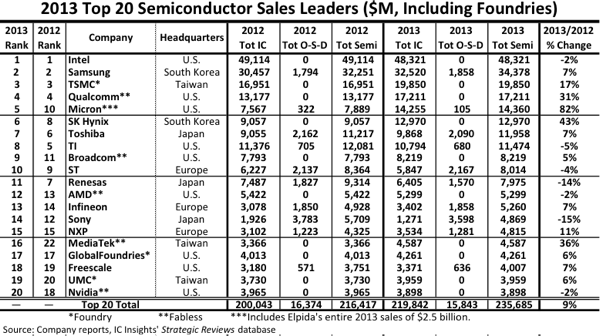
IC Insights’ April Update to The 2014 McClean Report will show a ranking of the 2013 top 50 semiconductor suppliers. A preview of the top 20 companies is listed in Figure 1.  The top 20 worldwide semiconductor (includes ICs and O-S-Ds—optoelectronics, discretes, and sensors) sales leaders for 2013 included nine suppliers headquartered in the U.S., three in Japan, three in Taiwan, three in Europe, and two in South Korea, a relatively broad representation of geographic regions.

The top 20 ranking also includes three pure-play foundries (TSMC, GlobalFoundries, and UMC) and five fabless companies.  It is interesting to note that the top four semiconductor suppliers all have different business models. Intel is essentially a pure-play IDM, Samsung a vertically integrated IC supplier, TSMC a pure-play foundry, and Qualcomm a fabless company.

IC foundries are included in the top 20 semiconductor supplier ranking because IC Insights has always viewed the ranking as a top supplier list, not as a marketshare ranking, and realizes that in some cases semiconductor sales are double counted.  With many of our clients being vendors to the semiconductor industry (supplying equipment, chemicals, gases, etc.), excluding large IC manufacturers like the foundries would leave significant “holes” in the list of top semiconductor suppliers.  Foundries and fabless companies are clearly identified in Figure 1.  In the April Update to The McClean Report, “marketshare” rankings of IC suppliers by product type are presented and foundries are excluded from these rankings.

It should be noted that not all foundry sales should be excluded when attempting to create marketshare data.  For example, although Samsung had a large amount of foundry sales last year, most of its sales were to Apple.  Apple does not re-sell these devices, so counting these foundry sales as Samsung semiconductor sales does not introduce double counting.

Overall, the list shown in Figure 1 is provided as a guideline to identify which companies are the leading semiconductor suppliers, whether they are IDMs, fabless companies, or foundries.


Figure 1

Excluding the foundries of TSMC, GlobalFoundries, and UMC from the top 20 ranking would bring Fujitsu, Marvell, and Sharp into the 18th, 19th, and 20th positions, respectively (Figure 2).


Figure 2

There were numerous changes within the top 20 semiconductor supplier ranking in 2013 as compared to the top 20 ranking of 2012.  Spurred by its acquisition of Elpida last year, Micron climbed five spots and moved into the top 5 ranking.  Some of the other companies that rose in the 2013 ranking include SK Hynix, which, despite a significant fire and production setback at its largest memory fab in China, took full advantage of the 32% surge in the DRAM market last year and moved up two places into the 6th position.  Also, Broadcom moved into the top 10 while MediaTek jumped up six positions to 16th place and into the top 20 ranking for the first time. 

MediaTek is experiencing extremely strong demand for its devices in the booming low-end smartphone business in China and other Asia-Pacific locations.  In fact, MediaTek’s application processor shipments for smartphones reached over 200 million units last year, about double the 108 million units the company shipped in 2012.  Moreover, with MediaTek and MStar expected to merge in 2014, the annual post-merger sales for MediaTek should be over $6 billion, most likely enough to lift the company into the 12th spot in the 2014 ranking.

Another company expected to make a significant move up in the ranking this year by way of acquisition is Avago. After the company’s purchase of LSI Corp., the combined semiconductor sales of the two companies is likely to be well over $5 billion this year, which could propel Avago from its 27th 2013 ranking to as high as 13th in 2014!

In contrast to the semiconductor companies moving up in the ranking, Fujitsu dropped five places to fall out of the top 20 ranking in 2013, going from being ranked 16th in 2012 to 21st last year (the company sold its analog and MCU business to Spansion in August of 2013).  Renesas was another “casualty” in the top 20 ranking and fell to 11th place last year from the 7th position it held in 2012.

In total, the top 20 semiconductor companies’ sales increased by 9% in 2013 as compared to 2012, which was more than twice the 4% growth rate for total worldwide semiconductor market last year!  It took total semiconductor sales of about $3.9 billion to make the top 20 ranking in 2013.

Figure 3 shows that there was a 97-percentage-point range of growth rates among the worldwide top 20 semiconductor suppliers in 2013 (from +82% for Micron to -15% for Sony).  The continued success of the fabless/foundry business model and the strong growth of the memory market (especially the 32% DRAM market surge) last year is evident when examining the six top 20 semiconductor suppliers that logged double-digit growth. As shown, the top six performers in 2013 included two memory companies (SK Hynix and Micron), two fabless companies (MediaTek and Qualcomm), and TSMC (the largest pure-play foundry).

Figure 3 shows that the two top 20 ranked companies that registered double-digit sales declines in 2013 are headquartered in Japan (Renesas and Sony).  As previously shown, Japan-based Fujitsu also registered a double-digit decline (-16%) in 2013 and dropped out of the top 20 ranking last year.  However, it should be noted that the conversion of Japanese company semiconductor sales from yen to U.S. dollars, at 97.6 yen per dollar in 2013 versus the 79.8 yen per dollar rate in 2012, had a significant impact on the sales figures for the Japanese companies.  Using a constant 2012 U.S. dollar versus Japanese yen exchange rate for 2013, the 2013 semiconductor sales of Renesas, Sony, and Fujitsu, would have increased 5%, 4%, and 3%, respectively.

More details on the 2013 top 50 semiconductor suppliers will be provided in the April Update to The McClean Report.


Figure 3

Monday, March 3, 2014

Flash NAND, NOR, eMMC Market Growth

NAND market continues to grow while NOR continue to shrink (see article below). 

The reason for NAND dominance were explained on my May 2007 article on Long Term Trends in the NOR and NAND Markets .


Highlights from review of the IHS report in the article below:
"NAND product known as embedded multimedia card (eMMC) enjoyed record shipments in 2013 of more than 1 billion units, up a hefty 49 percent from 687 million in 2012. NAND revenue rose 28 percent to US$25.8 billion.
In comparison, NOR shipments last year fell 10 percent to 606 million units, with revenue down 15 percent to approximately US$3.0 billion....
The evolution of eMMC, in particular, has been rapid, with nearly annual enhancements to performance. As an economical choice for greater flash-memory densities, eMMC has become viable in high-end markets like smartphones and tablets, in which high-density storage capacity is required along with low-power consumption and a small footprint.
Embedded NAND’s utility has also now carried over from smartphones in its early use, to tablets. Last year, eMMC was the standard memory configuration for a vast majority of tablets, the only exception being the Surface Pro from Microsoft, which employs a SATA-interface solid-state drive.
The billion-unit shipment level of eMMC last year is a milestone, Yang remarked, and the product shows the way forward for managed NAND solutions by its deft handling of error correction and enhanced reliability at the solution level."
Ron
Insightful, timely, and accurate semiconductor consulting.
Semiconductor information and news at - http://www.maltiel-consulting.com/


NAND eMMC hits a record year, while NOR Flash shrinks further

 
NAND eMMC hits a record year, while NOR Flash shrinks further
Source: IHS Technology, February 2014

The global memory market presented a vivid picture of contrast last year given the wildly divergent fortunes of its two main segments, with spritely NAND offset by the sobering continued downturn of beleaguered NOR flash, according to a new report from IHS Technology.
On the one hand, the NAND product known as embedded multimedia card (eMMC) enjoyed record shipments in 2013 of more than 1 billion units, up a hefty 49 percent from 687 million in 2012. NAND revenue rose 28 percent to US$25.8 billion.
In comparison, NOR shipments last year fell 10 percent to 606 million units, with revenue down 15 percent to approximately US$3.0 billion.
The overall flash market in 2013 was worth US$28.8 billion, up from US$23.7 billion a year earlier, as shown in the attached figure.
“The key driver to NAND lies in its proliferating use for mobile consumer electronics, exemplified by the memory’s increasingly widespread application in devices like smartphones, tablets and notebook PCs,” said Michael Yang, senior principal analyst for memory & storage at IHS.
“Meanwhile, NOR’s once-broad portfolio of applications in low-end mobile handsets and desktop PCs has mostly matured, and its next killer market has yet to manifest.”
These findings are contained in the report, “Mobile & Embedded Memory Tracker – Q4 2013,” from the Semiconductors & Components service of IHS.
NAND memory, in the form of either raw NAND or eMMC, is now the standard memory used for most smartphones. The only exception is Apple’s iPhone, which uses its own managed NAND memory product.
The evolution of eMMC, in particular, has been rapid, with nearly annual enhancements to performance. As an economical choice for greater flash-memory densities, eMMC has become viable in high-end markets like smartphones and tablets, in which high-density storage capacity is required along with low-power consumption and a small footprint.
Embedded NAND’s utility has also now carried over from smartphones in its early use, to tablets. Last year, eMMC was the standard memory configuration for a vast majority of tablets, the only exception being the Surface Pro from Microsoft, which employs a SATA-interface solid-state drive.
The billion-unit shipment level of eMMC last year is a milestone, Yang remarked, and the product shows the way forward for managed NAND solutions by its deft handling of error correction and enhanced reliability at the solution level.
The rise of eMMC has also bred a new cast of suppliers. While Samsung remains dominant, players like SK Hynix, SanDisk and Toshiba are fiercely competitive and poised to gain ground.
The eMMC space, however, could see challenges this year. With growth slowing in the smartphone and tablet markets, there could be a possible oversupply of the memory type, in the process also leading to a possible large drop in eMMC average selling prices.
The steady decline of the NOR flash market began in 2007 and hasn’t stopped since. At its peak, the NOR market exceeded US$9 billion a year and last hit US$8 billion back in 2006—a far cry from its current numbers.
The NOR picture is also complicated by the contrasting outlook for its two sub-segments.
Parallel NOR, long used in computers for boot-code execution or serving as a storage medium for entry-level cellphones, will see its run in wireless devices come to an end sometime next year.
Parallel NOR will continue to be used in high-level industrial, medical, networking and military applications, but its exit from wireless will be a blow.
Meanwhile, serial peripheral interface (SPI) NOR, rival to parallel NOR, will go on to wider use in both wireless and consumer devices.
SPI NOR’s relative simplicity in design and low manufacturing cost will prove appealing, and the memory will be especially attractive to manufacturers of low-cost cellphones that need to keep a lid on expenses.
The shift from parallel to SPI NOR has also impacted their respective suppliers. Micron Technology and Spansion, the foremost producers of parallel NOR, now also have SPI offerings.
However, both companies have been at pains to differentiate their SPI product from the rest of the pack, in order to stave off the aggressive penetration of other SPI NOR suppliers such as Macronix, Winbond Electronics and GigaDevice.
The ongoing growth of SPI NOR will help offset a shrinking parallel NOR market, but the industry would be healthier if consolidation took place and reduced the number of players to four, IHS believes.
There are five suppliers at present that command 75 percent of the market, along with a spattering of smaller producers that make up the rest of the market.
Even so, there are no quick fixes, with the largest NOR applications disappearing or on their way out, and new deployments like automotive NOR still facing an uphill climb.

Friday, November 22, 2013

Facebook: Flash Storage in Database

Facebook continue to propel flash NAND memory usage in server and storage through open source implementations. See below more details on Flash Based Database.
“With the advent of flash storage, we are starting to see newer applications that can access data quickly by managing their own dataset on flash instead of accessing data over a network. These new applications are using what we call an embedded database.
“… When database requests are frequently served from memory or from very fast flash storage, network latency can slow the query response time. Accessing the network within a data center can take about 50 microseconds, as can fast-flash access latency. This means that accessing data over a network could potentially be twice as slow as an application accessing data locally. “
Additional technical details at Under the Hood: Building and open-sourcing RocksDB


More about Facebook Propels SSD Flash Storage


Ron
Insightful, timely, and accurate semiconductor consulting.
Semiconductor information and news at - http://www.maltiel-consulting.com/


Facebook’s latest open source effort: a flash-powereddatabase called RocksDB

by Derrick Harris


SUMMARY:

Facebook has open sourced a new embedded database called RocksDB that’s meant to take advantage of all the performance flash has to offer, from right on the application server. It might be a sign of best practices to come.

Facebook is on an open source roll lately, and on Thursday announced its latest open source project — an embedded key-value store called RocksDB. The company uses it to power certain user-facing applications that would suffer too much from having to access an external database over the network and to eliminate the certain problems relating to non-fully utilized IO performance on flash storage devices.

Facebook database engineer Dhruba Borthakur describes the design of and rationale behind RocksDB in some detail in a blog post, but the biggest factor leading to its creation might be the emergence of relatively inexpensive flash storage cards for servers (or, in Facebook’s case, custom-built servers packed entirely with flash).

“With the advent of flash storage, we are starting to see newer applications that can access data quickly by managing their own dataset on flash instead of accessing data over a network. These new applications are using what we call an embedded database.

“… When database requests are frequently served from memory or from very fast flash storage, network latency can slow the query response time. Accessing the network within a data center can take about 50 microseconds, as can fast-flash access latency. This means that accessing data over a network could potentially be twice as slow as an application accessing data locally. “

RocksDB was designed with these new hardware realities in mind, so it can take full advantage of the IOPS potential of flash memory as well as the computing power of many-core servers, Borthakur explains. Facebook has posted the results of a benchmark test running on a Fusion-io-powered server on the RocksDB GitHub page, and claims it’s significantly faster than Google’s LevelDB embedded key-value store.

From a broader IT perspective, RocksDB signals that the shifts in storage and computing economics that made the big data movement possible are now making their way into web application development, albeit using a storage media most organizations would consider using for storing “big data.” Facebook is performance hungry, but it’s also cost-sensitive, and it wouldn’t be storing “close to a petabyte of data across different applications,” as Borthakur writes, if the cost to do so was out of control.


He offered a handful of application types an embedded database like RocksDB is suitable for, including:

1. A user-facing application that stores the viewing history and state of users of a website.

2. A spam-detection application that needs fast access.

3. A graph-search query that needs to scan a data set in realtime.

4. RocksDB can be used to cache data from Hadoop, thereby allowing an app to query Hadoop data in realtime.

5. A message-queue that supports a high number of inserts and deletes.

In fact, Facebook has been finding all sorts of new ways to utilize flash as stepping stone between slow disks on one hand and expensive-but-fast RAM on the other.

Facebook is no doubt an early adopter of flash-heavy application architectures, but it’s also probably serving as a guiding light for other companies and their developers who want to achieve Facebook-like performance. As flash prices continue to drop — and now that Amazon Web Services is offering a whole suite of flash-backed instances on EC2 (the prices of which should also drop) — it’s conceivable we’re approaching an era of ever-better web and mobile applications that communicate with the network and the hard drive as little as possible.

Thursday, October 10, 2013

Facebook Propels SSD Flash Storage

Facebook continues to advance the frontier of flash NAND SSD in servers and data centers. The article bellow discusses  Flashcache and other open source projects.

"internally developed caching software, called Flashcache, to more efficiently use the thousands of solid-state drives (SSDs) that the social networking giant deploys to store frequently consulted data.
The newly released Flashcache 3.0 is able to make better decisions about what data to cache, while reducing the amount of wear and tear on expensive flash disks."
Earlier in the year Facebook asked for the cheapest and slowest flash memory
and Seven Questions for Facebook Infrastructure Guru Frank Frankovsky


Ron
Insightful, timely, and accurate semiconductor consulting.
Semiconductor information and news at -
http://www.maltiel-consulting.com/


Facebook open-source cache squeezes more from flash disks

Facebook continues to push the boundaries of storage and server technology in order to more quickly serve its billion users, and the results are being offered as open-source technology that can also benefit other companies.
Recently, Facebook updated its internally developed caching software, called Flashcache, to more efficiently use the thousands of solid-state drives (SSDs) that the social networking giant deploys to store frequently consulted data.
The newly released Flashcache 3.0 is able to make better decisions about what data to cache, while reducing the amount of wear and tear on expensive flash disks.
“With these improvements, Flashcache has become a building block in the Facebook stack,” wrote Domas Mituzas, a Facebook database engineer who authored a blog post explaining the updates to the open-source software.
The work aims to improve overall Facebook performance without unduly driving up operating costs.
“While the cost per GB for flash is coming down, it’s still not where it needs to be,” Mituzas wrote. Given the premium prices commanded for SSDs, Facebook doesn’t want to wear out these disks too quickly. “SSDs have limited write cycles, so we have to make sure that we’re not writing too much.”

Other open-source projects

Flashcache is one of a number of software projects that Facebook originally developed in house that the company has also released as open source. Earlier this year, for instance, the company also released a virtual machine, called HipHop, that speeds the processing of PHP code.
The company hopes that other organizations could reuse such programs as HipHop and Flashcache and eventually contribute to their further development. Like other open-source caching software such as memcache and Redis, Flashcache can be used to speed the responsiveness of a heavily visited website or popular Web application.
Facebook originally created Flashcache to boost the responsiveness of the MySQL databases that store user data. The software can be loaded onto the Linux kernel as a module without making any changes to the kernel itself.
The idea behind Flashcache is to use SSDs to hold the material that is most requested by users. SSDs tend to be faster than traditional rotating platter hard drives, though they are also more expensive by the GB when compared to hard drives. So it would not be cost-effective for Facebook to store all of its data on SSDs, especially if the vast majority of Facebook user data is rarely consulted.

FACEBOOK
Facebook found hotspots in its cache, where frequently consulted data could cluster in small areas, causing bottlenecks.
Although designed to work with MySQL and the MySQL InnoDB database storage engine, Flashcache can be used as a general caching mechanism for Linux systems.

Flashcache can also speed times it takes to write data to disk, from the user’s perspective, by saving newly updated data on SSD first and then writing it to the hard drives later.
The updated Flashcache module improves performance in read-write distribution, cache eviction and write efficiency.
Analyzing Flashcache performance, Facebook had found that most of its caches have a small subset of data that is read much more frequently than most of the other data.
With the previous version of Flashcache, 50 percent of a cache’s contents accounted for 80 percent of disk operations. Such a concentration of frequently consulted material could cause performance bottlenecks.
To improve Flashcache’s read-write distribution, the engineers developed a number of techniques to automatically position the data so that cache reads are distributed more evenly across the SSD. Now 50 percent of the cache accounts for 50 percent of the disk operations.
To improve the process of determining which data to move off the cache, a process called cache eviction, Flashcache switched from using the FIFO (first in first out) algorithm—in which the oldest data in the cache is removed first to make room for new data—to a LRU (least recently used) algorithm, which discards the data that hasn’t been requested for the longest period of time.
Improvements were also made in write efficiency.
Previously the software would write to disk only when it had a certain amount of data that was ready to be written. This resulted in uneven performance across different caches, however. So, Facebook engineers developed an approach that would write the cached data to disk whenever a copy of that data was requested by a user, which resulted in a smoother flow of write operations.
Thanks to these improvements, the updated caching mechanism has an average hit rate—or information that is requested by users that resides in cache—of 80 percent, up from 60 percent in the previous version. This means more data is served more quickly.
Updating the software has also slashed server I/O (input/output) required to read data by 40 percent, and reduced the I/O required to write data by 75 percent. For a company that is running thousands of servers, such a reduction in traffic can help make more efficient use of servers and keep hardware costs manageable.

Wednesday, April 24, 2013

Tablets,Smartphones, and SSDs Market Share of NAND in 2013


The Smartphones, Tablet PCs, SSDs Propelling NAND Flash Sales in 2013 report  discusses the percentages of NAND sales to the various end markets.  NAND demand is being impacted quite a bit by the growth of tablets that are replacing laptops.   iPad market grew fast and the pc makers have been marketing and testing out various tablet forms that are gaining acceptance.  Tablets are expected to reach 12% of the $30.0 Billion NAND flash market in 2013.  In addition, every Tablet has an SSD storage, so the growth of Tablets will lead to increased demand of SSDs.

More about Tablets are the new mobile (Tablets are the new mobile, the slide deck in the article shows the growth of mobile and Tablets in the Apple and Android eco-sphere. There are many other slides at the link below. The future of mobile was discussed in the April 15, 2009 Mobile Computing the Next Big Market article)

Ron
Insightful, timely, and accurate semiconductor consulting.Semiconductor information and news at - www.maltiel-consulting.com

Tuesday, March 12, 2013

Apple A7 Foundry:TSMC, Samsung, Intel?


Reuters last week suggested that Apple and Intel have at the very least discussed the option of introducing its chips in to the iDevice range. It would make sense for Apple to diversify its fab manufacturing.

More is discussed in the report below (the updae). However it could be also just rumor to impact the real negotiations between Apple and its vendors.

More about it in an October Next iPhone A7 Made by TSMC not Samsung .

Update - There is an interesting discussion on Linkedin about Intel as Altera foundry

Ron
Insightful, timely, and accurate semiconductor consulting.
Semiconductor information and news at - www.maltiel-consulting.com

"Is Intel ready for foundry?

Started by Ron Jones

The announcement this week that Intel would start providing foundry services to Altera moves them from a toe-in-the-water foundry provider to a player. On the surface, the question of whether Intel is ready for foundry might seem a bit silly.
Intel has leading edge technology, a massive manufacturing engine and world class controls on yield and cycletime. They have a highly integrated environment where design, product and process engineers have access to fab data, planners have availability of WIP information and sales orders, etc. This works great for them as an IDM.

Being a foundry is not just about building wafers for your customers, however. There is a broad spectrum of customer facing data and information that fabless or fab-lite customers require from their foundry on a regular and near real time basis. This includes:

• WIP reports (both in snapshot and lot-move format)
• Yield loss information both in process and at probe
• PCM data
• WAT data
• Lot start, WIP status, lot hold, ship alert, . . . information
• E-commerce information
The foundries have spent well over 15 years developing and refining a broad range of customer facing systems that provide this to their customers, both large and small. The information flows from WIP management and multiple other systems into data warehouses that are partitioned to keep customer data protected. It is a massive undertaking and one that continues to be refined today...."

and a reply by Andy Turudic ...

"Altera is ONE customer, a customer that is very savvy at doing pretty much every part of wafer manufacturing THEMSELVES, except the dipping silicon in beakers, and making almost all the transistors work, part. And Altera has IP to where ALMOST all the devices working is perfectly acceptable and yields passing devices at the billion+ transistor count level.


Altera's move to Intel is merely ONE customer and that does not make Intel a "player", but a shrewd business strategist that is moving to fill its fabs with large volume, BIG die, devices that pay a premium for high yield without compromising gross margin for either partner, and by taking on process-savvy customers vs every Joe Startup that comes along and needs caressing, handholding, WIP and process monitors, and a bureaucracy of "standard" support because they are not worth the time of the foundry in providing direct support. With Altera, Intel can remain an "IDM", no differently than it has two process flows in its captive fabs today. Both companies have honorable business dealings, so there's no fear of IP theft as there could be in an offshored scenario.

Intel is a world class fab, arguably at or very near the top of choices, that is capable of yield in the billion+ transistor class. Those are few and far between, as is demonstrated by Altera's competitor who appear that they cannot yield big die and instead are looking at 3D stacking smaller ones.... "


Rumor: Intel could land 10% of Apple's 'A7' chip orders http://appleinsider.com/articles/13/03/12/rumor-intel-could-land-10-of-apples-a7-chip-orders
By Sam Oliver , Tuesday, March 12, 2013, 08:27 am

As Intel gets into the chip contracting business, the company could obtain as much as 10 percent of Apple's next-generation mobile chip orders, insiders believe.

"Institutional investors" cited by DigiTimes on Tuesday believe Intel could be making a play to get a slice of Apple's business for its so-called "A7" chip, expected to power the company's next-generation iPhone. Apple has reportedly been looking to move its chip production contracts away from rival Samsung, which currently handles all of the company's current A-series chips.

The company expected to take the bulk of the work away from Samsung is Taiwan Semiconductor Manufacturing Company. Rumors have claimed for years that TSMC is on the brink of building chips for Apple, but that has yet to happen.


Tuesday's report claimed that both TSMC and Samsung are competing for contracts to build "A7" chips for Apple. It said that production of A-series chips through TSMC is expected to begin in 2014.
Now, institutional investors reportedly believe that Samsung will receive about half of Apple's "A7" orders, while TSMC will take 40 percent, and Intel will grab the remaining 10 percent.

"In the past, Apple's processor orders were unattractive because of low profit margins and Samsung was the only cooperating firm," the report said. "In addition, at the time Samsung's smartphones were no threat to Apple's iPhone. But Samsung has since become the biggest smartphone vendor in the world."

Just last week, a separate report suggested that Intel and Apple were in talks for Intel to potentially build next-generation chips for devices like the iPhone and iPad. Intel may be making a shift to build ARM-based systems-on-chips for companies like Apple after the PC market has struggled in recent years against smartphones and tablets.
Intel's current CEO, Paul Otellini, plans to retire in May, and some market watchers believe a new chief executive could push the company in a different direction. In particular, contracts to build custom chips for mobile device makers could help keep the chipmaker's manufacturing facilities working at full capacity.