My expertise in semiconductors, process, and circuits have led to some really interesting places. Thanks for having me on your show Max for a fascinating
Showing posts with label testifying. Show all posts
Showing posts with label testifying. Show all posts
Monday, November 27, 2017

Monday, June 16, 2014
SSD Market Share/ SanDisk buys Fusion-io

A recent survey by Gartner (see below) shows Intel and Samsung leading in shipment of SSD storage for enterprise.
Ron
Insightful, timely, and accurate semiconductor consulting.
Semiconductor information and news at - http://www.maltiel-consulting.com/
Insightful, timely, and accurate semiconductor consulting.
Semiconductor information and news at - http://www.maltiel-consulting.com/
Gartner AFA data hits the street
By Chris Mellor, 13 Jun 2014
No,
it isn’t the greatly anticipated all-flash array magic quadrant, but it's great
Gartner analysis nonetheless. The number-crunchers at Gartner HWQ have produced
a Market Share Analysis: SSDs and Solid-State Arrays, Worldwide, 2013. Yummy.
Let’s see what’s inside.
The
doc, available as a download from Pure Storage (guess who's
done well in the analysis) after registering a few details. It looks at both
SSDs and all-flash arrays, which Gartner calls Solid State Arrays (SSAs) and
IBM comes out as the leading SSA shipper – with Pure Storage second.
SSAs
are defined carefully: ”SSAs are scalable, dedicated, solutions based solely on
solid-state semiconductor technology for data storage that cannot be configured
with HDD technology at any time. As distinct from SSD-only racks within ECB
storage arrays, an SSA must be a stand-alone product denoted with a specific
name and model number, which typically (but not always) includes an operating
system and data management software optimised for solid-state technology.”
To
cut a long story short, Dell and HDS all-flash array products are excluded, as
are all-flash versions of – for example – EMC VMAX and VNX, and NetApp FAS
arrays.
The
SSD category embraces PCIe flash cards and also includes “self-contained
solid-state NAND dual in-line memory modules (DIMMs), which must be used in dedicated
slots in servers. Mainstream PC SSDs being used in servers are counted in this
category due to end consumption.”
We’ll
graph the information here, and you can read the detailed numbers by
downloading the doc. The SSD info starts with worldwide vendor revenues:

Click chart for larger version
Total
SSD revenues in 2012 were $7.2 billion, and in 2013 had risen to $10.99
billion, a 53.1 per cent increase.
Samsung
as top dog got most of that with Intel, growing less, at number 2. Look at
Sandisk’s rocketing growth up into the no 3 slot, closely followed by Micron.
Toshiba held its fifth place but didn’t grow much. WD grew, Fusion-io declined
and now we’re in the tail-enders.
Now
let’s look at the enterprise SSD market:
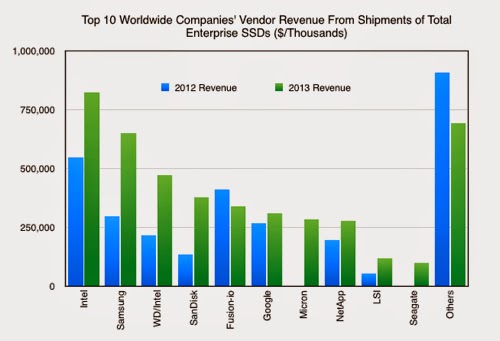
Intel
is top dog, not second-placed Samsung. WD, with its HGST/Intel SSDs is in third
place followed by SanDisk successfully exhibiting its enterprise supplier
credentials. Then there’s Fusion-io, which declined 2012 - 2013, Google with
its internal use - amazing - Micron is a, we think, in a disappointing sixth
place, NetApp a, for it, strong seventh then LSI and Seagate. EMC does not
appear at all.
Now
for the SSA numbers.
Here
are the vendor revenue market share numbers:

Click chart to make it larger.
And
here the actual SSA revenues by vendor:

Click chart to make it larger
IBM
has had a wildly successful 2013 year, solidly overtaking Violin Memory to
claim a dominating number 1 slot. Pure Storage has rocketed to the number 2
position in 2013 while Violin Memory slumped from first place in 2013 to third
in 2013, illustrating the new management team’s uphill task. EMC has sprung
into fourth place from a standing start and NetApp is not far behind in the
fifth slot. Then there’s Nimbus Data and tail-ender Cisco - a dismal showing
for the networking behemoth in our view, with startup SolidFire very close
behind.
The
SSA market was sized by Gartner at $236.5m in 2012, and 182.1 per cent higher
at $667.3m in 2013. IBM’s SSA revenues grew at 278.1 per cent, Pure's at a
magnificent 642.3 per cent and no other vendor outpaced the market, meaning
they lost share.
Now
this is artificial, as EMC, Kaminario, SolidFire and HP had no presence in
Gartner’s numbers in 2013, but we can assert that Violin Memory, NetApp, Nimbus
and Cisco all lost share from 2012 to 2013. With EMC, Kaminario, SolidFire and
HP now in the SAA market we might expect these losses to continue in 2014.
The
Gartner analysis contains more data, segment metrics and so forth. It’s worth a
download and read if you’re interested.
Main takeaway? Big Blue
really is big in SSAs, Pure Storage is living up to its hype, and the SSA
market is growing at a fast lick. NAND the story goes on
Wednesday, April 3, 2013
Top Semiconductor Ranking 2012 (Sales, Growth)
 |
| http://www.semiconportal.com/en/archive/news/news-flash/120330-isuppli-semiconductor-ranking.html |
See more about it at 2012 Q1 Ranking: Toshiba Outperforms NAND Market and overall foundries and Japanese fab status Semiconductor Ranking: Foundries Soar, Japanese Crash
Ron
Insightful, timely, and accurate semiconductor consulting.Semiconductor information and news at - www.maltiel-consulting.com
Qualcomm, GloFo star in chip supplier ranking
Peter , 3/28/2013 6:18 AM EDT
http://www.eetimes.com/electronics-news/441084/Qualcomm-GloFo-are-stars-of-2012-chip-supplier-ranking
LONDON – A ranking of the top 25 worldwide semiconductor companies by sales, covering ICs optoelectronics, sensors and discrete devices, from market research firm IC Insights shows that Globalfoundries increased sales by 31 percent and Qualcomm by 30 percent. Qualcomm broke into the top five (see figure 1 below).
Foundry TSMC remained in third place but increased sales by 18 percent getting closer to Samsung and Intel, which both saw sales decline. Although both Samsung and Intel are making first steps to enter the foundry business the former was weighed down with memory sales and the latter with a focus on processors for the lackluster PC market.
In total, the top 25 semiconductor companies’ sales declined by 1 percent in 2012, two points less than the total worldwide semiconductor market decline of 3 percent.
By geography the top 25 includes 10 suppliers headquartered in the U.S., seven in Japan, three in Taiwan, three in Europe, and two in South Korea.

Click on image to enlarge.
2012 top 25 semiconductor suppliers ranked by sales ($millions, including foundries).
Same companies, different order, ranked by annual growth
IC Insights has also supplied a ranking of the same 25 companies ranked by annual growth (see figure 2 below). It is notable that lower order of that ranking filled with companies that experienced a double-digit percentage fall in sales includes a number of European and Japanese companies.
It is notable that GlobalFoundries with a 31 percent increase in sales and AMD with a 17 percent decline are at opposite ends of that ranking in 2012. AMD was the original parent of Globalfoundries and has been its primary customer. IC Insights interprets the success as an indication that Globalfoundries has achieved success in attracting additional IC foundry customers such as STMicroelectronics, Freescale, Qualcomm and others.
The inclusion of foundries in such rankings is contentious because it means that some sales are double counted – from foundry to fabless chip company and then from fabless chip company to customer. However, IC Insights said that in a forthcoming update to The McClean Report, marketshare rankings of IC suppliers by product type will also be presented and foundries are excluded from these rankings.

Click on image to enlarge.
2012 top 25 semiconductor companies by sales ranked by annual growth ($millions, including foundries).
Wednesday, March 6, 2013
Proving Obviousness in Patent

Ron
Insightful, timely, and accurate semiconductor consulting.
Semiconductor information and news at -www.maltiel-consulting.com
Proving Obviousness in Patent Cases From the Experts
By John Haynes and Rishi Suthar All, March 6, 2013
http://www.law.com/corporatecounsel/PubArticleCC.jsp?id=1202591012772&Proving_Obviousness_in_Patent_Cases=&et=editorial&bu=Corporate%20Counsel&cn=cc20130306&src=EMC-Email&pt=Corporate%20Counsel%20Daily%20Alerts&kw=John%20Haynes%20&slreturn=201302060913
Companies accused of patent infringement often ask “How did they get a patent on that? It is so obvious.” The reality is that most modern patents are nothing more than a combination of known elements assembled in a novel—or not so novel—manner. The challenge for accused infringers is how to prove that the claimed combination of elements was known to those skilled in the art. The “smoking gun” in such cases is a single prior reference that discloses the exact same combination, but such smoking guns are all too rare. Accused infringers are thus often forced to argue that the patented combination would have been obvious to others using only the ordinary skill of those in the field.
Practitioners generally agree that since the U.S. Supreme Court’s ruling in KSR v. Teleflex (2007), proving obviousness has become easier, because KSR eliminated any rigid formula for proving obviousness and placed renewed emphasis on the problems being solved and the use of plain common sense. KSR’s looser framework, however, can also create a trap for the unwary who fail to gather the proof needed to satisfy even the looser standards set forth in KSR.
Awareness of these traps, and how to avoid them, is essential to the successful litigant.
Common Pitfalls in Proving Obviousness
1. More is not always better: Accused infringers may spend hundreds of thousands of dollars creating claim charts that map out invalidity theories across dozens of prior art references. These charts often focus on finding each individual element of a combination in as many places as possible, but rarely focus on the reason why a “skilled artisan” (i.e., a person having ordinary skill in the art) would want to put those separate pieces together. Proving obviousness is like putting together a jigsaw puzzle: You certainly need all the pieces, but if you do not put the pieces together the jury will never understand the full picture.
2. Legal rhetoric is no substitute for competent evidence: Attorneys often make the mistake of using legal arguments as the glue to hold their puzzle together. Bald assertions that a person skilled in the art would know how to fit the puzzle together, however, do little to explain what the puzzle should look like or why the skilled artisan would know exactly where the pieces fit
A recent Federal Circuit decision, ActiveVideo v. Verizon (2012), provides a good example of how lawyer rhetoric is rarely sufficient to demonstrate obviousness. In ActiveVideo, the defendant’s expert testified that each of the claim elements were “modular” and could be combined to achieve the claimed combination because of efficiency and market demand. The expert’s assertions were rejected, however, because he failed to explain how the “modular” puzzle pieces fit together in the exercise of ordinary skill.
3. Common sense must be common knowledge: Although KSR placed renewed emphasis on the use of common sense to solve ordinary problems, it did not sanction the use of “common sense” to plug holes absent proof that the skilled artisan was aware of both the problem and the common sense solution. Litigants need to frame the problem facing the skilled artisan and then explain how that artisan would use their ordinary skill to solve the problem in the same manner as is claimed in the patent.
This requires more than lawyers’ arguments about “common sense” dictating the claimed combination. It requires a careful analysis of how the skilled artisan would have approached the problem, the tools available to solve it, and the reasons why solving it would have resulted in the claimed combination. In the jigsaw puzzle analogy, you need the pieces, the picture on the box, and the knowledge that putting the pieces together will yield that picture.
How to Avoid the Pitfalls
As the Supreme Court stated in KSR, the obviousness analysis is a flexible one. In other words, the approach is highly dependent on the technology at issue and the problems the patent seeks to address. Regardless of the approach, however, following a few simple guidelines will go a long way towards a successful defense.
1. Don’t forget the basics: The Supreme Court provided the framework for proving obviousness in the seminal case of Graham v. John Deere (1966). KSR did not lessen the importance of this framework, and litigants should always begin an obviousness analysis by outlining the proof needed to prevail on each element of that framework. This requires not only developing a clear picture of the prior art, but also a clear picture of the industry at issue, market pressures, and secondary considerations like long-felt need and commercial success.
2. Analyze the invention as a whole: Most inventions are comprised of combinations of known elements, so proving obviousness requires more than finding each piece of the puzzle. Care must be taken to explain, in detail, the modification to the prior art as a whole.
Obviousness in some cases, such as in KSR or Stone Strong v. Del Zotto (2011), may be satisfied by explaining the reasonable expectation of success of combining the prior art’s known elements, but more complex inventions may require expert explanation of why one skilled in the art would have been inclined to combine the teachings in seemingly unrelated disciplines. Although composing an owner’s manual is unnecessary, enough detail should be presented so that it is clear that one skilled in the art would recognize and perform the modifications to the prior art with anticipated results.
3. Always identify a convincing reason why the specific combination of known features claimed in the patent would have been obvious to the skilled artisan: While the Supreme Court acknowledged in KSR that the prior art need not explicitly provide a motivation to combine prior art features, it did not eliminate the requirement that the skilled artisan have a reason to combine prior art features in the manner claimed. In KSR, the reasons to combine stemmed from market pressures of transitioning from cable-actuated throttles to drive-by-wire systems, in connection with common problems existing in the prior art. Motivation may also be shown through “common sense” or by demonstrating that the claimed combination would have been “obvious to try” in order to solve a particular problem. To prevail using such motivations, litigants must do more than simply repeat the language of KSR.
As the Federal Circuit recently explained in In re Novel (2012), succeeding on a common sense theory requires the accused infringer to provide a rational explanation as to why the skilled artisan would consider a specific combination a product of common sense. Similarly, when relying on an “obvious to try” rationale, care must be taken to explain precisely why there are only a finite number of solutions to the problem at hand, as well as why the particular modification to the prior art yields nothing more than expected results. See Perfect Web v. InfoUSA (2009). Even though conclusory statements in these scenarios are tempting, they will almost guarantee an unsuccessful defense.
4. Develop a solid evidentiary record for each aspect of the obviousness inquiry: This requires forming obviousness theories early, using the discovery process to develop those theories, and then carefully funneling the evidence to support them through fact and expert witnesses.
While obviousness determinations often turn on the sufficiency of an expert’s opinion, successful litigants should not assume that experts alone will carry the day. It is just as important to gather literature and fact-witness testimony that directly or indirectly supports the obviousness defense. Litigants should seek to introduce testimony from knowledgeable individuals in the industry to establish known problems and known solutions in the prior art, as well as reasons why it is desirable to combine those solutions in the manner recited in the claims of the patent. Such evidence will not only bolster the expert’s opinion, but may also help preserve important invalidity defenses in the event the fact finder does not give the expert’s opinions much weight, or in less complex cases, no weight at all. See, e.g., Stone Strong v. Del Zotto (2011).
While no set blueprint exists for guaranteeing a perfect obviousness combination, the main point to remember is that proving obviousness requires proof, and a lawyer’s argument or conclusory expert testimony is not sufficient. Careful litigants form their obviousness theories early in the case and develop the factual record to support those theories. Keeping each of the above points in mind throughout litigation will put you on the right track to avoiding the usual pitfalls and presenting a convincing invalidity defense.
John Haynes is a partner in Alston & Bird’s Intellectual Property Litigation Group and has experience litigating a wide variety of disputes involving complex technology and intellectual property. He specializes in complex patent cases involving electronics, wireless communications, computer software, and networking. Rishi Suthar is an associate in the firm’s Intellectual Property Litigation Group. Prior to attending law school, Rishi worked as a patent examiner for the U.S. Patent and Trademark Office.
Monday, March 4, 2013
Storage Memory Tipping Point

Ambuj Goyal 2/27/2013 2:01 AM EST
www.eetimes.com/electronics-blogs/other/4407874/storage-tipping-point-upon-us
Keeping pace with the onslaught of Big Data requires a revolutionary approach to storage. It’s well known that the performance of computing has advanced at a much faster rate than the systems that store and retrieve the information they generate.
For many, this game of catch-up has existed since the first digital storage systems were introduced more than 50 years ago. At the time, the concern was no longer about the performance of computing, but about creating a digital storage system that could keep up with it.
Thus began the subsequent watershed moves from paper punch cards to magnetic tape and then hard disk drives—moments that revolutionized computing and ultimately the world in which we live.
Today we find ourselves at another critical technological juncture that once again is demanding a revolutionary approach to storage—an approach that will help it keep pace with not only computing, but with the information onslaught of Big Data.
To understand where the storage industry is headed, one need only look to the reason that computing has historically outpaced it. Unlike the storage industry, computing has continually leveraged and advanced semiconductor trends while storage systems have remained mechanical, with motorized wheels of tape or spinning disks. In fact, computing shifted from mechanical devices more than a hundred years ago, while digital storage, for the most part, remains tethered to technologies born out of the 1950’s.
Not any longer. We are at the tipping point of a new era of computer storage that will witness entire systems based on flash semiconductor memory to handle fast moving, operational data in real-time. Though flash has been utilized in a variety of capacities over the past 30 years and in hybrid storage systems over the past several years, complete flash systems will dominate the landscape in the coming months and years.
All-flash systems will not only provide exponential performance gains over mechanical and hybrid systems, they will help organizations dramatically lower data center energy consumption rates due to their inherent low power-consuming memory and lack of moving parts—no small feat. According to a 2011 study by Stanford University, data centers account for 2 percent of all the electricity consumed in the U.S.
Improved performance, reliability, and durability
To be sure, such systems will be the storage platform of choice to handle ever-growing and increasingly critical workloads such as credit card processing, stock exchange transactions, manufacturing and order processing systems. Even app stores on the web are starting to use flash-only storage.
Such attributes as improved performance, reliability, and durability make flash systems desirable today, but virtually mandatory for the future. That’s because the tsunami of Big Data shows no sign of receding. Researchers predict that the digital universe—all the digital information created around the world—will hit 8 zettabytes by 2015. That’s about all the data found in the U.S. Library of Congress times 800 million.
Today we find ourselves at a tipping point of computer storage, once again, where the challenges of computing are no longer at issue but, rather the storing and retrieving of the information they generate and share.
Through our acquisition of Texas Memory Systems last fall, we have systems that can store almost 24 terabytes of storage in a unit the size of a pizza box, and that provide access to data 100 times faster than mechanical storage. If we were to stack 42 such pizza boxes in a rack, it would provide 1 petabyte of storage, which is more storage than any single operational application requires.
The industry is moving rapidly in the direction of all-flash storage for operational information. Such systems will not only help organizations respond to, and exploit the challenges of Big Data today and tomorrow, but once again will change the future of computing and the possibly the world along with it.
Ambuj Goyal is general manager of IBM System Storage & Networking.
Thursday, January 10, 2013
Fabless Catching Up to IDM Sales

Fabless semiconductor companies continued to increase their shares relative to IDM sales in 2012 as the graph shows.
More about it from IC Insights is below.
Earlier reports from August 2012 Samsung,a Top IC Foundry in 2012 and Semiconductor Ranking: Foundries Soar, Japanese Crash
Ron
Insightful, timely, and accurate semiconductor consulting.
Semiconductor information and news at - http://www.maltiel-consulting.com/
Fabless IC Company Sales “Shine” While IDM IC Sales “Slump” in 2012
upcoming McClean Report 2013, IC Insights
Contrary to some opinions, the fabless/foundry business model shows no signs of "collapsing."
IC Insights’ 2013 edition of The McClean Report shows that the fabless IC suppliers grew by 6% in 2012, 10 points better than the 4% decline registered by the IDMs (i.e., companies with IC fabrication facilities) and eight points better than the 2% decline shown by the total IC market last year.
As shown in Figure 1, except for 2010, fabless company IC sales growth has outpaced IDM IC sales growth (or the decline was less severe) since 1999.

Figure 1 Fabless vs. IDM Company Sales. Source: IC Insights
The year 2010 was the first and only time on record that IDM IC sales growth (34%) outpaced fabless IC company sales growth (29%). Since very few fabless IC suppliers participate in the memory market, they did not receive a boost from the surging DRAM and NAND flash memory markets in 2010, which grew 75% and 44%, respectively.
Another reason for relatively poor showing by the total IC fabless segment in 2010 was that some of the large fabless IC suppliers like MediaTek and ST-Ericsson, registered growth that was less than half the total 2010 IC industry average. However, the fabless IC suppliers once again grew faster than the total IC market beginning in 2011 by registering a 5% increase as compared to a 1% decline in sales for the IDM companies.
Figure 2 compares fabless-company IC sales to IDM-company IC sales since 1999. As shown, the 1999-2012 worldwide IC market displayed a modest 5% CAGR. In contrast, total IC sales from the fabless IC companies during this same timeframe increased at more than three times this rate and registered a very strong 16% CAGR. As a result of this trend, fabless IC company sales increased over 7x from 1999 to 2012 whereas total IDM IC sales were up less than 50% over this same timeperiod. Moreover, the IDM companies’ IC sales in 2012 were only 10% greater than they were 12 years earlier in 2000 and were less than they were five years ago in 2007.
Figure 2 Source: Fabless (Foundries) vs. IDM Sales. IC Insights
Given the big disparity in the 1999-2012 CAGRs between the fabless IC suppliers and the IDMs, it comes as little surprise that, except in 2010, fabless IC companies have been increasing their share of the worldwide IC market (Figure 3). As shown, in 1999, fabless IC company sales accounted for just over 7% of the total IC market. However, in 2012, fabless IC suppliers represented 27.1% of worldwide IC sales, a new record high.

Figure 3 Fabless sales as a precentage of WW IC sales. Source: IC Insights
IC Insights forecasts that in 2017, fabless IC companies will command at least one-third (33%) of the total IC market (especially if more large companies like IDT, LSI Logic, Agere, and AMD become fabless over the next five years). Over the long-term, IC Insights believes that fabless IC suppliers, and the IC foundries that serve them, will continue to become a stronger force in the total IC industry.
Wednesday, August 29, 2012
IBM Ecosystem: $1 billion Drives 40% Profit

This type of leverage is the key behind Apple and Google / Samsung success. It will be hard for their competitors to fight ( Apple vs. Samsung: Not Really an Apple Win ).
Ron Maltiel
www.maltiel.com
I.B.M. Mainframe Evolves to Serve the Digital World
http://www.nytimes.com/2012/08/28/technology/ibm-mainframe-evolves-to-serve-the-digital-world.html?_r=1
By STEVE LOHR August 28, 2012
I.B.M. is introducing on Tuesday a new line of mainframe computers, adding yet another chapter to a remarkable story of technological longevity and business strategy.
The new model, the zEnterprise EC12, has strengthened the traditional mainframe’s skill of reliably and securely handling vast volumes of transactions. That is why the mainframe is still the digital workhorse for banking and telecommunications networks — and why mainframes are selling briskly in the emerging economies of Asia and Africa.
The new models have added capabilities for computing chores that are growing rapidly, like analyzing torrents of data from the Web and corporate databases to predict consumer behavior and business risks. Name a trend in corporate computing — cloud computing, data center consolidation, flash-memory storage, so-called green computing — and I.B.M. executives point to tailored features in its mainframe that deliver the goods.
The death of the mainframe has been predicted many times over the years. But it has prevailed because it has been overhauled time and again. In the early 1990s, the personal computer revolution took off and I.B.M., wedded to its big-iron computers, was in deep trouble. To make the mainframe more competitive, its insides were retooled, using low-cost microprocessors as the computing engine.
Like any threatened species that survives, the mainframe evolved. It has been tweaked to master new programming languages, like Java, and new software operating systems, like Linux.
“The mainframe is the most flexible technology platform in computing,” said Rodney C. Adkins, I.B.M.’s senior vice president for systems and technology.
That flexibility is a byproduct of investment. The new I.B.M. mainframe, according to the company, represents $1 billion in research and development spending over three years.
I.B.M. has also invested beyond its corporate walls. Nearly a decade ago, fearing that its mainframe business would wither if retiring mainframe engineers were not replaced, I.B.M. went out to universities, advocating for mainframe courses and offering support. Today, more than 1,000 schools in 67 countries participate in I.B.M.’s academic initiative for mainframe education.
The sale of mainframe computers accounts for only about 4 percent of I.B.M.’s revenue these days. Yet the mainframe is a vital asset to I.B.M. because of all the business that flows from it. When all the mainframe-related software, services and storage are included, mainframe technology delivers about 25 percent of I.B.M.’s revenue and more than 40 percent of its profits, estimates A. M. Sacconaghi, an analyst at Sanford C. Bernstein.
The I.B.M. mainframe story offers a glimpse of why manufacturing can be crucial to an American company — and to the economy as a whole — even though high-end manufacturing does not employ large numbers of factory workers.
Over the last 15 years, I.B.M. has aggressively globalized its operations and work force, and pulled out of manufacturing businesses including personal computers and disk drives.
But I.B.M. held on to its core mainframe business, whose development is supported by thousands of engineers and scientists. Mainframe parts are produced in I.B.M. facilities in the United States, in Endicott, N.Y., and Fishkill, N.Y., and in Germany and elsewhere. The final assembly work is done in Poughkeepsie, N.Y., where I.B.M. opened a $30 million mainframe plant in 2010.
A mainframe costs more than $1 million, and higher-performance models with peripheral equipment often cost $10 million or more. Yet even young companies and emerging nations, analysts say, find the expense worth it for some tasks.
Comepay, for instance, is a fast-growing company that says it operates more than 10,000 self-service payment kiosks in Russia, where consumers pay for products and services ranging from Internet service and cellphones to electric bills. Comepay handles millions of transactions a day, and the volume is rising. The Russian company bought an I.B.M. mainframe in 2010.
“Mainframes are extremely reliable,” said Ruslan Stepanenko, chief information officer of Comepay. “It keeps working even when the transaction load is very high.”
Last year, the Senegal Ministry of Finance bought two I.B.M. mainframes to help monitor all the imports, exports and customs duties at the African country’s 30 border checkpoints.
Performance, security and reliability were the main reasons for selecting the mainframe, said Momar Fall, a manager and mainframe technical specialist in CFAO Technologies, an I.B.M. partner in Senegal. But another advantage in a developing nation, he said, is that the mainframes are constantly communicating over the Internet with a remote I.B.M. support center.
“So seven days a week, 24 hours a day, I.B.M. is looking after them,” Mr. Fall said.
Longtime mainframe customers say the technology has done a good job keeping up with the times. Last year, Primerica, a financial services company, purchased its 19th mainframe in 30 years.
David Wade, chief information officer, has worked for Primerica, based in Duluth, Ga., since its first mainframe arrived. With more than four million life insurance customers and more than two million investment-account clients, he said the company needs the reliable processing technology of the mainframe. “It works like nothing else,” Mr. Wade said.
Tuesday, August 28, 2012
Apple Seeks Injunction Against Old Samsung Phones

Additional issues with the jury decisions are in Apple vs. Samsung: Not Really an Apple Win .
A video of Apple Jury foreman perspective - Here's How We Reached a Verdict
A list of the phones that Apple sought injunction against are in the article below. Another good summary of the likely future impact is at Apple's $1 Billion Win Over Samsung: Q&A
Ron Maltiel
http://www.maltiel.com/
Apple seeks injunction against sale of some Samsung smartphones
By Anne B. McDonaldMonday, August 27, 2012 2:44 PM
http://www.techhive.com/article/2000360/apple-seeks-injunction-against-sale-of-some-samsung-smartphones.html
Apple today filed a notice with the U.S. District Court of Northern California, seeking an injunction against the sale of eight specific Samsung products in the United States, all smartphones. The move comes on the heels of Apple's decisive win last week in the so-called "patent trial of the century."
Here's a list of the phones Apple singled out in its filing with the court Monday:
Galaxy S 4G
Galaxy S2 (AT&T)
Galaxy S2 (Skyrocket)
Galaxy S2 (T-Mobile)
Galaxy S2 Epic 4G
Galaxy S Showcase
Droid Charge
Galaxy Prevail
A quick check by TechHive shows that none of the phones listed—mostly older models—currently are available on any of the major U.S. mobile carriers.
The list of Samsung phones and which patents they allegedly infringe. A Silicon Valley jury ruled late last week that a series of ubiquitous smartphone and tablet features—such as the rounded rectangular form and how screens slide and bounce when touched—are proprietary Apple innovations.
The nine-person jury, which deliberated for less than three days, found the South Korean company had copied iPhone and iPad features and awarded Apple more than $1 billion in damages. Experts said the verdict could lead to a ban on sales of popular Samsung products—which process Apple appears to be starting with this filing-- and further cements Apple's dominance in the mobile device market.
[Related: Apple's $1 Billion Win Over Samsung: Q&A]
How this affects the consumer
If the court grants the injunction, which is still to be determined, it doesn't appear that it will affect Samsung very much. Most of the phones that Apple seeks to ban are no longer being sold by any of the major carriers. The Samsung Droid Charge, for instance, is nearly a year and a half old. A ban would, however, hurt anyone who currently owns one of these devices. For owners of any of these phones, it may be harder to get the phone fixed or replaced. Additionally, the carrier support for these phones (in terms of updates and bug fixes) may become even more limited.
Undecided
After a three-day period of deliberations, the jury in the landmark patent suit found that Samsung had infringed on Apple's patents in a number of cases, awarding Apple $1 billion in damages. Samsung has vowed to appeal, if Judge Lucy Koh doesn't throw out the verdict, according to CNN.
Legal experts at the well-known Groklaw blog have pointed out several inconsistencies in the jury's verdict that could put Apple's big win in doubt—including the fact that some of the evidence was apparently ignored by the panel, and subsequent interviews with jurors that suggest the judge's instructions on damages were not followed.
According to the Guardian, Judge Koh will make a final decision on the case within a few weeks.
Jon Gold of Network World contributed to this report.
Monday, August 27, 2012
Apple vs. Samsung: Not Really an Apple Win

1. The case is likely to go to appeal.
Comments from juror "because we had hard time believing there was no prior art, that there wasn't something out there before Apple. "In fact we skipped that one," Ilagan continued, "so we could go on faster. It was bogging us down."
"How can you determine whether the patents are invalid if you skip determining whether there was prior art? Determining if there was prior art is requisite to determining validity. The jury verdict is null and void."
(patnews@ns1.patenting-art.com)
2. Jury decisions regarding the design patents that Apple won were already designed around by Samsung, Google and the rest of android ecosystem. It will just temporally slow down android phone ecosytem.
3. Samsung did not lose in the tablet market, which is very important. This market is younger and tablet makers are trying to start a strong growth to counter iPad success.
4. A some what different prospective is in the article below has some good point about the momentum of market acceptance of Apple and Samsung products.
Ron
www.maltiel.com
Microsoft and Nokia Win, Google Loses in the Samsung Apple Patent Case?
http://www.forbes.com/sites/timworstall/2012/08/26/links-26-aug-microsoft-and-nokia-win-google-loses-in-the-samsung-apple-patent-case/
Tim Worstall, Contributor , 8/26/2012
Move up Move down Apple is About to Reduce Google's Revenues Tim Worstall Contributor Google Makes More From iPhones Than it Does From Android Tim Worstall Contributor Windows Phone Could be Cheaper Than Google's Android Tim Worstall Contributor Google Blasts Past Apple: Android Now 50% of Market Tim Worstall Contributor
The verdict in the Apple Samsung patent case came a little too late on Friday, West Coast time, for the think piece people to really comb through who was likely to benefit from the verdict. Plenty of very good reporting of what had happened but that’s not really the purpose of the press these days. What has happened is one thing: what it means is where the value is added. Now that we’re 36 hours on from the verdict we’re seeing the ruminations on who has really won and lost.
A general feeling is that it might be Microsoft that has really won with the results of this case. Our own Ewan Spence makes the case:
“Apple walks away with a ruling that Samsung copied the iPhone. Samsung will appeal and look to have the decision mitigated as much as possible. And over in the corner, Microsoft and Nokia look at each other, nod their heads, and smile. This was a good court verdict for Windows Phone.
Half of Apple’s win was about hardware design, something that can be changed over time (indeed, largely is already on newer models). Half was on software features and that’s really Google‘s Android. So, the idea is that manufacturers will look more kindly on Microsoft’s Windows Phone as it is entirely clear of such problems. If that’s true then it will be Google which is the ultimate loser:
“The biggest loser in the case might not be Samsung, but Google, the company some analysts say Apple was targeting all along, as the New York Times points out. And Microsoft could end up being a collateral winner from all this. Bill Cox, senior marketing director for the Windows Phone, quipped on Twitter: “Windows Phone is looking gooooood right now.”
Google doesn’t actually charge for Android, but it is still part of its strategy to make money from mobile:
“Samsung’s Galaxy line of phones run on Android, and ISI Group analysts viewed the verdict as a blow to Android as much as Samsung.
If Android lose any ground in the mobile computing market, that would hurt Google, too. That’s because Google relies on Android to drive mobile traffic to its search engine and services to sell more advertising.
Google also charges for certain Google services to be incorporated but as we’ve noted before, Google’s revenue from iOS currently outstrips that from Android for these.
Yet Microsoft does face a problem:
“Some analysts are skeptical that Microsoft can produce a device that the mobile consumer will love.
“Microsoft has been the beneficiary of this whole fight as the other non-Android option,” said Ron Laurie, a Silicon Valley-based specialist in IP and investment banking and co-founder of Inflexion Point Strategy. “But safety (from lawsuits) by itself is not enough. You have to appeal to consumers.”
And so far the market has seen that consumers want phones and tablets that look like Apple’s devices, he added.
If it really is true that people like Android because the look and feel is like Apple’s iOS then producing something like Windows which has an entirely different look and feel might not do the trick.
And maybe Android has already been changed enough to make it safe from attack by Apple?
“Meanwhile, Pure Android, in its Jelly Bean iteration now significantly different in look and feel from TouchWiz, has so far escaped Apple’s iOS comparison wrath. That might make an untampered Android OS more appealing to manufacturers (and make Google more likely to speak out in their defense should Cupertino come calling).
That is, it was Samsung’s specific tweaks to Android to make it more like iOS which infringed Apple’s patents, rather than Android itself?
Of course, it’s always open to people to try and license Apple’s patents. But why should Apple do so?
“And we shouldn’t take for granted that Apple *wants* to license its design patents. It isn’t like they need the money; they are already sitting on $1B in cash. Right now its priority is to grow its platform, not its revenues. And there are no FRAND (Fair, Reasonable, and Non-Discriminatory) requirements for design patents.
Given that Nokia is just about ready to go with models running the new Microsoft Windows, perhaps they’ll be the big marketplace winners?
“When Nokia decided to go with Microsoft instead of Android, many considered the move foolish. With Android now dealt a major legal blow by Apple, the move looks like genius. The company does not have to worry about Apple coming after it with as many patent claims and can clearly show that its products are radically different. With uncertainty over the evolution (or even support) of Samsung products in the marketplace (while the case will surely go to appeal, further wins for Apple could force Samsung to pull its products from the American market), carriers will pay more attention to products that are not running on the Android platform and the biggest player in that market is now Nokia.
Yet it’s entirely possible that not a great deal will actually change. Recall, again, what Apple actually won on. Three patents relating to hardware design and these are not, at least as far as anyone has proven in court as yet, being violated by the new Samsung models. The other three were software patents. And those, well, it’s not all that certain that these are an insuperable barrier. As above, the latest build of Android may or may not violate them. Further, it’s not all that difficult:
“Others said the effect will be limited.
UCLA law professor Douglas Lichtman said the fixes could be as simple as offering software upgrades. For example, one of the decisions in the case was that Samsung infringed Apple’s patent concerning screen icons.
“Icons sitting in perfect rounded squares, for instance, will be replaced by icons sitting in smooth circles,” Lichtman said, “or icons sitting directly on a uniform black background. No big deal.”
It’s all too early to tell of course. And prediction is very difficult, especially about the future. But opinions seem to range from Samsung having to cough up for past misdemeanors and tweaking the hardware design (something they’ve, arguably, already done on newer models) and similarly tweaking the version of Android they use to Android itself being entirely crippled and Microsoft’s Windows being about to take the mobile world by storm. On that last I’m not entirely sure that Nokia will be the big winner though: Samsung itself has a range of phones running Windows……
Tuesday, August 21, 2012
Samsung,a Top IC Foundry in 2012

Samsung produce half of the total worldwide smartphone shipments. It probably process similar portion of flash NAND, DRAM , and other semiconductor chips used in these cell phones.
"Samsung and Apple represented almost half of the total worldwide smartphone shipments (168 million) in the second quarter, IC Insights observed. As a result, Samsung is enjoying a tremendous amount of synergy by supplying application processors to the largest (i.e., itself) and second-largest (i.e., Apple) suppliers in the world of smartphones"
Future growth for foundries would not be easy as the article below see "the leading-edge IC foundry business is going to be very competitive between the four major advanced technology suppliers - TSMC, Globalfoundries, Samsung and UMC. With the continued success of the fabless companies as well as the strong movement by many IDMs like TI, Renesas and STMicro to the fab-lite business model, IC Insights expects the IC foundries to witness very strong demand for their services over the next few years."
It is going to be tough to keep up with the cost of new fabs soaring. It will limit the number of foundries in the future. See earlier blogs; TSMC: Single-Customer (Apple? Qualcomm?) Fabs Make Sense , the cost issues were discussed in several earlier blogs starting in the March blog Moore's Law End? (Next semiconductors gen. cost $10 billion).
Ron
Apple the driving force behind Samsung foundry business, says IC Insights
http://www.digitimes.com/news/a20120821PR202.html?mod=2
Press release; Jessie Shen, DIGITIMES [Tuesday 21 August 2012]
IC Insights has published its ranking of the forecast 2012 top 12 IC foundries (pure-play and IDM). TSMC, by far, is expected to remain the leading foundry. TSMC's 2012 sales are forecast to be almost 4x that of second-ranked Globalfoundries, which in turn is expected to have more than 2x the sales of the fifth-ranked foundry SMIC. Samsung is expected to be the largest of only three IDM foundries in the 2012 ranking with almost 8x the sales of IBM, the second-largest IDM foundry.
In total, the top 12 foundries are expected to represent 89% of the total foundry sales (IDM and pure-play) in 2012, according to IC Insights. This share is eight points higher than the 81% figure the top 12 represented in 2009 (before Samsung dramatically ramped up production for Apple). With the barriers to entry (e.g., fab costs, access to leading edge technology, etc.) into the foundry business being so high and rising, IC Insights expects this "top 12" market share figure to steadily rise in the future.
For the second year in a row, Samsung is expected to be ranked as the fourth largest IC foundry. However, IC Insights believes that the company will challenge UMC for the number three spot in the ranking in 2013. Samsung has the ability (i.e., leading-edge capacity and a huge capital spending budget) and desire to become a major force in the IC foundry business. It is estimated that the company's capacity dedicated to its IC foundry business reached 130,000 300mm wafers per month in mid-2012. Using an average revenue per wafer figure of US$2,500, Samsung currently has the potential to produce annual IC foundry sales of about US$3.9 billion, IC Insights indicated.
In the second quarter of 2012, Samsung was by far the largest supplier of smartphones in the world, shipping an estimated 54 million handsets with Apple coming in second after selling about 26 million iPhones. Thus, in total, Samsung and Apple represented almost half of the total worldwide smartphone shipments (168 million) in the second quarter, IC Insights observed. As a result, Samsung is enjoying a tremendous amount of synergy by supplying application processors to the largest (i.e., itself) and second-largest (i.e., Apple) suppliers in the world of smartphones, IC Insights pointed out.
After surging by 82% in 2011, Samsung's IC foundry sales are forecast to jump by another 54% in 2012, which would make it the fastest growing top-12 IC foundry last year and this year, IC Insights said. Moreover, Apple's 2012 share of Samsung's total foundry sales is expected to be 85%. However, as Apple begins to engage other foundries (e.g., TSMC) to produce its custom processors, Samsung will need to make up for these lost sales by signing up additional large-scale customers, IC Insights suggested.
While Apple and Samsung are currently embroiled in a dramatic courtroom battle concerning various lawsuits and counter-lawsuits regarding system level patents, Apple is still very reliant on Samsung for advanced IC processor production for its iPad tablets, iPhone handsets, and iPod portable media players. It should be noted that TSMC was working at over 100% utilization in mid-2012 and essentially had no ability to allocate large amounts of leading-edge IC production capacity to Apple, IC Insights said.
One important factor that is oftentimes overlooked with regards to the Samsung/Apple IC supply relationship is the large amount of memory, both DRAM and flash, that Apple buys from Samsung, the largest IC memory manufacturer in the world. Since Apple is such a big memory customer, Samsung is able to "bundle" its IC offerings to Apple and deliver a cost-effective high-volume supply of leading-edge flash memory, DRAM, and processors to the company. It should be noted that, as of mid-2012, no other foundry in the world could come close to matching Samsung's total IC supply capabilities. Thus, while Apple and Samsung battle it out in the courtroom over system level issues, at the chip level, Apple must continue to endure its "marriage of convenience" with Samsung, IC Insights indicated.
There is no doubt that Apple is looking to diversify away from being so reliant on its major system level competitor (Samsung) for the production of its advanced ICs. However, IC Insights believes this transition is likely destined to happen over a few years rather than a few quarters.
Overall, IC Insights believes that the leading-edge IC foundry business is going to be very competitive between the four major advanced technology suppliers - TSMC, Globalfoundries, Samsung and UMC. With the continued success of the fabless companies as well as the strong movement by many IDMs like TI, Renesas and STMicro to the fab-lite business model, IC Insights expects the IC foundries to witness very strong demand for their services over the next few years.
Thursday, August 16, 2012
IBM Acquires Texas Memory (SSD Vendor)

Ron
More about IBM buying a 30 years old vendor of SSD
IBM selects 'mature' flash option, buys Texas Memory Systems
"TMS has been around since 1978 but remains relatively small with 100 employees. It started with memory systems for seismic processing for the oil and gas industry. TMS was among the first solid-state storage vendors, shipping its first NAND flash system – the RamSan-500 – in 2007."
and
IBM to Buy Solid-State Storage Supplier TMS
"TMS, in fact, has been selling IT transformation for years. An early player in the Flash-based storage market, the 34-year-old company sells rackmount systems and PCIe cards under its RamSan brand. The purpose of these solutions is to improve the performance of IT systems, using less power and smaller form factors.
Performance and throughput are getting more important than ever, thanks to big-data, cloud infrastructures, and the need for more and better storage in-house -- at lower-than-ever prices.
TMS makes its own solid-state storage modules with its own controllers and designs. It claims patented RAID technologies -- an important feature, given that early solid-state storage systems were sometimes accused of being less durable than hard-disk drives."
IBM Solidifies SSD Strategy With Texas Memory Acquisition
In what could be one of the most important acquisitions of the year, IBM today announced plans to acquire Texas Memory Systems. While the details will be presented later on today, we think this is an excellent move on the part of IBM. Texas Memory brings a deep technical bench and excellent leadership that will allow IBM to differentiate itself from other large storage vendors.
As we described in our article " IBM Storage Makes Its SSD Case " this purchase significantly strengthens IBM's SSD Strategy. As the Texas Memory products are integrated into the IBM portfolio it puts IBM on par, if not ahead of EMC for completeness of flash offering.
Now the race will be to see who can address the integration of all of these flash domains (server, network, storage) as well as automate these domains. Doing so is a key requirement in eliminating performance sprawl as we describe in our latest chalktalk
Friday, August 3, 2012
Semiconductor Ranking: Foundries Soar, Japanese Crash

If we look at the cost of future technologies, it will be hard for the smaller foundries to continue on their own. See earlier blogs; TSMC: Single-Customer (Apple? Qualcomm?) Fabs Make Sense , the cost issues were discussed in several earlier blogs starting in the March blog Moore's Law End? (Next semiconductors gen. cost $10 billion)
The article below also mentions that "the combined sales of the four Japanese companies in the top 20 ranking (Toshiba, Renesas, Sony, and Fujitsu) dropped 16% in 2Q12 as compared to 1Q12". Additional signs of Japanese fabs deteriorating position is the March blog Are Japan's Fabs stuck above 28nm Process Technology?.
Ron
Foundries Soar While Most Japanese Companies Crash in 2Q12 Ranking
http://www.design-reuse.com/news/29899/1h12-top-semiconductor-suppliers.html
GlobalFoundries jumps five spots and now ranks 16th in the first half 2012 ranking.
August 02, 2012 -- A ranking of the 1H12 top semiconductor suppliers will be included as part of IC Insights' upcoming August Update to The McClean Report. As shown in Figure 1, there are three pure-play foundries in the top 20 ranking. In total, these foundries logged a 20% increase in 2Q12/1Q12 sales. In fact, TSMC’s capacity utilization rate in 2Q12 was 102% (exceeding 100% because of the way the company defines its utilization rate). With the continued success of the fabless companies as well as the strong movement by many IDMs (Integrated Device Manufacturers like TI, Renesas, ST, etc.) to the fab-lite business model, IC Insights expects the IC foundries to witness very strong demand for their services over the next few years.

Figure 1
GlobalFoundries’ 2Q12 sales jumped by 18%, which helped move the company past UMC to become the second-largest foundry in the world. Currently, GlobalFoundries is ranked as the 16th largest semiconductor supplier worldwide and IC Insights believes the company has a good chance of surpassing Fujitsu in full-year 2012 sales to move into 15th place.
In contrast to the excellent performance of the foundries, the combined sales of the four Japanese companies in the top 20 ranking (Toshiba, Renesas, Sony, and Fujitsu) dropped 16% in 2Q12 as compared to 1Q12, with Sony being the only Japanese company to register quarterly growth. However, things may not be as bad as they appear for some of the Japanese companies as Renesas is currently expecting a 3Q12/2Q12 semiconductor sales increase of 24% and Toshiba has not yet changed its relatively aggressive full-year fiscal 2013 (ending March of 2013) guidance, which suggests it may be expecting a strong rebound in sales later this year.
Ninth-ranked Micron is now set to acquire bankrupt Elpida, another struggling Japanese company that is currently ranked 24th in the world. If this occurs, Micron would likely add between $2.5 and $3.0 billion in revenue to its annual sales, which could move the company up one or two positions in the ranking. This acquisition would also end Japanese company involvement in the DRAM market, a market they once dominated in the 1980s and 1990s.
Figure 2 illustrates that there was a wide range of 2Q12/1Q12 growth rates among the top 20 semiconductor suppliers. In total, the top 20 semiconductor suppliers showed a 3% increase in 2Q12 sales as compared to 1Q12. This figure is three points less than the total 2Q12 worldwide semiconductor industry growth rate of 6%. In fact, when excluding the top three foundries—TSMC, GlobalFoundries, and UMC, the combined sales of the remaining 17 companies in the top-20 ranking logged a sales increase of only 1% in 2Q12.

Figure 2
As shown, Toshiba ranked as the worst performing top-20 company in 2Q12, registering a steep 26% 2Q12/1Q12 sales decline. This drop was due almost entirely to the poor performance of its memory segment (primarily NAND flash), which saw a dramatic 40% 2Q12/1Q12 sales collapse (a decline of about $800 million). As has been recently reported, the company plans to cut its NAND flash production by 30% in response to this situation. In contrast to its memory sales, Toshiba’s 2Q12/1Q12 logic IC sales were down only 9% and its O-S-D (optoelectronics, sensors, and discretes) sales were flat. It is interesting to note that SanDisk, Toshiba’s NAND flash memory partner, encountered a much more moderate 2Q12/1Q12 sales decline of 14%.After reviewing the top 20 companies’ 3Q12 outlooks, it appears that the top 20 semiconductor suppliers, in total, are likely to show a 5% increase in sales in 3Q12 as compared with 2Q12. While this level of growth is not very exciting, it is only one point below the past 30-year average third quarter total semiconductor market increase of 6%.
Several major product introductions are set to occur in 4Q12 that could potentially bring additional momentum to the semiconductor market at the end of this year. The release of Apple’s newest version of its iPhone (iPhone 5) is expected no later than October. Moreover, Microsoft’s Windows 8 operating system is the first major upgrade to its OS in several years and is scheduled to be released in 4Q12. Also, Intel reports that numerous new ultra-thin but powerful Ultrabook computers will debut in 4Q12, some priced as low as $699. In total, IC Insights expects a 4Q12/3Q12 semiconductor sales increase of 2% and a full-year 2012 semiconductor market increase of 3%.
Thursday, July 26, 2012
TSMC: Single-Customer (Apple? Qualcomm?) Fabs Make Sense

Would Apple, Qualcomm, or Nvidia step up and pay for some of the development and fab processing equipment costs? Apple could... considering their trouble with Samsung.
However, Apple is conservative and does not push process technology edge for their processors (see my May blog Apple's A5 Die Shrink, Improve Battery Life, Cut Cost )
Ron
TSMC says single-customer fabs make sense
http://www.eetimes.com/electronics-news/4391104/TSMC-says-single-customer-fabs-make-sense
Peter Clarke
7/25/2012 10:50 AM EDT
LONDON – The world's leading foundry chip maker Taiwan Semiconductor Manufacturing Co. Ltd. is considering operating single-customer wafer fabs, according to chairman and CEO Morris Chang.
Chang, speaking to analysts on a conference call to discuss the company's second quarter financial results, said that the market is tending to produce fewer higher volume customers and some are so large they need their own dedicated fabs. This is despite the fact that, as a foundry TSMC, has risen on its ability to serve many customers from a single line.
"I think that they are going to be larger customers, and now it makes complete sense to dedicate a whole fab to just one customer and hold that – to hold fabs in fact to just one customer," Chang was reported as saying in a Seeking Alpha transcript of the question and answer session in the conference call.
Chang said TSMC would retain the ability to serve many customers but the presence of large customers that are getting bigger means "it makes sense that we dedicate a whole fab or even more than a whole fab to just one customer."
Qualcomm is one such very large customer. It has had problems in recent months getting as much supply of 28-nm CMOS from TSMC as it would like.
Chang did not mention Qualcomm explicitly but said that Taichung, where TSMC has its Fab 15, will be the source of the majority of TSMC's 28-nm CMOS whereas Tainan, home to Fab 14, will be the source of the majority of 20-nm planar CMOS and 16-nm FinFET CMOS.
Subscribe to:
Posts (Atom)