Showing posts with label battery. Show all posts

Thursday, June 7, 2012

Intel, Google and Smartphones


The article below raises an important point. Intel can get ahead in the smart phone market by working closely together with Google on next generation mobile phones.

Both can benefit by combining Intel's advanced processing and design prowess with Google's software and hardware capabilities.


See more about Intel, Google, and mobile phones in the enterprise market at Intel to Target Enterprise by Including vPro in Smartphones


Ron


Intel Chips on Android based Motorola and Lenovo Smart Phones
http://nucleation.blogspot.com/2012/01/intel-chips-on-android-based-motorola.html?m=1


Intel Chips on Android based Motorola and Lenovo Smart Phones Intel has made an announcement at Consumer Electronics Show (CES) that Motorola Mobility and Lenovo will use their new chip designed for mobile devices on upcoming Android based smart phones. Intel even demoed its own prototype smart phone built using the new chip Medfield.

Medfield chip will help Intel in entering the mobile process sector, dominated by Arm Holdings. This is Intel's second attempt to have their chips on smart phones. In CES 2010, LG had announced a tie up with Intel, which never found light. This time Intel has even announced some rough shipping dates. Lenovo would launch a Medfield-based phone by July in China and Motorola in second half this year.


Designed to balance processing power against energy use the chip helps in maximising battery life. With Intel's well-established 32-nanometre technology, the chip packs C86-architecture central processing unit (CPU), RAM Memory, storage and graphics processing unit all onto the same chip. The prototype unit that Intel demoed in CES could deliver eight hours of 3G voice calls, six hours of 1080p video decoding or five hours of 3G internet browsing.


In an interview given to BBC, Intel's Ultra Mobility Group General Manager told, "Battery life on this platform is not the best in the mobile market, but it is by far not the worst. We are very effective and good at some tasks and sort of in the middle of the pack at others. Essentially, we think you can build a Smartphone based upon our processor with an ordinary sized battery that you see in today's smart phones that will provide a great experience. There will be no battery life issue on our platform."


Intel claims to have taken steps to prevent existing Android apps from being incompatible or slow on its chips.

Intel says that it has developed a technology to tackle 25% of apps designed specifically to run on ARM-based processors.

These applications may consume more power than applications developed for Intel chips. This power consumption will not be so noticeable by end users. Intel is planning to use the chip in tablets at a later stage. However, for now Intel is promoting a Clover Trail processor for tablets running the upcoming Windows 8 system. There have been discussions in Intel to move into mobile manufacturing sector also. That may happen only in distant future. For the success of Intel, it is important for them to crack a way into the mobile device market. With the advent of new technologies, gap between smart phones and tablets versus PCs and laptops will become narrow. Manufacturers have started experimenting ARM-based laptops running Linux Operating system.
To be on the run, Intel needs to grow its business at a significant rate and must participate in this market.

Thursday, May 31, 2012

Apple NAND Storage in Upcoming MacBook Pros

There is a room for an overall personal computer hierarchy reorganization. Maybe Apple could lead here.

Currently in PC/ Mac we have a microprocessor (with some fast DRAM memory) connected to long term storage in flash SSD or HDD.

There would be many benefits to adding a small flash NAND between the microprocessor and the long term storage. Such computer hierarchy would benefit from the faster operation of the small flash NAND storage and its long term non volatile storage. It will also reduce power consumption.

The NAND memory could support the microprocessor operations or be used for storage of the operating system.

There were rumors a couple of years ago about Intel working on such system. It never made it out due to legacy software optimization issues.

Ron


Apple likely to use NAND storage in upcoming MacBook Pros, analyst says
http://www.appleinsider.com/articles/12/05/30/apple_likely_to_use_nand_storage_in_upcoming_macbook_pros_analyst_says.html
By Mikey Campbell
Published: 05:35 PM EST (02:35 PM PST)

A research analyst from Barclays believes that Apple's success in NAND adoption will drive the company to use the technology in a rumored refresh of its MacBook Pro line, a move that will disrupt the business of of both hard drive and PC makers.

In a note to investors released on Wednesday, Ben Reitzes of Barclays Equity Research said that the adoption rate of Apple devices using SSDs, along with a continuing move to cloud computing, will push consumer laptop demand toward flash-based storage.

Perhaps the single greatest setback to flash adoption is that the price of solid state solutions grossly outweigh comparable HDDs, keeping the technology out of reach for everyday consumers. This cost ratio may tilt in the physical hard drive's favor, however consumers have recently started giving up storage space and low cost for design and performance benefits, evidenced by the success of the thin and light MacBook Air.

Reitzes believes that the advent of cloud computing will help ease consumers in the transition from physical drives to flash by offloading storage to servers, thus diminishing the need for pricey high-capacity NAND drives. Apple's iCloud is already well in-place and has the potential of filling offsite storage needs if the company chooses to move to a NAND-heavy laptop lineup.

For these reasons, the analyst expects Apple to reveal a NAND-equipped MacBook Pro as well as MacBook Airs with increased storage options in the near future.

"We believe these products combined can ramp quarterly demand for Macs by up to 1 million incremental units on a run rate basis - taking over a point of share from HDD-based PCs," Reitzes said.

He goes on to say that an estimated 5 to 10 percent of notebook PC sales have been cannibalized by NAND-carrying iPads and iPhones, further impacting HDD demand for PCs. The move to portable products has been dubbed as the "post-PC era," as consumers begin to replace computers with tablets and handset. Interestingly, this trend toward flash in consumer devices is seen as fueling data growth, which helps to augment sales of enterprise-class HDDs.

Thursday, May 17, 2012

Flash, DRAM Memory Impact Smartphone Design

Reducing  power consumption and heat production is key for long operation time of battery between charges.  Memory chip  design plays a major role in increasing it.   The article below discuss three different approaches to achieve long battery life.

Ron Maltiel


Semiconductor memory plays a large role in smartphone design says Matti Floman of Nokia | Denali Memory Report

http://denalimemoryreport.wordpress.com/2012/05/16/semiconductor-memory-plays-a-large-role-in-smartphone-design-says-matti-floman-of-nokia/

“There’s no real difference between PCs and mobile phones today,” said Matti Floman from Nokia who gave the first keynote speech at last week’s JEDEC Mobile Forum. There is no difference in the types of applications run; there’s no difference in performance; there’s no difference in connectivity. Because smartphones now offer the sort of universal, run-any-app abilities of PCs, they are rapidly moving down the phone hierarchy, penetrating the broad mobile phone subscriber market and pushing out phones with lesser abilities such as feature phones.

Although user expectations are not different between PCs and phones, there’s certainly a difference in terms of hardware design. It’s not easy to make powerful memory that doesn’t consume lots of power, said Floman. In addition, phones need to fit more and more memory capacity into smaller and smaller volumes to make room for more battery in the phone—to accommodate users’ desire for more time between battery charges. Smartphone form factors are also evolving, said Floman. The favored form factor these days is a thin phone with a large display.

Semiconductor memory requirements to accommodate these design characteristics include:

■Scalability (in terms of capacity, performance, and functionality), because no one can see five years ahead
■More bandwidth
■New packages (to accommodate 3D IC assembly and thermal issues)
■Lower power consumption
■Scalable modules
■Standards

Then Floman focused on what’s really important now: power. “Power is the focus of the future,” he said. Power consumption is limited by battery capacity and the heat tolerance of stacked packages, because whether or not the mobile phone makers are using 3D IC assembly, they are already stacking die. Here’s an image Floman used to show the evolution of 3D stacking in smartphone design. Floman noted that the maximum operating temperature for NAND Flash devices is 85° C and that DRAMs are limited to 105° C. Die stacking compounds the problem of heat dissipation.

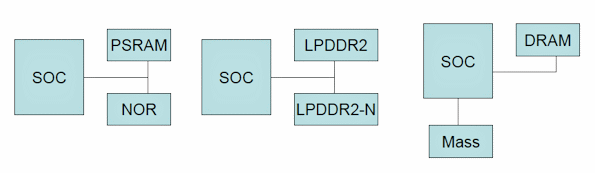
One of the most interesting slides that Floman presented at the JEDEC Mobile Forum, in my opinion, was an image that showed three processor/memory architectures for mobile phones.

The graphic looked like this:


The two architectures on the left are execute-in-place (XIP) architectures. The leftmost architecture employs pseudo-static RAM and NOR Flash as memory and executes operating-system code directly from the NOR Flash memory. The middle architecture replaces the pseudo-static RAM and NOR Flash memory with LPDDR2 SDRAM and LPDDR2-N Non-Volatile Flash memory. It’s still an execute-in-place architecture but the memory components are newer and deliver more performance with better capacity.

The architecture on the right is a shadowing architecture where the OS code is stored in a mass-storage device (NAND Flash memory) and the code is first transferred to DRAM and then executed. High-end smartphones use this architecture.


These architectural designs will hold unless a new type of memory with both fast read/write times and non-volatile storage become commercially available in the required capacities and the required cost per bit. If that happens, the smartphone will only need one memory type—perhaps that might be magnetic RAM (MRAM) or Memristor-based memory. But that’s not the situation today.

The best possible performance, said Floman, will come from Wide I/O DRAM while the UFS (Universal Flash Storage) standard appears to be poised to become the next commonly used storage medium for smartphone design. UFS “will be the next generation mass memory” for smartphones, said Floman.

All of this evolution has but a single purpose. “You will not buy your next phone from the same manufacturer unless it provides new functions,” Floman said as he concluded his keynote speech.

Wednesday, April 4, 2012

Six Technologies that Save Smartphone Batteries

These six new technologies are interesting approaches for cutting down the power used during battery operation.
Some of the technologies, such as operating near the threshold voltage, would be difficult to manufacture consistently in the fab with reasonable yield.

Ron Maltiel


Six Paths to Six Technologies that Save Smartphone Batteries
http://spectrum.ieee.org/semiconductors/processors/six-paths-to-longer-battery-life#.T3Wwc8D6prE.twitter
By Rachel Courtland / April 2012

The boom in mobile devices and data centers has circuit designers
racing to find new ways to slash power consumption. At this year's
International Solid-State Circuits Conference, in San Francisco, six
power-saving technologies took center stage. Some will emerge in
products this year, while others are just beginning to catch the
interest of major chipmakers.rigueur for today's processors—all the
way down to 280 millivolts. The chip's sweet spot for energy
efficiency was 450 mV, just above the threshold voltage. At that
level, Intel's chip ran slowly, at less than 100 megahertz, but it
also consumed just about a fifth of the energy it did at 1.2 V.
Parallel processing could be used to pick up some of the slack in
performance.Mudd College, in Claremont, Calif., showed that the
approach works on an ARM Cortex-M3 processor, boosting energy
efficiency by 60 percent. The team says it's the first implementation
of a Razor-style scheme on a complete commercial processor. nm Ivy
Bridge chips can be run just as fast as the company's previous chips,
but with an operating voltage that's 200 mV lower. Intel has also
incorporated designs at the circuit and core level to improve the
chip's power management. A separate system-on-a-chip code-named
Silvermont, based on the same transistor-making process, will be
geared for mobile handsets. Samsung presented a new improvement on the
all-digital phase-locked loop, a 0.012-square-millimeter circuit that
consumes just 2.5 mW. Intel showed off a version of the circuit, built
with the company's 22-nm technology, that consumes as little as 0.7
mW.Chiao Tung University, in Hsinchu, Taiwan, found a way to save
power by working on signals in two separate stages—one for crude
processing and the other for fine-tuning—that can each be
optimized.Samsung and Hynix Semiconductor both unveiled details on the
next incarnation of synchronous DRAM, the memory that drives today's
processors. The new generation, which goes by the name DDR4, boasts
circuit tricks that let Samsung drop the supply voltage to its memory
modules from 1.5 V to 1.2 V. The modules also include better clocking
and faster algorithms for encoding data to be sent to and fetched from
memory. DDR4 may make its commercial debut as early as 2013.

Friday, June 12, 2009

Palm Pre Teardown

First look inside the Palm PreModular design leaves mysteries on battery, display

SAN JOSE, Calif. — A teardown of the Palm Pre reveals few surprises, but leaves two intriguing questions unanswered.It's not clear from a first inspection of the Pre's internals why the handset is delivering subpar battery performance in early reviews. Analysts are also scratching their heads over why Cypress Semiconductor is not providing technical information on what appears to be a new multi-touch display controller used in the cellphone.The Palm Pre went on sale June 6 after debuting at the Consumer Electronics Show in January. The handset has been of the most anticipated new cellphone designs since the iPhone, in part because Jon Rubinstein, the company's recently installed executive chairman, was the former vice president of engineering at Apple's iPod division. Additional details

Rick Merritt/ (06/07/2009 6:45 PM EDT) / www.eetimes.com/showArticle.jhtml?articleID=2177021