Showing posts with label processors. Show all posts

Friday, September 25, 2015

iPhone 6s Teardown: A9, M9 Processors Secret Sauce

The new iPhone is a fast phone. The iPhone tear-down detailed below reveals that the processor A9 is packaged together with the mobility processor M9. "A9 package itself appears bigger—roughly 14.5 x 15 mm, up from 13.5 x 14.5 mm on the A8. That could represent a smaller die plus the addition of the embedded M9"

Placing both processors in close proximity in one package reduces the delay in operations that use both processors. For example operations using the new 3D touch technology. 

In addition, increasing the DRAM size to 2GB  LPDDR4 DRAM , also increase the speed of the phone by providing additional storage enabling more operations to occur at the same time in parallel.

It is also interesting that the battery "1715 mAh. It's a small but notable decrease from the 1810 mAh battery in last year's iPhone 6 "  is smaller. Using one package for A9 and M9 processors, and a larger LPDDR4 DRAM help to reduce power consumption.

Ron
Insightful, timely, and accurate semiconductor consulting.
Semiconductor information and news at - http://www.maltiel-consulting.com/


iPhone 6s Teardown


Step 1  iPhone 6s Teardown 

  • The 6s may look the same as last year's iPhone, but there are plenty of new features in this phone:
    • Apple A9 processor with embedded M9 motion coprocessor
    • 16, 64, or 128 GB of storage
    • 4.7-inch 1334 × 750 pixels (326 ppi) Retina HD display with 3D Touch
    • 12 MP iSight camera supporting 4K video recording with 1.22 ยต pixels, and a 5 MP FaceTime HD camera
    • 7000 Series aluminum enclosure and Ion-X Glass
    • 802.11a/b/g/n/ac Wi‑Fi with MIMO + Bluetooth 4.2 + NFC + 23-band LTE
    • Taptic Engine
    • ......
    • Step 14 

      • It turns out the rumors were true—battery capacity is down a bit, likely in order to make room for new features like the Taptic Engine and slightly thicker display.
      • The Lithium-ion pack comes in at 3.8 V, 6.55 Whr, and 1715 mAh. It's a small but notable decrease from the 1810 mAh battery in last year's iPhone 6.
      • This iPhone's battery still has the same identity issues as last year's. It seems to think it's from Apple South Asia (Thailand) Limited, Apple Japan, and is made in Changsu, China.
      • Nevertheless, Apple says battery life holds steady at up to 14 hours of 3G talk time and 10 days of standby—the same as in the iPhone 6. ...
      • ...
    • Step 17 

      • And now, for the moment we've all been waiting for... It's time to reveal some ICs on the front of the logic board:
        • Apple A9 APL0898 SoC + Samsung 2 GB LPDDR4 RAM (as denoted by the markings K3RG1G10BM-BGCH)
        • Qualcomm MDM9635M LTE Cat. 6 Modem (vs. the MDM9625M found in the iPhone 6)
        • InvenSense MP67B 6-axis Gyroscope and Accelerometer Combo (also found in iPhone 6)
        • Bosch Sensortec 3P7 LA 3-axis Accelerometer (likely BMA280)
        • TriQuint TQF6405 Power Amplifier Module
        • Skyworks SKY77812 Power Amplifier Module
        • Avago AFEM-8030 Power Amplifier Module
      Image 1/2: 57A6CVI

      EditStep 18 

      • Two more ICs on the front of the logic board:
        • 57A6CVI
        • Qualcomm QFE1100 Envelope Tracking IC
      • Based on alleged schematics leaked last month, the rumor mill had the A9 pegged at a 15% smaller die size from the A8. We can't confirm the die size, but the A9 package itself appears bigger—roughly 14.5 x 15 mm, up from 13.5 x 14.5 mm on the A8. That could represent a smaller die plus the addition of the embedded M9 and other functions.
      Image 1/1: Toshiba THGBX5G7D2KLFXG 16 GB 19 nm NAND Flash

      6 EditStep 19 

      • But wait, there's more! We'll double your order of chips absolutely free!
        • Toshiba THGBX5G7D2KLFXG 16 GB 19 nm NAND Flash
        • Universal Scientific Industrial 339S00043 Wi-Fi Module
        • NXP 66V10 NFC Controller (vs. 65V10 found in iPhone 6)
        • Apple/Dialog 338S00120 Power Management IC
        • Apple/Cirrus Logic 338S00105 Audio IC
        • Qualcomm PMD9635 Power Management IC
        • Skyworks SKY77357 Power Amplifier Module (likely an iteration of theSKY77354)
      Image 1/1: Murata 240 Front-End Module

      1 EditStep 20 

      • More ICs on the back of the logic board:
        • Murata 240 Front-End Module
        • Possibly a Bosch Sensortec barometric pressure sensor BMP280
        • RF Micro Devices RF5150 Antenna Switch
        • NXP 1610A3 (likely an iteration of the1610A1 found in the iPhone 5s and 5c)
        • Apple/Cirrus Logic 338S1285 Audio IC (likely an iteration of the 338S1202 audio codec found in the iPhone 5s)
        • Texas Instruments 65730AOP Power Management IC
        • Qualcomm WTR3925 Radio Frequency Transceiver

Wednesday, August 6, 2014

Top Semiconductor (1st Qtr 2014) Vendors

IC Insights have a new report about the top semiconductor ranking (see below).

"The ranking by IC Insights include three pure-play foundries (TSMC, GlobalFoundries, and UMC) and six fabless companies. It is interesting to note that the top four semiconductor suppliers all have different business models. Intel is essentially a pure-play IDM, Samsung a vertically integrated IC supplier, TSMC a pure-play foundry, and Qualcomm a fabless company, as observed by IC Insights."


As mentioned previously ( Top 25 2011 Semiconductor Sales Ranking) NAND market growth is not well document here. It is important to note that the semiconductor sales and growth rankings do not include SanDisk's $5.66B sales in 2011 and more than $6 Billion in 2013.


Ron
Insightful, timely, and accurate semiconductor consulting.
Semiconductor information and news at - 
http://www.maltiel-consulting.com/


Top 20 semiconductor vendors in 1Q2014


Date: 03/08/2014
The top-20 semiconductor ranking in Q1 2014 is quite a mix of companies with different product focus. The ranking by IC Insights include three pure-play foundries (TSMC, GlobalFoundries, and UMC) and six fabless companies. It is interesting to note that the top four semiconductor suppliers all have different business models. Intel is essentially a pure-play IDM, Samsung a vertically integrated IC supplier, TSMC a pure-play foundry, and Qualcomm a fabless company, as observed by IC Insights.

The further finding shared by IC Insights include:

IC foundries are included in the top 20 ranking because IC Insights has always viewed the ranking as a top supplier list, not as a market share ranking, and realizes that in some cases semiconductor sales are double counted. With many of our clients being vendors to the semiconductor industry (supplying equipment, chemicals, gases, etc.), excluding large IC manufacturers like the foundries would leave significant “holes” in the list of top semiconductor suppliers. Foundries and fabless companies are clearly identified in Figure 1. In the April Update to The McClean Report, market share rankings of IC suppliers by product type were presented and foundries were excluded from these listings.

It should be noted that not all foundry sales should be excluded when attempting to create marketshare data. For example, although Samsung had a large amount of foundry sales in the first quarter, most of its sales were to Apple. Apple does not re-sell these devices, so counting these foundry sales as Samsung semiconductor sales does not introduce double counting.

Overall, the list shown in Figure 1 is provided as a guideline to identify which companies are the leading semiconductor suppliers, whether they are IDMs, fabless companies, or foundries.


top semiconductor 20 2014

Figure 1

Outside of the top five spots, there were numerous changes within the 1Q14 top-20 semiconductor supplier ranking. As shown, MediaTek jumped up four positions in 1Q14 as compared to 1Q13 into 12th place. MediaTek continues to experience extremely strong demand for its devices in the booming low-end smartphone business in China and other Asia-Pacific locations. Moreover, MediaTek and MStar finalized their merger on February 1, 2014. Annual post-merger sales for MediaTek are expected to be well over $6 billion.

After Avago’s purchase of LSI Corp. on May 6, 2014, the combined annual semiconductor sales run-rate of the two companies is likely to be over $5 billion. Also, last year’s Micron/Elpida merger essentially created a new “giant” semiconductor company with Micron’s sales expected to be over $17 billion this year!

It should be noted that the sales of Micron and Elpida (merged on July 1, 2013), MediaTek and MStar, and Avago and LSI use the combined sales of the two companies for both 1Q13 and 1Q14, regardless of when the merger actually occurred. This was done in an attempt to make the company’s 1Q14/1Q13 sales growth rates more directly comparable and give a clearer picture of the merged company’s sizes going forward.

Another potential merger to keep a watch for in the future is Fujitsu and Panasonic. In February of this year, the two Japan-based companies signed a memorandum of understanding to combine the two companies’ system LSI businesses and form a new fabless semiconductor company. IC Insights estimates that the combined 1Q14 semiconductor sales of these two companies was about $1.25 billion (down from $1.44 billion in 1Q13), which would have ranked the “merged” company as the sixteenth largest semiconductor company in the first quarter of this year.

In total, the top 20 semiconductor companies’ sales increased by 9% in 1Q14 as compared to 1Q13, which was two points higher than IC Insights’ current 7% forecast for total worldwide semiconductor market growth this year. As shown, it took total semiconductor sales of just over $1.0 billion to make the 1Q14 top 20 ranking.

Figure 2 shows that there was a 58-percentage-point range of year-over-year growth rates among the 1Q14 worldwide top 20 semiconductor suppliers—from +48% for MediaTek/MStar to -10% for ST (it should be noted that excluding the legacy ST-Ericsson products, ST’s 1Q14/1Q13 sales increased 1%).

top semiconductor 20 2014

Figure 2

The success of the fabless and fab-lite business models and the continued strong growth of the memory market are evident when examining the top 20 semiconductor suppliers that logged double-digit growth in 1Q14. As shown, 10 of the top 11 1Q14 performers were either memory suppliers (SK Hynix, Micron, and Samsung) or fabless/fab-lite companies (MediaTek, AMD, Infineon, Freescale, Avago/LSI, NXP, and Nvidia). 

Friday, April 4, 2014

Top Semiconductor Ranking for 2013


The article below describes growth and ranking of top semiconductor companies in 2013.  


Last year growth was driven by;
  •         acquisitions such as Micron of Elpida, MediaTek merger with MStar,
  •        Mobile chip demand (processors, memory, etc.)
  •        DRAM market demand growth, Hynix was able to grow 43% even with the fire in a manufacturing plant

Qualcomm was ranked 4th, growing 31% in 2013.

NAND market growth is not well document here. For example SanDisk still is not ranked here even though it is a major NAND supplier with revenue of more than $6 Billion in 2013.


Ron
Insightful, timely, and accurate semiconductor consulting.
Semiconductor information and news at - 
http://www.maltiel-consulting.com/


IC Insights Shows Big Changes to 2013 Top 20 Semi Supplier Ranking

SK Hynix, MediaTek, Micron, and Qualcomm each registered ≥30% year-over-year growth.

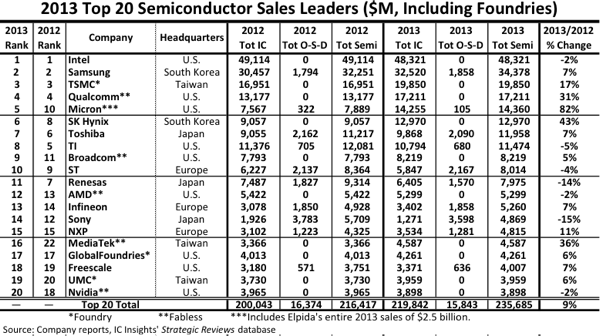
IC Insights’ April Update to The 2014 McClean Report will show a ranking of the 2013 top 50 semiconductor suppliers. A preview of the top 20 companies is listed in Figure 1.  The top 20 worldwide semiconductor (includes ICs and O-S-Ds—optoelectronics, discretes, and sensors) sales leaders for 2013 included nine suppliers headquartered in the U.S., three in Japan, three in Taiwan, three in Europe, and two in South Korea, a relatively broad representation of geographic regions.

The top 20 ranking also includes three pure-play foundries (TSMC, GlobalFoundries, and UMC) and five fabless companies.  It is interesting to note that the top four semiconductor suppliers all have different business models. Intel is essentially a pure-play IDM, Samsung a vertically integrated IC supplier, TSMC a pure-play foundry, and Qualcomm a fabless company.

IC foundries are included in the top 20 semiconductor supplier ranking because IC Insights has always viewed the ranking as a top supplier list, not as a marketshare ranking, and realizes that in some cases semiconductor sales are double counted.  With many of our clients being vendors to the semiconductor industry (supplying equipment, chemicals, gases, etc.), excluding large IC manufacturers like the foundries would leave significant “holes” in the list of top semiconductor suppliers.  Foundries and fabless companies are clearly identified in Figure 1.  In the April Update to The McClean Report, “marketshare” rankings of IC suppliers by product type are presented and foundries are excluded from these rankings.

It should be noted that not all foundry sales should be excluded when attempting to create marketshare data.  For example, although Samsung had a large amount of foundry sales last year, most of its sales were to Apple.  Apple does not re-sell these devices, so counting these foundry sales as Samsung semiconductor sales does not introduce double counting.

Overall, the list shown in Figure 1 is provided as a guideline to identify which companies are the leading semiconductor suppliers, whether they are IDMs, fabless companies, or foundries.


Figure 1

Excluding the foundries of TSMC, GlobalFoundries, and UMC from the top 20 ranking would bring Fujitsu, Marvell, and Sharp into the 18th, 19th, and 20th positions, respectively (Figure 2).


Figure 2

There were numerous changes within the top 20 semiconductor supplier ranking in 2013 as compared to the top 20 ranking of 2012.  Spurred by its acquisition of Elpida last year, Micron climbed five spots and moved into the top 5 ranking.  Some of the other companies that rose in the 2013 ranking include SK Hynix, which, despite a significant fire and production setback at its largest memory fab in China, took full advantage of the 32% surge in the DRAM market last year and moved up two places into the 6th position.  Also, Broadcom moved into the top 10 while MediaTek jumped up six positions to 16th place and into the top 20 ranking for the first time. 

MediaTek is experiencing extremely strong demand for its devices in the booming low-end smartphone business in China and other Asia-Pacific locations.  In fact, MediaTek’s application processor shipments for smartphones reached over 200 million units last year, about double the 108 million units the company shipped in 2012.  Moreover, with MediaTek and MStar expected to merge in 2014, the annual post-merger sales for MediaTek should be over $6 billion, most likely enough to lift the company into the 12th spot in the 2014 ranking.

Another company expected to make a significant move up in the ranking this year by way of acquisition is Avago. After the company’s purchase of LSI Corp., the combined semiconductor sales of the two companies is likely to be well over $5 billion this year, which could propel Avago from its 27th 2013 ranking to as high as 13th in 2014!

In contrast to the semiconductor companies moving up in the ranking, Fujitsu dropped five places to fall out of the top 20 ranking in 2013, going from being ranked 16th in 2012 to 21st last year (the company sold its analog and MCU business to Spansion in August of 2013).  Renesas was another “casualty” in the top 20 ranking and fell to 11th place last year from the 7th position it held in 2012.

In total, the top 20 semiconductor companies’ sales increased by 9% in 2013 as compared to 2012, which was more than twice the 4% growth rate for total worldwide semiconductor market last year!  It took total semiconductor sales of about $3.9 billion to make the top 20 ranking in 2013.

Figure 3 shows that there was a 97-percentage-point range of growth rates among the worldwide top 20 semiconductor suppliers in 2013 (from +82% for Micron to -15% for Sony).  The continued success of the fabless/foundry business model and the strong growth of the memory market (especially the 32% DRAM market surge) last year is evident when examining the six top 20 semiconductor suppliers that logged double-digit growth. As shown, the top six performers in 2013 included two memory companies (SK Hynix and Micron), two fabless companies (MediaTek and Qualcomm), and TSMC (the largest pure-play foundry).

Figure 3 shows that the two top 20 ranked companies that registered double-digit sales declines in 2013 are headquartered in Japan (Renesas and Sony).  As previously shown, Japan-based Fujitsu also registered a double-digit decline (-16%) in 2013 and dropped out of the top 20 ranking last year.  However, it should be noted that the conversion of Japanese company semiconductor sales from yen to U.S. dollars, at 97.6 yen per dollar in 2013 versus the 79.8 yen per dollar rate in 2012, had a significant impact on the sales figures for the Japanese companies.  Using a constant 2012 U.S. dollar versus Japanese yen exchange rate for 2013, the 2013 semiconductor sales of Renesas, Sony, and Fujitsu, would have increased 5%, 4%, and 3%, respectively.

More details on the 2013 top 50 semiconductor suppliers will be provided in the April Update to The McClean Report.


Figure 3