Showing posts with label Solid-state drive. Show all posts

Monday, June 16, 2014

SSD Market Share/ SanDisk buys Fusion-io

A recent survey by Gartner (see below) shows Intel and Samsung leading in shipment of SSD storage for enterprise.


Ron
Insightful, timely, and accurate semiconductor consulting.
Semiconductor information and news at - http://www.maltiel-consulting.com/


 IBM officially biggest all-flash array shipper - analyst

Gartner AFA data hits the street
By Chris Mellor, 13 Jun 2014 

No, it isn’t the greatly anticipated all-flash array magic quadrant, but it's great Gartner analysis nonetheless. The number-crunchers at Gartner HWQ have produced a Market Share Analysis: SSDs and Solid-State Arrays, Worldwide, 2013. Yummy. Let’s see what’s inside.
The doc, available as a download from Pure Storage (guess who's done well in the analysis) after registering a few details. It looks at both SSDs and all-flash arrays, which Gartner calls Solid State Arrays (SSAs) and IBM comes out as the leading SSA shipper – with Pure Storage second.
SSAs are defined carefully: ”SSAs are scalable, dedicated, solutions based solely on solid-state semiconductor technology for data storage that cannot be configured with HDD technology at any time. As distinct from SSD-only racks within ECB storage arrays, an SSA must be a stand-alone product denoted with a specific name and model number, which typically (but not always) includes an operating system and data management software optimised for solid-state technology.”
To cut a long story short, Dell and HDS all-flash array products are excluded, as are all-flash versions of – for example – EMC VMAX and VNX, and NetApp FAS arrays.
The SSD category embraces PCIe flash cards and also includes “self-contained solid-state NAND dual in-line memory modules (DIMMs), which must be used in dedicated slots in servers. Mainstream PC SSDs being used in servers are counted in this category due to end consumption.”
We’ll graph the information here, and you can read the detailed numbers by downloading the doc. The SSD info starts with worldwide vendor revenues:
Click chart for larger version
Total SSD revenues in 2012 were $7.2 billion, and in 2013 had risen to $10.99 billion, a 53.1 per cent increase.
Samsung as top dog got most of that with Intel, growing less, at number 2. Look at Sandisk’s rocketing growth up into the no 3 slot, closely followed by Micron. Toshiba held its fifth place but didn’t grow much. WD grew, Fusion-io declined and now we’re in the tail-enders.
Now let’s look at the enterprise SSD market:
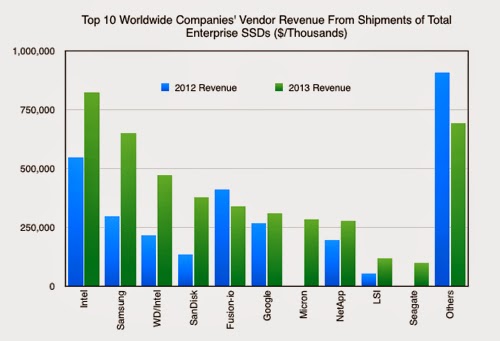

Intel is top dog, not second-placed Samsung. WD, with its HGST/Intel SSDs is in third place followed by SanDisk successfully exhibiting its enterprise supplier credentials. Then there’s Fusion-io, which declined 2012 - 2013, Google with its internal use - amazing - Micron is a, we think, in a disappointing sixth place, NetApp a, for it, strong seventh then LSI and Seagate. EMC does not appear at all.
Now for the SSA numbers.
Here are the vendor revenue market share numbers:

Click chart to make it larger.
And here the actual SSA revenues by vendor:

Click chart to make it larger
IBM has had a wildly successful 2013 year, solidly overtaking Violin Memory to claim a dominating number 1 slot. Pure Storage has rocketed to the number 2 position in 2013 while Violin Memory slumped from first place in 2013 to third in 2013, illustrating the new management team’s uphill task. EMC has sprung into fourth place from a standing start and NetApp is not far behind in the fifth slot. Then there’s Nimbus Data and tail-ender Cisco - a dismal showing for the networking behemoth in our view, with startup SolidFire very close behind.
The SSA market was sized by Gartner at $236.5m in 2012, and 182.1 per cent higher at $667.3m in 2013. IBM’s SSA revenues grew at 278.1 per cent, Pure's at a magnificent 642.3 per cent and no other vendor outpaced the market, meaning they lost share.
Now this is artificial, as EMC, Kaminario, SolidFire and HP had no presence in Gartner’s numbers in 2013, but we can assert that Violin Memory, NetApp, Nimbus and Cisco all lost share from 2012 to 2013. With EMC, Kaminario, SolidFire and HP now in the SAA market we might expect these losses to continue in 2014.
The Gartner analysis contains more data, segment metrics and so forth. It’s worth a download and read if you’re interested.
Main takeaway? Big Blue really is big in SSAs, Pure Storage is living up to its hype, and the SSA market is growing at a fast lick. NAND the story goes on


Wednesday, May 22, 2013

SSD Market Share by Technology, Application, and Company

From Trend focus analysis of flash NAND Solid State Drive (SSD) market growth, prices by application and technology:

  • "MLC dominated the NAND market in CQ1 with 77.9% share, up 8% quarter on quarter.
  • TLC (3bit/cell) is gaining traction and rose 8% from quarter-to-quarter.
  • Samsung is the only company shipping TLC-based SSDs in volume.
  • SLC is declining quickly as demand transitions to MLC, except in certain high performance, high-endurance applications such as military, industrial, medical and automotive."


Additional details below.

More about Cache SSD Shipments to Explode and Apple's iPad, iCloud Drive Semiconductor Industry reports from June 2012

Ron
Insightful, timely, and accurate semiconductor consulting.
Semiconductor information and news at - http://www.maltiel-consulting.com/


SSD Units Grew 22% from 4Q12 to 1Q13 - Trendfocus

http://www.storagenewsletter.com/news/marketreport/trendfocus-ssd-market
Leaders being in order Samsung, SanDisk, Toshiba and Intel
The NAND market continued to heat up, as NAND supply was tight in CQ1 '13 due to healthy demand and supply constraints. Nevertheless, the SSD market grew from the prior quarter to 13.28 million, up 22% quarter on quarter. 

In CQ1, the client SSD market was up 19% sequentially to 12.06 million. Enterprise SSD growth rates continue to outpace any seasonal server or storage system softness - this market was up 66% from CQ4 '12, to 1.22 million.

Client SSDs were dominated by NAND suppliers, especially Samsung, who took the lead in selling TLC (3bit/cell) into PC OEMs and the retail channel. Toshiba and SanDisk, who had been the main drivers for TLC in the industry up to this point, could not sustain the momentum and lost share in the market.

The enterprise SSD market is gaining more traction in data centers and cloud storage, as the $/GB metric decreased to levels low enough to drive an inflection in demand. TCO and performance arguments are far more compelling at today's $/GB levels and with costs expected to continue downward, enterprise SSD adoption will continue to grow at rates outpacing other storage devices.

        Total SSD Market by Application
Units in million  CQ1 '13 
 actuals
 CQ1 '14 
Forecast
 
   Y/Y 
Growth
 Client SSDs   
 Stand-Alone Units   7.073  10.180  44%
 Cache Units   4.986   8.319  67%
 Total  12.059  18.499  53%
    
 Enterprise SSDs   
 SATA Units   1.009   1.151  14%
 SAS Units   0.170   0.198  16%
 PCIe Units   0.037   0.042  14%
 Total   1.216   1.391   14%
    
 Total SSD Units 13.275 19.890 50%
  (Source: Trendfocus, May 2013)

           Total NAND Market Share by Technology
trendfocus_f1_540
 (Source: Trendfocus, May 2013)

                         Spot Market Pricing of SSDs
trendfocus_f2_540
   (Source: Trendfocus, May 2013)
  • Price for SSDs in the spot market continues to rise due to constrained NAND supply. OEM and large-scale contracts can be markedly different than spot market pricing.
  • 256GB SSD increased 57% from $145 in January to $227 in first week of May.
  • 128GB SSD increased 87% since January to $140.
    SSD Supplier Market Share in 1Q13
 in million 
 of units
 Client  Enterprise Total Share 
 Samsung 4.092     0.060 4.152 31.3%
 SanDisk 2.200     0.026 2.226 16.8%
 Toshiba 1.222     0.000 1.222  9.2%
 Intel 0.832     0.025 0.857  6.5%
 HGST 0.000     0.094 0.094  0.7%
 STEC 0.000     0.044 0.044  0.3%
 Others 3.713     0.967 4.680 35.3%
 Total12.059     1.21613.275 100%
 (Source: Trendfocus, May 2013)
Our comments :
Now Trendfocus is becoming a serious analyst firm in SSDs after being concentrated for several years on HDDs disk heads and media only. Other ones in this flash sector include IDC and IHS iSuppli.

It's a difficult job because there are over 100 SSD makers around the world. It's easier to track HDDs with only three manufacturers remaining.

What is published above is a small abstract of the 29 pages of the Trenfocus report NAND/SSD Information Service - May 13, 2013, CQ1'13 Quarterly Update. 

We just found the Californian analysts relatively conservative concerning the growth of the enterprise PCIe SSD market compared to the SAS one, and more globally on enterprise SSDs.

Wednesday, April 24, 2013

Tablets,Smartphones, and SSDs Market Share of NAND in 2013


The Smartphones, Tablet PCs, SSDs Propelling NAND Flash Sales in 2013 report  discusses the percentages of NAND sales to the various end markets.  NAND demand is being impacted quite a bit by the growth of tablets that are replacing laptops.   iPad market grew fast and the pc makers have been marketing and testing out various tablet forms that are gaining acceptance.  Tablets are expected to reach 12% of the $30.0 Billion NAND flash market in 2013.  In addition, every Tablet has an SSD storage, so the growth of Tablets will lead to increased demand of SSDs.

More about Tablets are the new mobile (Tablets are the new mobile, the slide deck in the article shows the growth of mobile and Tablets in the Apple and Android eco-sphere. There are many other slides at the link below. The future of mobile was discussed in the April 15, 2009 Mobile Computing the Next Big Market article)

Ron
Insightful, timely, and accurate semiconductor consulting.Semiconductor information and news at - www.maltiel-consulting.com

Thursday, August 16, 2012

IBM Acquires Texas Memory (SSD Vendor)

It is interesting that IBM buy an hardware company. It further highlights the rising importance of flash memory solid state drives (SSD) as part of data storage system, cloud infrastructures, and the need for more and better storage in-house. Gaining in house knowledge would help IBM in thier consulting and services projects.
Ron


More about IBM buying a 30 years old vendor of SSD
IBM selects 'mature' flash option, buys Texas Memory Systems


"TMS has been around since 1978 but remains relatively small with 100 employees. It started with memory systems for seismic processing for the oil and gas industry. TMS was among the first solid-state storage vendors, shipping its first NAND flash system – the RamSan-500 – in 2007."

and
IBM to Buy Solid-State Storage Supplier TMS

"TMS, in fact, has been selling IT transformation for years. An early player in the Flash-based storage market, the 34-year-old company sells rackmount systems and PCIe cards under its RamSan brand. The purpose of these solutions is to improve the performance of IT systems, using less power and smaller form factors.
Performance and throughput are getting more important than ever, thanks to big-data, cloud infrastructures, and the need for more and better storage in-house -- at lower-than-ever prices.

TMS makes its own solid-state storage modules with its own controllers and designs. It claims patented RAID technologies -- an important feature, given that early solid-state storage systems were sometimes accused of being less durable than hard-disk drives."


IBM Solidifies SSD Strategy With Texas Memory Acquisition

In what could be one of the most important acquisitions of the year, IBM today announced plans to acquire Texas Memory Systems. While the details will be presented later on today, we think this is an excellent move on the part of IBM. Texas Memory brings a deep technical bench and excellent leadership that will allow IBM to differentiate itself from other large storage vendors.

As we described in our article "  IBM Storage Makes Its SSD Case "  this purchase significantly strengthens IBM's SSD Strategy. As the Texas Memory products are integrated into the IBM portfolio it puts IBM on par, if not ahead of EMC for completeness of flash offering.

Now the race will be to see who can address the integration of all of these flash domains (server, network, storage) as well as automate these domains. Doing so is a key requirement in eliminating performance sprawl as we describe in our latest chalktalk

Wednesday, June 20, 2012

Flash Memory Controller is the Secret Sauce

This is the the fifth SSD controller company to be acquired recently:
* In March of last year OCZ acquired Indilinx
* In may 2011 SanDisk bought Pliant
* LSI acquired SandForce in October
* December brought Apple's acquisition of Anobit
* Now SK Hynix has acquired Link_A_Media

At the  Flash Summit in August 2011, Sandisk discussed The Future of SSD Architectures. Several of the key technical issues of a flash NAND memory controller were highlighted.

Having controller knowledge in-house is a key edge in designing fast and low power flash memory systems.

Ron


SK Hynix to Acquire Link_A_Media Devices

http://finance.yahoo.com/news/sk-hynix-acquire-media-devices-222500217.html
SEOUL, South Korea--(BUSINESS WIRE)--


SK hynix Inc. (‘SK hynix’ or ‘the Company’) announced that it has entered into an agreement to acquire California-based storage solution company Link_A_Media Devices Corporation (‘LAMD’). LAMD, founded in 2004, is a leader in the development of semiconductor system-on-chip (SoC) solutions for the data storage market. These SoC solutions, also called controllers, interface with processors to significantly increase the speed and reliability of Flash memory. Upon completion of the acquisition, LAMD will join SK hynix as a business unit focused on customized NAND based solutions.


As various mobile applications such as smartphones and tablet PCs are being rapidly adopted and cloud computing grows in popularity, the NAND Flash market has been evolving from raw NAND memory solutions for USB and memory cards to value-added products equipped with controllers. The role of the NAND controller in premium products such as e-MMC (embedded Multi Media Card) and SSDs (Solid State Drives) has become increasingly important to meet the high memory densities and improved interface speeds required by end users.


“We expect our NAND Flash competitiveness will be further strengthened by the acquisition of LAMD which has extensive expertise in controller technology and excellent engineering resources. SK hynix will leverage this acquisition and continuously develop value-added NAND solutions and respond to our customers’ needs,” said Mr. Oh Chul Kwon, President and CEO of SK hynix.


“We are excited to become a part of the SK hynix family. This will enable us to bring our advanced controller solutions to a wide range of data storage products to meet the rapidly increasing demands of the worldwide business and consumer markets,” said Dr. Hemant Thapar, Founder and CEO of LAMD.

Friday, June 15, 2012

Cache SSD Shipments to Explode

"Hybrid hard disk drives (HDD) containing a built-in layer of NAND flash memory may offer the advantage of consolidated storage for increasingly popular ultrabooks, but cache solid state drives (SSD) will remain the mainstream ultrabook storage solution".

In 2012 "cache SSD volume this year to 23.9 million unit...
dedicated SSDs that contain no cache component, will attain shipments this year of 18 million...
 hybrid HDDs will reach two million units this year...on their way to reaching 25 million units by 2016"

A key driver of cache SSD  is Intel's strong support of ultrabooks.

In January 2012 IHS report "Fueled by rising sales of ultrabooks, shipments of cache SSD units in 2012 are projected to reach 25.7 million units, up from 881,000 units in 2011 when the technology first appeared. Next year, cache SSD shipments will amount to 68.2 million units, on their way to approximately 121.0 million units by 2015, as shown in the figure below.

The majority of cache SSD units will find their way into devices known as ultrabooks—the superthin mobile computers launched by chipmaker Intel in 2011—even though non-ultrabook desktops and notebooks also will account for cache SSD use. Of the more than 25 million cache SSDs to be shipped this year, about 22 million units will be present in ultrabooks, up from a mere 500,000 last year."


Ron


Cache is king in solid state drive market, says IHS
http://www.digitimes.com/news/a20120615PR200.html?mod=2
Press release; Jessie Shen, DIGITIMES [Friday 15 June 2012]

Hybrid hard disk drives (HDD) containing a built-in layer of NAND flash memory may offer the advantage of consolidated storage for increasingly popular ultrabooks, but cache solid state drives (SSD) will remain the mainstream ultrabook storage solution, according to IHS iSuppli.

Already the leading storage form factor in ultrabooks, cache SSDs will see their shipments rise even more this year to 23.9 million units, up by an astounding 2,660% from just 864,000 units in 2011, IHS said. Shipments will then jump to 67.7 million units in 2013, cross the hundred-million-unit mark in 2015, and hit 163 million units by 2016, IHS forecast.

In comparison, shipments of hybrid HDDs will reach two million units this year, up from one million in 2011, on their way to reaching 25 million units by 2016, IHS indicated. A third form of flash storage, dedicated SSDs that contain no cache component, will attain shipments this year of 18 million in consumer applications, gradually ramping up to 69 million units in 2016, IHS said.


Consisting of a traditional HDD and an integrated NAND flash layer within one self-contained form factor, hybrid HDDs are a new storage option being considered for the super-thin ultrabooks. The Momentus XT hybrid product from Seagate Technology has up to 8GB of single-level-cell NAND and 750GB of memory on two 2.5-inch platters. Seagate rivals Western Digital and Toshiba are also considering hybrid HDDs of their own, with drives containing 8GB or more of NAND cache.


In contrast to hybrid HDDs, cache SSDs are employed as a discrete, separate memory component alongside a HDD, with both elements existing side by side, not together in one housing unit. A sample cache SSD configuration from Acer's Aspire S3 ultrabook carried a 20GB SSD next to 320GB of hard disk space.


"The cache SSD solution was first hit upon by PC manufacturers because the use of a dedicated solid state drive proved too expensive when passed on to consumers in the retail market," said Ryan Chien, analyst for memory & storage at IHS. "However, a combined physical hard disk drive with a smaller cache component allowed PC makers to reap the advantages of faster responsiveness and larger capacities while keeping costs down."


Cache SSDs also offer more advantages than consolidated hybrid HDDs. For instance, discrete cache SSDs and HDDs are much more scalable and efficient for mainstream storage, given the broad selection of drive manufacturers, IHS said. And because SSDs and HDDs have lately been focused on more mobile sizes, few changes are needed for cache SSDs or thin HDDs to keep their manufacturing processes cost effective.


Moreover, the expected evolution of cache SSDs to a swappable mSATA form factor not only helps narrow the convenience advantage currently enjoyed by hybrid HDDs but also facilitates upgradability akin to DRAM modules or USB drives, IHS noted. HDDs sized 7mm are available with 500GB in 2.5-inch platters, with a 5mm z-height as the next step, while hybrid HDDs are still 9mm high. SATA SSDs are also getting denser, and NAND on the motherboard is becoming more feasible.


Such benefits overall highlight the strength of discrete, dedicated hardware emblematic of cache SSDs over those of hybrids, which tend to make compromises in exchange for volume implementation, IHS said. Cost concerns, longer design cycles and tighter engineering tolerances in the case of hybrid HDDs also add to their difficulty of use in ultrabooks, IHS added.


As a result, the gain achieved through a consolidated form factor supposed to be a strength of hybrid HDDs will actually be a weakness in a few years as cache SSDs overcome that advantage, IHS said. For their part, cache SSDs will remain as the favored storage solution in ultrabooks, with penetration of the desktop and the rest of the notebook segments anticipated to follow.