Showing posts with label cell. Show all posts

Monday, May 18, 2015

Top Semiconductor Products & Sale

Micron has benefited from its timely acquisition of Elpida . The chart presents in a nice graphically way semiconductor manufacturers ranking by size and products.

One issue with this ranking is that SanDisk has a joint venture with Toshiba which produce all of its NAND chips. SanDisk has yearly revenue of about $6.5B , portion of which is all the flash NAND chips used to build their products. It would be interesting where a combined Toshiba / SanDisk rank would be in the chart.

More about SanDisk ranking in April 2011 blog Top 25 2011 Semiconductor Sales Ranking


Ron
Insightful, timely, and accurate semiconductor consulting.
Semiconductor information and news at - http://www.maltiel-consulting.com/


Micron Climbs to Fifth in Chip Manufacturing Market

Published: May 15,2015
Global Top-10 Chip Manufacturer Revenue Ranking in 2014(Source: Respective companies, compiled by MIC, May 2015)
According to MIC, Micron has emerged as the fifth largest chip manufacturer in the world. In 2014, Micron earned US$16.4 billion and climbed all the way from tenth to fifth place, only next to Intel, Samsung, TSMC and Qualcomm."Micron has been highly engaged in M&A activities and strategic alliances over the past years. Those two approaches, though not new, have been able to help Micron obtain the most outcomes such as increased sales and profitability," says Hui-Chung Tu, industry analyst with MIC.
Micron's ability to spot good investment timing is another factor determining its success. Among all, perhaps the most noteworthy deployment of Micron is its deployment in DRAM. Micron has witnessed a strong uptake in DRAM and NAND flash businesses with its annual revenue breaking US$14 billion.
This has helped Micron land in top-five semiconductor vendors, next to Intel, Samsung, TSMC and Qualcomm. While the growth momentum continued well into 2014, Micron is expected to continue to cling to the fifth spot in 2015, as the global economy is showing promising signs.

Wednesday, November 19, 2014

China Cell Phone Growth in 2014-5

The growth of NAND flash consumption in China is a strong indication of cell phone, tablet, and other mobile products future growth in China. The prediction in the article below of

"The proportion of China's overall NAND Flash usage relative to the world's NAND Flash output... expected to hit 20.6 per cent in 2014, and 30 per cent or more in 2015."


This prediction will depend on a very high growth in mobile products


Ron
Insightful, timely, and accurate semiconductor consulting.
Semiconductor information and news at - http://www.maltiel-consulting.com/


Mobile device space lifts memory market in China

Posted: 18 Nov 2014  
China has consumed about 4.789 billion DRAM chips and 3.518 billion NAND Flash chips from the 2Gb category this year, accounting for a respective 19.2 per cent and 20.6 per cent of the world's total DRAM and NAND Flash output. This highlights the country's increasing business potential as a result of the appeal China generates in terms of consumer device markets such as PC, smartphone and tablets, indicated DRAMeXchange, a research arm of TrendForce.
China's PC DRAM consumption is presently at about 15 per cent. Benefiting from domestic demand, Lenovo has managed to raise the scale of its business operations over the years, and is acquiring other companies as a means to boost its presence among first tier manufacturers. While the company is still competing fiercely with HP for top position in the PC market, its overall PC shipments are ahead of all of its other competitors. For 2015, DRAMeXchange predicted that Lenovo's market share will arrive at about 17 per cent. As has been the case with the other markets, mobile DRAM is expected to gradually replace PC DRAM as the mainstream in China given the country's growing smartphone and tablet sales. Aside from ZTE and Huawei, which are doing relatively well overseas, most China-based smartphone brands are expected to place their focus on the domestic market. Based on TrendForce's 2014 market statistics, China alone accounts for 28 per cent of mobile DRAM's overall bit demand. The importance of China's economic development to the entire DRAM industry is expected to become more apparent next year as that proportion rises to over 40 per cent.
As the NAND Flash manufacturing processes are advancing to under 1ynm, many NAND Flash applications including smartphone and tablet-based eMMCs and notebook-based SSDs are showing improved growth in the market. Competition among global OEM manufacturers, meanwhile, is starting to become more intense, with brands other than Apple and Samsung starting to make their way into the country's lucrative market. The level of China's NAND Flash consumption has managed to grow considerably over recent years due to Lenovo's rise to prominence, the above-average growth shown by China's emerging brands, and the improving standards of China's hardware designs. By the end of 2014, DRAMeXchange projects that the NAND Flash market's total value in China will reach up to $6.3 billion. The proportion of China's overall NAND Flash usage relative to the world's NAND Flash output, on the other hand, is expected to hit 20.6 per cent in 2014, and 30 per cent or more in 2015.

China's efforts over the years to transform from a manufacturing-based to consumption-based economy has been largely successful. Given the consistent growth in its economy and the country's rising wage levels, many of the productions in China are bound to be outsourced to other emerging countries. The Chinese government's present goal is to improve the country's outlook by implementing strategic policies that are aimed at enhancing its industrial capabilities. One such policy involves increasing the imports of semiconductor components such as smartphone CPU, AP, DRAM and NAND Flash, the combined value of which exceeds the value of China's imports for oil. In the future, it would be interesting to see whether Unisplendour Corp. Ltd's (UNIS) efforts to integrate resources from Spreadtrum Communications, RDA and Intel will be successful.
Due to the relatively high proportion of CPU, DRAM and NAND Flash components imported by China, the government policies that are implemented with regard to these three product categories may prove critical to the country's industries. A few days ago, the Chinese government announced a policy worth nearly $20 billion that involves mastering the technologies at the upper streams of the country's semiconductor supply chain and applying these technologies to mid to lower streams. The main purpose behind this is to enable the country's supply chains to be more integrated and to allow momentum in China's domestic industries to persist.

Wednesday, August 6, 2014

Top Semiconductor (1st Qtr 2014) Vendors

IC Insights have a new report about the top semiconductor ranking (see below).

"The ranking by IC Insights include three pure-play foundries (TSMC, GlobalFoundries, and UMC) and six fabless companies. It is interesting to note that the top four semiconductor suppliers all have different business models. Intel is essentially a pure-play IDM, Samsung a vertically integrated IC supplier, TSMC a pure-play foundry, and Qualcomm a fabless company, as observed by IC Insights."


As mentioned previously ( Top 25 2011 Semiconductor Sales Ranking) NAND market growth is not well document here. It is important to note that the semiconductor sales and growth rankings do not include SanDisk's $5.66B sales in 2011 and more than $6 Billion in 2013.


Ron
Insightful, timely, and accurate semiconductor consulting.
Semiconductor information and news at - 
http://www.maltiel-consulting.com/


Top 20 semiconductor vendors in 1Q2014


Date: 03/08/2014
The top-20 semiconductor ranking in Q1 2014 is quite a mix of companies with different product focus. The ranking by IC Insights include three pure-play foundries (TSMC, GlobalFoundries, and UMC) and six fabless companies. It is interesting to note that the top four semiconductor suppliers all have different business models. Intel is essentially a pure-play IDM, Samsung a vertically integrated IC supplier, TSMC a pure-play foundry, and Qualcomm a fabless company, as observed by IC Insights.

The further finding shared by IC Insights include:

IC foundries are included in the top 20 ranking because IC Insights has always viewed the ranking as a top supplier list, not as a market share ranking, and realizes that in some cases semiconductor sales are double counted. With many of our clients being vendors to the semiconductor industry (supplying equipment, chemicals, gases, etc.), excluding large IC manufacturers like the foundries would leave significant “holes” in the list of top semiconductor suppliers. Foundries and fabless companies are clearly identified in Figure 1. In the April Update to The McClean Report, market share rankings of IC suppliers by product type were presented and foundries were excluded from these listings.

It should be noted that not all foundry sales should be excluded when attempting to create marketshare data. For example, although Samsung had a large amount of foundry sales in the first quarter, most of its sales were to Apple. Apple does not re-sell these devices, so counting these foundry sales as Samsung semiconductor sales does not introduce double counting.

Overall, the list shown in Figure 1 is provided as a guideline to identify which companies are the leading semiconductor suppliers, whether they are IDMs, fabless companies, or foundries.


top semiconductor 20 2014

Figure 1

Outside of the top five spots, there were numerous changes within the 1Q14 top-20 semiconductor supplier ranking. As shown, MediaTek jumped up four positions in 1Q14 as compared to 1Q13 into 12th place. MediaTek continues to experience extremely strong demand for its devices in the booming low-end smartphone business in China and other Asia-Pacific locations. Moreover, MediaTek and MStar finalized their merger on February 1, 2014. Annual post-merger sales for MediaTek are expected to be well over $6 billion.

After Avago’s purchase of LSI Corp. on May 6, 2014, the combined annual semiconductor sales run-rate of the two companies is likely to be over $5 billion. Also, last year’s Micron/Elpida merger essentially created a new “giant” semiconductor company with Micron’s sales expected to be over $17 billion this year!

It should be noted that the sales of Micron and Elpida (merged on July 1, 2013), MediaTek and MStar, and Avago and LSI use the combined sales of the two companies for both 1Q13 and 1Q14, regardless of when the merger actually occurred. This was done in an attempt to make the company’s 1Q14/1Q13 sales growth rates more directly comparable and give a clearer picture of the merged company’s sizes going forward.

Another potential merger to keep a watch for in the future is Fujitsu and Panasonic. In February of this year, the two Japan-based companies signed a memorandum of understanding to combine the two companies’ system LSI businesses and form a new fabless semiconductor company. IC Insights estimates that the combined 1Q14 semiconductor sales of these two companies was about $1.25 billion (down from $1.44 billion in 1Q13), which would have ranked the “merged” company as the sixteenth largest semiconductor company in the first quarter of this year.

In total, the top 20 semiconductor companies’ sales increased by 9% in 1Q14 as compared to 1Q13, which was two points higher than IC Insights’ current 7% forecast for total worldwide semiconductor market growth this year. As shown, it took total semiconductor sales of just over $1.0 billion to make the 1Q14 top 20 ranking.

Figure 2 shows that there was a 58-percentage-point range of year-over-year growth rates among the 1Q14 worldwide top 20 semiconductor suppliers—from +48% for MediaTek/MStar to -10% for ST (it should be noted that excluding the legacy ST-Ericsson products, ST’s 1Q14/1Q13 sales increased 1%).

top semiconductor 20 2014

Figure 2

The success of the fabless and fab-lite business models and the continued strong growth of the memory market are evident when examining the top 20 semiconductor suppliers that logged double-digit growth in 1Q14. As shown, 10 of the top 11 1Q14 performers were either memory suppliers (SK Hynix, Micron, and Samsung) or fabless/fab-lite companies (MediaTek, AMD, Infineon, Freescale, Avago/LSI, NXP, and Nvidia). 

Friday, April 4, 2014

Top Semiconductor Ranking for 2013


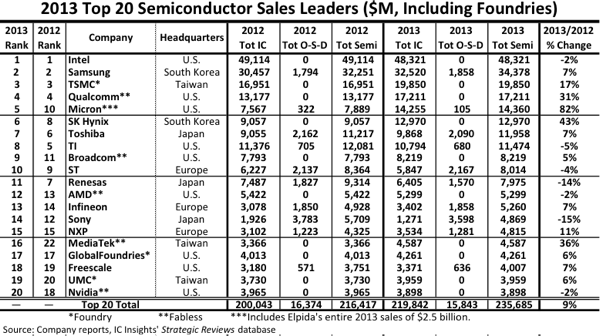
The article below describes growth and ranking of top semiconductor companies in 2013.  


Last year growth was driven by;
  •         acquisitions such as Micron of Elpida, MediaTek merger with MStar,
  •        Mobile chip demand (processors, memory, etc.)
  •        DRAM market demand growth, Hynix was able to grow 43% even with the fire in a manufacturing plant

Qualcomm was ranked 4th, growing 31% in 2013.

NAND market growth is not well document here. For example SanDisk still is not ranked here even though it is a major NAND supplier with revenue of more than $6 Billion in 2013.


Ron
Insightful, timely, and accurate semiconductor consulting.
Semiconductor information and news at - 
http://www.maltiel-consulting.com/


IC Insights Shows Big Changes to 2013 Top 20 Semi Supplier Ranking

SK Hynix, MediaTek, Micron, and Qualcomm each registered ≥30% year-over-year growth.

IC Insights’ April Update to The 2014 McClean Report will show a ranking of the 2013 top 50 semiconductor suppliers. A preview of the top 20 companies is listed in Figure 1.  The top 20 worldwide semiconductor (includes ICs and O-S-Ds—optoelectronics, discretes, and sensors) sales leaders for 2013 included nine suppliers headquartered in the U.S., three in Japan, three in Taiwan, three in Europe, and two in South Korea, a relatively broad representation of geographic regions.

The top 20 ranking also includes three pure-play foundries (TSMC, GlobalFoundries, and UMC) and five fabless companies.  It is interesting to note that the top four semiconductor suppliers all have different business models. Intel is essentially a pure-play IDM, Samsung a vertically integrated IC supplier, TSMC a pure-play foundry, and Qualcomm a fabless company.

IC foundries are included in the top 20 semiconductor supplier ranking because IC Insights has always viewed the ranking as a top supplier list, not as a marketshare ranking, and realizes that in some cases semiconductor sales are double counted.  With many of our clients being vendors to the semiconductor industry (supplying equipment, chemicals, gases, etc.), excluding large IC manufacturers like the foundries would leave significant “holes” in the list of top semiconductor suppliers.  Foundries and fabless companies are clearly identified in Figure 1.  In the April Update to The McClean Report, “marketshare” rankings of IC suppliers by product type are presented and foundries are excluded from these rankings.

It should be noted that not all foundry sales should be excluded when attempting to create marketshare data.  For example, although Samsung had a large amount of foundry sales last year, most of its sales were to Apple.  Apple does not re-sell these devices, so counting these foundry sales as Samsung semiconductor sales does not introduce double counting.

Overall, the list shown in Figure 1 is provided as a guideline to identify which companies are the leading semiconductor suppliers, whether they are IDMs, fabless companies, or foundries.


Figure 1

Excluding the foundries of TSMC, GlobalFoundries, and UMC from the top 20 ranking would bring Fujitsu, Marvell, and Sharp into the 18th, 19th, and 20th positions, respectively (Figure 2).


Figure 2

There were numerous changes within the top 20 semiconductor supplier ranking in 2013 as compared to the top 20 ranking of 2012.  Spurred by its acquisition of Elpida last year, Micron climbed five spots and moved into the top 5 ranking.  Some of the other companies that rose in the 2013 ranking include SK Hynix, which, despite a significant fire and production setback at its largest memory fab in China, took full advantage of the 32% surge in the DRAM market last year and moved up two places into the 6th position.  Also, Broadcom moved into the top 10 while MediaTek jumped up six positions to 16th place and into the top 20 ranking for the first time. 

MediaTek is experiencing extremely strong demand for its devices in the booming low-end smartphone business in China and other Asia-Pacific locations.  In fact, MediaTek’s application processor shipments for smartphones reached over 200 million units last year, about double the 108 million units the company shipped in 2012.  Moreover, with MediaTek and MStar expected to merge in 2014, the annual post-merger sales for MediaTek should be over $6 billion, most likely enough to lift the company into the 12th spot in the 2014 ranking.

Another company expected to make a significant move up in the ranking this year by way of acquisition is Avago. After the company’s purchase of LSI Corp., the combined semiconductor sales of the two companies is likely to be well over $5 billion this year, which could propel Avago from its 27th 2013 ranking to as high as 13th in 2014!

In contrast to the semiconductor companies moving up in the ranking, Fujitsu dropped five places to fall out of the top 20 ranking in 2013, going from being ranked 16th in 2012 to 21st last year (the company sold its analog and MCU business to Spansion in August of 2013).  Renesas was another “casualty” in the top 20 ranking and fell to 11th place last year from the 7th position it held in 2012.

In total, the top 20 semiconductor companies’ sales increased by 9% in 2013 as compared to 2012, which was more than twice the 4% growth rate for total worldwide semiconductor market last year!  It took total semiconductor sales of about $3.9 billion to make the top 20 ranking in 2013.

Figure 3 shows that there was a 97-percentage-point range of growth rates among the worldwide top 20 semiconductor suppliers in 2013 (from +82% for Micron to -15% for Sony).  The continued success of the fabless/foundry business model and the strong growth of the memory market (especially the 32% DRAM market surge) last year is evident when examining the six top 20 semiconductor suppliers that logged double-digit growth. As shown, the top six performers in 2013 included two memory companies (SK Hynix and Micron), two fabless companies (MediaTek and Qualcomm), and TSMC (the largest pure-play foundry).

Figure 3 shows that the two top 20 ranked companies that registered double-digit sales declines in 2013 are headquartered in Japan (Renesas and Sony).  As previously shown, Japan-based Fujitsu also registered a double-digit decline (-16%) in 2013 and dropped out of the top 20 ranking last year.  However, it should be noted that the conversion of Japanese company semiconductor sales from yen to U.S. dollars, at 97.6 yen per dollar in 2013 versus the 79.8 yen per dollar rate in 2012, had a significant impact on the sales figures for the Japanese companies.  Using a constant 2012 U.S. dollar versus Japanese yen exchange rate for 2013, the 2013 semiconductor sales of Renesas, Sony, and Fujitsu, would have increased 5%, 4%, and 3%, respectively.

More details on the 2013 top 50 semiconductor suppliers will be provided in the April Update to The McClean Report.


Figure 3

Monday, March 24, 2014

Apple 64 bits,Mobile DRAM Market, and Masking Lithography


"mass producing what the company said is the most advanced 4Gb DDR3 memory based on a new 20 nanometer process technology using immersion ArF lithography...

key element of the new design and manufacturing technology is a modified double patterning and atomic layer deposition that allows for continued scaling. The new approach to double patterning enables 20nm DDR3 production using current photolithography equipment, Kadivar said. “We have found the most efficient way to manufacture high density DDR3 technology, in this case 4Gb.” Samsung has also created ultrathin dielectric layers of cell capacitors with a very high level of uniformity, which is an important contributor to higher cell performance."

While in the ecosystem of mobile DRAM products sale and marketing -

 “After the 64bit AP was first applied to the iPhone 5S by Apple last year, it was expected to become the basic performance of premium smartphones. However, companies in the Android camp cannot bring themselves to use the 64bit AP. The 64bit AP is not compatible with the Google Android OS yet…

Qualcomm has already unveiled the 64bit Snapdragon, and SEC is known to have almost developed the 64bit AP. If the OS problem is solved, it appears that Android smartphones will not have much difficulty adopting the 64bit AP.

The delayed commercialization of the 64bit mobile AP impacted on the DRAM market. 1~2GB mobile DRAMs are used in 32bit AP smartphones, but 64bit AP smartphones come with 3GB or bigger DRAMs. Memory semiconductor makers established the mobile DRAM production plan for this year in consideration of the demands for the 64bit AP. As demands are not picking up, the Q2 contract prices of mobile DRAMs are expected to go down. (http://english.etnews.com/device/2933349_1304.html)


Ron
Insightful, timely, and accurate semiconductor consulting.
Semiconductor information and news at - http://www.maltiel-consulting.com/


Korea's DRAM Market Suffers as Google Delays Android 64-bit


Apple introduced the first smartphone in the world to run on a 64 bit architecture last September. The iPhone 5S lead the way. Thereafter it was simply expected to become the basic performance of premium smartphones. However, Android OEMs can't match Apple's offering because Android isn't 64bit compatible at the moment even though Qualcomm has a 64bit processor ready to ship. While Samsung is hoping to be the first Android OEM to deliver a 64bit based smartphone this fall, industry Insiders aren't so sure it'll be ready in time. In fact they believe that will be pushed into sometime in 2015.


Those in the DRAM market have suffered a direct blow due to Google's inability to deliver a 64bit version of Android. 

Tuesday, May 7, 2013

Google and Facebook Shaking Server market


See more about server marketplace at Google, Facebook Top Buyers of Intel Server Chips


and at SSD, Flash, iPad, PC, Tablet, and Servers Architecture


Ron
Insightful, timely, and accurate semiconductor consulting.Semiconductor information and news at - www.maltiel-consulting.com


Google and Facebook Are Shaking Up the Server Market

The 'Net giants are shunning traditional suppliers for cheaper, made-to-order hardware.

Hewlett-Packard and Dell, the top two global vendors of server computers, are caught in a whirlwind of change.
The personal-computer market, which generates enormous revenue for both firms, gets most of the attention when the companies' attempts to right their businesses are analyzed. But the humble server, which many assume is the stable part of the computer world, is experiencing far greater change -- change that, in coming years, could pay off in a big way for the duo, or cause them tremendous pain.
Hewlett-Packard (ticker: HPQ) made up 26.5% of worldwide server sales volume in the December quarter; Dell (DELL), 21.3%. Servers handle a myriad of tasks in corporate- and Internet-data centers, from serving up files to desktop computers in offices to processing online purchases to streaming video to tablet computers. Last year, the server market was worth roughly $52.5 billion on shipments of 9.7 million units, according to research firm Gartner.
That's relatively minuscule, compared with 2012 PC shipments of 352 million units. But the corporate market is a bastion of profits that offsets the low margins on PCs.
In the fiscal fourth quarter ended in January, for example, Hewlett-Packard's enterprise group, although not a perfect proxy since it sells networking and storage equipment in addition to servers, accounted for almost 16% of HP's total profit. PCs produced only 3% of the company's earnings, even though they generated greater revenue.
And unlike the personal-computer market, which is fighting tablets and smartphones for attention, servers are constantly finding new uses, and they're not going away anytime soon. "Servers have always been a gluttonous market," says Gartner analyst Jeff Hewitt, meaning the industry just can't get enough of them. Richard Fichera, who follows the industry for Forrester Research, even argues that building server farms is "the élan vital [vital impulse] of modern society."
Fichera and Hewitt agree that a couple of massive changes are under way.
One is that large Internet stars such as Google (GOOG), Facebook (FB) and Amazon.com (AMZN) are building their own servers by picking out parts and having machines assembled to spec by some outfit other than Dell or HP, often one of the Asia-based "original design manufacturers," such as Inventec, Quanta or Wistron. Google and Amazon "have incredibly low-cost infrastructures" as a result of using this commodity hardware, says Fichera.
Public and private organizations, such as schools, government and smaller companies, don't have the resources of a Google, but they're eagerto get the kinds of savings that can come from buying cheap, no-name hardware.
The category of "other," meaning not HP and Dell, made up 35% of server unit shipments in the fourth quarter, up from 31% a year earlier. Hewitt expects the figure to rise this year.
"The substitution of commodity servers for name brands is a real thing," observes Fichera. He cites a "large Wall Street firm" that has more than 75,000 servers, of which 20% are nonbranded. Hewitt says that Google and other nonbrand buyers have "been one of the primary drivers of unit growth" in the server market for some time.
The other trend is toward simple, modular servers -- basically, appliances -- that perform one dedicated task. As Hewitt sees it, the software vendor VMware (VMW) brought about a revolution in servers by allowing companies to use a single machine for several tasks simultaneously. The inadvertent outcome of VMware's software is that some of the server "workloads" -- video serving, database queries -- are now as big as the entire database market in terms of the number of "virtual servers" they employ. That makes it feasible to create specialized, stripped-down servers built for each kind of workload.
And he observes, "Where it gets interesting over the next three to four years is that these low-power processors in our cellphones are all that's needed for certain kinds of server workloads that don't demand a lot of individual CPU horsepower."
Both trends are being helped by the breakdown of the old WinTel regime in computing. Says Hewitt: "For years, if you did what Microsoft (MSFT) and Intel (INTC) told you to do in terms of product design, you could make money." Now, "You can still listen to Intel, but there are other influences weighing on server design."
HP and Dell realize all this, of course. They hope that some outfits that aren't Google will look to them to wrap their brand and support around the cheaper hardware -- to mainstream it. HP and Dell can certainly build server appliances.
But for the moment, both trends favor the no-name vendors of Asia, along with the Silicon Valley appliance start-ups. "There is market pressure on Dell and HP from both sides," says Hewitt. The outcome, he adds, "will depend, in part, on how they respond and whether they want to end up squeezed into a higher-margin but increasingly lower-volume segment of the market."
THE STAR OF BLACKBERRY'S fiscal fourth-quarter earnings report on Thursday was undoubtedly the phone maker's chief, Thorsten Heins, who resonated calm, confidence, and intelligence as he batted away the frantic questions of the business news anchors. This is a man who will go places.
And what of the business? What we know is that BlackBerry's subscriber base is declining; it fell by three million last quarter. Shipments of the new BlackBerry models are off to a good, but not great, start, with one million shipped in the quarter. And the company produced a surprise profit in the three-month period.
The stock (BBRY), which is up almost 22% this year, trades at just 1.2 times tangible book value, and the company has a still significant cash pile of $2.9 billion. All that probably puts a floor under its shares, around their Thursday close of $14.44. What we don't know is whether sales of the new handsets will speed up or slow down, and by how much. The mobile market is fiercely competitive, with Apple (AAPL) and Samsung Electronics (005930.Korea) dominating sales. We don't know how quickly -- or whether -- subscribers will keep sliding. But the drop last quarter -- the quarter in which BlackBerry introduced new phones -- isn't encouraging.
Probably, earnings estimates will rise in coming weeks as the next new model, the Q10, comes to market. This is a stock that still trades based on the premise that BlackBerry the company can be a profitable third- or fourth-place player in the smartphone market. For now, based on those hopes, the stock will continue to levitate. 

Thursday, September 13, 2012

Google, Facebook Top Buyers of Intel Server Chips

The link below discuss the top 8 buyers of server chips from Intel. It is interesting to notice the rise of Google and Facebook in the list.


These chips are about 20% of Intel's revenues (Intel: Tremendous Growth of Clouds' Servers ).


Ron
http://www.maltiel-consulting.com/


Intel Confirms Decline of Server Giants HP, Dell, and IBM
http://www.wired.com/wiredenterprise/2012/09/29853/

In 2008, says Intel bigwig Diane Bryant, three familiar names bought far more server chips than any other company on earth. That year, she remembers, HP, Dell, and IBM accounted for 75 percent of the revenue Intel raked in from the sale of processors destined for the beefy computer servers that drive the internet and so much of the software used inside the world’s businesses
Intel sells a vast majority of the world’s server chips, so this was a sure sign that a vast majority of the world’s businesses were buying their servers from HP, Dell, and IBM.
But just four years later, Bryant says, the landscape has completely changed. Today, she explains, eight server makers account for 75 percent of Intel’s server chip revenues, and at least one of those eight doesn’t even sell servers. It only makes servers for itself. “Google is something like number five on that list,” Bryant told us on Monday evening, during a dinner with reporters in downtown San Francisco.


That’s right, Google is likely the world’s fifth largest server maker.
Over a decade ago, Google started designing its own machines for the massive data centers that underpin its web empire, looking to save both power and cost as the empire expanded to epic proportions, and this was only the beginning of a movement away from traditional server sellers such as HP, Dell, and IBM. As Bryant points out, other companies are now buying machines directly from “original design manufacturers,” or ODMs, in Asia, working to cut costs in much the same way. This includes Facebook, and according to a former employee of one large ODM, it includes Amazon as well.
In short, some of the biggest server buyers are cutting out the big-name middlemen. Those ODMs are some of the same companies that manufacture machines on behalf of the HPs and the Dells.
Bryant did not list all eight of Intel’s biggest customers. But she did name Quanta and SuperMicro as ODMs who are “growing up into OEMs” — i.e., original equipment manufacturers that sell directly to server buyers — and she mentioned Wiwynn, the new U.S. subsidiary of ODM Wistron. The whole idea behind Wiwynn is to sell directly to server buyers here in the States.
She also said that new server makers in China, including Huawei, are now having a big effect on the worldwide market.

The Big Switch

In 2008, Diane Bryant left Intel’s server group to take over as the company’s CIO, but in January of this year, she returned to lead the group as vice president and general manager. When she arrived, she didn’t recognize the place.
For one, the name had changed. The server group had morphed into the datacenter and connected systems group, encompassing not only server chips but also storage and networking hardware. But the bigger change was that HP, Dell, and IBM were no longer the dominant forces of years gone by.
Dell and IBM did not immediately respond when asked about Bryant’s view of today’s server market. But an HP spokesperson said her comments were inconsistent with the latest server market stats from research outfit IDC, which still put the combined market share of HP, Dell, and IBM at 73.9 percent, down slightly from 78.2 percent in 2008.

‘Google is something like number five on that list.’
— Diane BryantIt should be noted, however, that research operations such as IDC and Gartner don’t have the best view into direct sales by the ODMs — let alone Google’s highly secretive hardware operation — and these hidden parts of the market are increasingly important. It’s the big web players that are moving away from the HPs and the Dells, and most of these same companies offer large “cloud” services that let other businesses run their operations without purchasing servers in the first place.
To be sure, as the market shifts, HP, Dell, and IBM are working to reinvent themselves. Dell, for instance, launched a new business unit dedicated to building custom gear for the big web players — Dell Data Center Services — and all these outfits are now offering their own cloud services. But the tide is against them.
Google now calls itself one of the world’s largest hardware makers, and Bryant’s comments show just how big it has become. Asked about its relationship with Intel, a Google spokesperson merely said: “We work with a variety of vendors to manufacture the equipment we use in our data centers.” But it has long been an open secret that Google buys directly from Intel — and that it buys so much.
This summer, Urs Hölzle told us that Google designs just about all the servers used in its worldwide network of data centers, and though he declined to discuss where these machines are manufactured, it appears that the company contracts with manufacturers in Asia and elsewhere in the world, providing these builders not only with the server designs but with chips and other hardware purchased from component suppliers such as Intel.


Google Not the Only One

In August, Bryant told us that Google is the only web company that buys chips directly from Intel. But Facebook also designs its own servers, and a source familiar with Facebook’s operation tells us that the company purchases directly from Intel too.
However, the source said, Facebook uses a “just-in-time” purchase model, meaning it does not actually acquire and store the chips itself. Intel sends Facebook’s chips directly to manufacturers such as Quanta and Wistron when they’re needed for manufacturing, the source said.
This means that Facebook avoids getting stuck with a warehouse full of old chips it doesn’t want. It simply buys chips as it needs them.
In any event, Facebook is also a big part of the move away from the HPs and the Dells. It has even “open sourced” its server designs, hoping that others will buy similar gear through the ODMs and drive down prices even further.
The social networking giants shows that the lines between the web players and the ODMs are often blurred. Facebook designs its servers in tandem with the ODMs and other hardware makers, and though it negotiates directly with Intel for chips, the ODMs do all the manufacturing. Which one is the server maker?
Though Bryant did not rank the rest of Intel’s largest server chip customers, we’re guessing that Quanta now sits quite high on the list. According to an ex-Google engineer, Quanta has worked with Google in the past on its custom-built networking gear. Facebook is quite open about its relationship with Quanta. And Quanta itself says it has been selling servers, storage gear, and networking switches to multiple web outfits, which jibes with what an ex-Quanta man has told us.

Typically, the big web companies say very little about who they’re buying gear from. Companies such as Google and Amazon see their hardware operations as a competitive advantage best kept hidden from rivals. But Diane Bryant provides another look behind the scenes. And one thing is for sure: HP, Dell, and IBM aren’t the powers they used to be.

Wednesday, August 29, 2012

IBM Ecosystem: $1 billion Drives 40% Profit

"The new I.B.M. mainframe, according to the company, represents $1 billion in research and development spending over three years...sale of mainframe computers accounts for only about 4 percent of I.B.M.’s revenue these days. Yet the mainframe is a vital asset to I.B.M. because of all the business that flows from it. When all the mainframe-related software, services and storage are included, mainframe technology delivers about 25 percent of I.B.M.’s revenue and more than 40 percent of its profits"


This type of leverage is the key behind Apple and Google / Samsung success. It will be hard for their competitors to fight ( Apple vs. Samsung: Not Really an Apple Win ).

Ron Maltiel
www.maltiel.com


I.B.M. Mainframe Evolves to Serve the Digital World
http://www.nytimes.com/2012/08/28/technology/ibm-mainframe-evolves-to-serve-the-digital-world.html?_r=1
By STEVE LOHR August 28, 2012


I.B.M. is introducing on Tuesday a new line of mainframe computers, adding yet another chapter to a remarkable story of technological longevity and business strategy.

The new model, the zEnterprise EC12, has strengthened the traditional mainframe’s skill of reliably and securely handling vast volumes of transactions. That is why the mainframe is still the digital workhorse for banking and telecommunications networks — and why mainframes are selling briskly in the emerging economies of Asia and Africa.
The new models have added capabilities for computing chores that are growing rapidly, like analyzing torrents of data from the Web and corporate databases to predict consumer behavior and business risks. Name a trend in corporate computing — cloud computing, data center consolidation, flash-memory storage, so-called green computing — and I.B.M. executives point to tailored features in its mainframe that deliver the goods.
The death of the mainframe has been predicted many times over the years. But it has prevailed because it has been overhauled time and again. In the early 1990s, the personal computer revolution took off and I.B.M., wedded to its big-iron computers, was in deep trouble. To make the mainframe more competitive, its insides were retooled, using low-cost microprocessors as the computing engine.
Like any threatened species that survives, the mainframe evolved. It has been tweaked to master new programming languages, like Java, and new software operating systems, like Linux.
“The mainframe is the most flexible technology platform in computing,” said Rodney C. Adkins, I.B.M.’s senior vice president for systems and technology.
That flexibility is a byproduct of investment. The new I.B.M. mainframe, according to the company, represents $1 billion in research and development spending over three years.
I.B.M. has also invested beyond its corporate walls. Nearly a decade ago, fearing that its mainframe business would wither if retiring mainframe engineers were not replaced, I.B.M. went out to universities, advocating for mainframe courses and offering support. Today, more than 1,000 schools in 67 countries participate in I.B.M.’s academic initiative for mainframe education.
The sale of mainframe computers accounts for only about 4 percent of I.B.M.’s revenue these days. Yet the mainframe is a vital asset to I.B.M. because of all the business that flows from it. When all the mainframe-related software, services and storage are included, mainframe technology delivers about 25 percent of I.B.M.’s revenue and more than 40 percent of its profits, estimates A. M. Sacconaghi, an analyst at Sanford C. Bernstein.
The I.B.M. mainframe story offers a glimpse of why manufacturing can be crucial to an American company — and to the economy as a whole — even though high-end manufacturing does not employ large numbers of factory workers.

Over the last 15 years, I.B.M. has aggressively globalized its operations and work force, and pulled out of manufacturing businesses including personal computers and disk drives.
But I.B.M. held on to its core mainframe business, whose development is supported by thousands of engineers and scientists. Mainframe parts are produced in I.B.M. facilities in the United States, in Endicott, N.Y., and Fishkill, N.Y., and in Germany and elsewhere. The final assembly work is done in Poughkeepsie, N.Y., where I.B.M. opened a $30 million mainframe plant in 2010.
A mainframe costs more than $1 million, and higher-performance models with peripheral equipment often cost $10 million or more. Yet even young companies and emerging nations, analysts say, find the expense worth it for some tasks.
Comepay, for instance, is a fast-growing company that says it operates more than 10,000 self-service payment kiosks in Russia, where consumers pay for products and services ranging from Internet service and cellphones to electric bills. Comepay handles millions of transactions a day, and the volume is rising. The Russian company bought an I.B.M. mainframe in 2010.

“Mainframes are extremely reliable,” said Ruslan Stepanenko, chief information officer of Comepay. “It keeps working even when the transaction load is very high.”

Last year, the Senegal Ministry of Finance bought two I.B.M. mainframes to help monitor all the imports, exports and customs duties at the African country’s 30 border checkpoints.
Performance, security and reliability were the main reasons for selecting the mainframe, said Momar Fall, a manager and mainframe technical specialist in CFAO Technologies, an I.B.M. partner in Senegal. But another advantage in a developing nation, he said, is that the mainframes are constantly communicating over the Internet with a remote I.B.M. support center.

“So seven days a week, 24 hours a day, I.B.M. is looking after them,” Mr. Fall said.

Longtime mainframe customers say the technology has done a good job keeping up with the times. Last year, Primerica, a financial services company, purchased its 19th mainframe in 30 years.
David Wade, chief information officer, has worked for Primerica, based in Duluth, Ga., since its first mainframe arrived. With more than four million life insurance customers and more than two million investment-account clients, he said the company needs the reliable processing technology of the mainframe. “It works like nothing else,” Mr. Wade said.

Tuesday, August 28, 2012

Apple Seeks Injunction Against Old Samsung Phones

An indication that the Apple win in its trial against Samsung would not have a strong impact is the fact that the eight phones that Apple ask for injunction from the judge are older phones. Those phones are not being sold in the USA.

Additional issues with the jury decisions are in Apple vs. Samsung: Not Really an Apple Win .

A video of  Apple Jury foreman perspective -  Here's How We Reached a Verdict

A list of the phones that Apple sought injunction against are in the article below. Another good summary of the likely future impact is at Apple's $1 Billion Win Over Samsung: Q&A

Ron Maltiel
http://www.maltiel.com/


Apple seeks injunction against sale of some Samsung smartphones
By Anne B. McDonaldMonday, August 27, 2012 2:44 PM
http://www.techhive.com/article/2000360/apple-seeks-injunction-against-sale-of-some-samsung-smartphones.html


Apple today filed a notice with the U.S. District Court of Northern California, seeking an injunction against the sale of eight specific Samsung products in the United States, all smartphones. The move comes on the heels of Apple's decisive win last week in the so-called "patent trial of the century."

Here's a list of the phones Apple singled out in its filing with the court Monday:
Galaxy S 4G
Galaxy S2 (AT&T)
Galaxy S2 (Skyrocket)
Galaxy S2 (T-Mobile)
Galaxy S2 Epic 4G
Galaxy S Showcase
Droid Charge
Galaxy Prevail

A quick check by TechHive shows that none of the phones listed—mostly older models—currently are available on any of the major U.S. mobile carriers.

The list of Samsung phones and which patents they allegedly infringe. A Silicon Valley jury ruled late last week that a series of ubiquitous smartphone and tablet features—such as the rounded rectangular form and how screens slide and bounce when touched—are proprietary Apple innovations.

The nine-person jury, which deliberated for less than three days, found the South Korean company had copied iPhone and iPad features and awarded Apple more than $1 billion in damages. Experts said the verdict could lead to a ban on sales of popular Samsung products—which process Apple appears to be starting with this filing-- and further cements Apple's dominance in the mobile device market.

[Related: Apple's $1 Billion Win Over Samsung: Q&A]

How this affects the consumer

If the court grants the injunction, which is still to be determined, it doesn't appear that it will affect Samsung very much. Most of the phones that Apple seeks to ban are no longer being sold by any of the major carriers. The Samsung Droid Charge, for instance, is nearly a year and a half old. A ban would, however, hurt anyone who currently owns one of these devices. For owners of any of these phones, it may be harder to get the phone fixed or replaced. Additionally, the carrier support for these phones (in terms of updates and bug fixes) may become even more limited.

Undecided

After a three-day period of deliberations, the jury in the landmark patent suit found that Samsung had infringed on Apple's patents in a number of cases, awarding Apple $1 billion in damages. Samsung has vowed to appeal, if Judge Lucy Koh doesn't throw out the verdict, according to CNN.
Legal experts at the well-known Groklaw blog have pointed out several inconsistencies in the jury's verdict that could put Apple's big win in doubt—including the fact that some of the evidence was apparently ignored by the panel, and subsequent interviews with jurors that suggest the judge's instructions on damages were not followed.

According to the Guardian, Judge Koh will make a final decision on the case within a few weeks.

Jon Gold of Network World contributed to this report.

Monday, August 27, 2012

Apple vs. Samsung: Not Really an Apple Win

While on the surface it looks that Apple won this round in court against Samsung. Apple did not really win.


1. The case is likely to go to appeal.
Comments from juror "because we had hard time believing there was no prior art, that there wasn't something out there before Apple. "In fact we skipped that one," Ilagan continued, "so we could go on faster. It was bogging us down."
"How can you determine whether the patents are invalid if you skip determining whether there was prior art? Determining if there was prior art is requisite to determining validity. The jury verdict is null and void."
(patnews@ns1.patenting-art.com)

2. Jury decisions regarding the design patents that Apple won were already designed around by Samsung, Google and the rest of android ecosystem. It will just temporally slow down android phone ecosytem.

3. Samsung did not lose in the tablet market, which is very important. This market is younger and tablet makers are trying to start a strong growth to counter iPad success.

4. A some what different prospective is in the article below has some good point about the momentum of  market acceptance of Apple and Samsung products.

Ron
www.maltiel.com


Microsoft and Nokia Win, Google Loses in the Samsung Apple Patent Case?
http://www.forbes.com/sites/timworstall/2012/08/26/links-26-aug-microsoft-and-nokia-win-google-loses-in-the-samsung-apple-patent-case/
Tim Worstall, Contributor , 8/26/2012

Move up Move down Apple is About to Reduce Google's Revenues Tim Worstall Contributor Google Makes More From iPhones Than it Does From Android Tim Worstall Contributor Windows Phone Could be Cheaper Than Google's Android Tim Worstall Contributor Google Blasts Past Apple: Android Now 50% of Market Tim Worstall Contributor


The verdict in the Apple Samsung patent case came a little too late on Friday, West Coast time, for the think piece people to really comb through who was likely to benefit from the verdict. Plenty of very good reporting of what had happened but that’s not really the purpose of the press these days. What has happened is one thing: what it means is where the value is added. Now that we’re 36 hours on from the verdict we’re seeing the ruminations on who has really won and lost.
A general feeling is that it might be Microsoft that has really won with the results of this case. Our own Ewan Spence makes the case:
“Apple walks away with a ruling that Samsung copied the iPhone. Samsung will appeal and look to have the decision mitigated as much as possible. And over in the corner, Microsoft and Nokia look at each other, nod their heads, and smile. This was a good court verdict for Windows Phone.
Half of Apple’s win was about hardware design, something that can be changed over time (indeed, largely is already on newer models). Half was on software features and that’s really Google‘s Android. So, the idea is that manufacturers will look more kindly on Microsoft’s Windows Phone as it is entirely clear of such problems. If that’s true then it will be Google which is the ultimate loser:
“The biggest loser in the case might not be Samsung, but Google, the company some analysts say Apple was targeting all along, as the New York Times points out. And Microsoft could end up being a collateral winner from all this. Bill Cox, senior marketing director for the Windows Phone, quipped on Twitter: “Windows Phone is looking gooooood right now.”
Google doesn’t actually charge for Android, but it is still part of its strategy to make money from mobile:
“Samsung’s Galaxy line of phones run on Android, and ISI Group analysts viewed the verdict as a blow to Android as much as Samsung.

If Android lose any ground in the mobile computing market, that would hurt Google, too. That’s because Google relies on Android to drive mobile traffic to its search engine and services to sell more advertising.
Google also charges for certain Google services to be incorporated but as we’ve noted before, Google’s revenue from iOS currently outstrips that from Android for these.

Yet Microsoft does face a problem:
“Some analysts are skeptical that Microsoft can produce a device that the mobile consumer will love.

“Microsoft has been the beneficiary of this whole fight as the other non-Android option,” said Ron Laurie, a Silicon Valley-based specialist in IP and investment banking and co-founder of Inflexion Point Strategy. “But safety (from lawsuits) by itself is not enough. You have to appeal to consumers.”

And so far the market has seen that consumers want phones and tablets that look like Apple’s devices, he added.
If it really is true that people like Android because the look and feel is like Apple’s iOS then producing something like Windows which has an entirely different look and feel might not do the trick.
And maybe Android has already been changed enough to make it safe from attack by Apple?

“Meanwhile, Pure Android, in its Jelly Bean iteration now significantly different in look and feel from TouchWiz, has so far escaped Apple’s iOS comparison wrath. That might make an untampered Android OS more appealing to manufacturers (and make Google more likely to speak out in their defense should Cupertino come calling).
That is, it was Samsung’s specific tweaks to Android to make it more like iOS which infringed Apple’s patents, rather than Android itself?
Of course, it’s always open to people to try and license Apple’s patents. But why should Apple do so?
“And we shouldn’t take for granted that Apple *wants* to license its design patents. It isn’t like they need the money; they are already sitting on $1B in cash. Right now its priority is to grow its platform, not its revenues. And there are no FRAND (Fair, Reasonable, and Non-Discriminatory) requirements for design patents.
Given that Nokia is just about ready to go with models running the new Microsoft Windows, perhaps they’ll be the big marketplace winners?
“When Nokia decided to go with Microsoft instead of Android, many considered the move foolish. With Android now dealt a major legal blow by Apple, the move looks like genius. The company does not have to worry about Apple coming after it with as many patent claims and can clearly show that its products are radically different. With uncertainty over the evolution (or even support) of Samsung products in the marketplace (while the case will surely go to appeal, further wins for Apple could force Samsung to pull its products from the American market), carriers will pay more attention to products that are not running on the Android platform and the biggest player in that market is now Nokia.
Yet it’s entirely possible that not a great deal will actually change. Recall, again, what Apple actually won on. Three patents relating to hardware design and these are not, at least as far as anyone has proven in court as yet, being violated by the new Samsung models. The other three were software patents. And those, well, it’s not all that certain that these are an insuperable barrier. As above, the latest build of Android may or may not violate them. Further, it’s not all that difficult:
“Others said the effect will be limited.
UCLA law professor Douglas Lichtman said the fixes could be as simple as offering software upgrades. For example, one of the decisions in the case was that Samsung infringed Apple’s patent concerning screen icons.
“Icons sitting in perfect rounded squares, for instance, will be replaced by icons sitting in smooth circles,” Lichtman said, “or icons sitting directly on a uniform black background. No big deal.”

It’s all too early to tell of course. And prediction is very difficult, especially about the future. But opinions seem to range from Samsung having to cough up for past misdemeanors and tweaking the hardware design (something they’ve, arguably, already done on newer models) and similarly tweaking the version of Android they use to Android itself being entirely crippled and Microsoft’s Windows being about to take the mobile world by storm. On that last I’m not entirely sure that Nokia will be the big winner though: Samsung itself has a range of phones running Windows……

Monday, August 13, 2012

Intel: Tremendous Growth of Clouds' Servers

In an interview with Bloomberg (interview) Diane Bryant, Intel VP states; "Cloud growth is tied to people accessing the Internet.

For every 600 smart phones, every 120 tablets there is a server behind it.

Intel architecture runs 90% share of all the servers in the world.  There is an accelerating demand for big cloud data servers, not just for Google and Facebook data servers, but even from companies in emerging markets in China such as Baidu, Tencent...."


Intel benefited from the server growths already in 2011. Its sales grew 24% in 2011.


See earlier April posts

Top 25 2011 Semiconductor Sales Ranking
"IC Insights' report of the top 25 semiconductor companies (see below) states that Intel grew 24% in 2011 due to the purchase of Infineon's wireless segment. It is likely that the growth of databases and cloud servers (20% of sales, 3x PC segment growth) also added to Intel's growth"  

Also in an Intel, AMD, or ARM Servers?
"The article...about low-power servers doesn't mention Intel's large growth in database servers. Intel had more than $10 billion in revenues from ICs sold into data centers, including servers, storage products, and networking"  

Wednesday, August 1, 2012

Apple vs.Samsung Case: Can Design Patents Win

"The potential for huge damages awards is one reason for the new focus. Design patents have a unique remedy: Whereas infringement of a utility patent allows a patentee to recoup only those profits associated with the patented feature—not the entire profit from the sale of the infringed product—infringement of a design patent allows the patentee to recoup the total profit without apportionment.


The provision has largely been a sleeper for 125 years"

Ron


Apple-Samsung Case Shows How Far U.S. Design Patents Have Come

http://www.law.com/jsp/cc/PubArticleCC.jsp?id=1202565565740&AppleSamsung_Case_Shows_How_Far_US_Design_Patents_Have_Come
Lisa Shuchman
Corporate Counsel  August 01, 2012


The high-stakes battle between Apple Inc. and Samsung Electronics Ltd. that began this week in federal court highlights a significant change that has taken place in the world of intellectual property law since the 1980s and 1990s: the steep rise in importance of the design patent.


Back in 1988, Apple sued Microsoft Corporation, alleging the company had infringed its copyright on the “look and feel” of the Apple Macintosh’s graphical user interface. That suit, which Apple ultimately lost, was a copyright case in which Apple had to show to the court that Microsoft had actually copied the design and appearance of Apple’s computer. In 1994, the U.S. Court of Appeals for the Ninth Circuit ruled that under copyright law, “Apple cannot get patent-like protection for the idea of a graphical user interface.”


Fast forward to Apple’s current lawsuit against Samsung and the focus is once again on design. But this time, Apple is alleging patent infringement—not copyright. And while some of the case deals with utility patents—those that focus on how something works—much of it revolves around design patents, which center on how something looks. In fact, Judge Lucy Koh, who is presiding in the case, noted in an earlier ruling: “It is the design patents that are at the core of this preliminary injunction motion.”


“With this case, design rights have taken center stage in the world of patent law,” said Christopher Carani, a partner at McAndrews, Held & Malloy.


In the 80s and early 90s, patents weren’t as much of a focus in technology as they are today, according to Ron Epstein, chief executive officer of Epicenter IP Group. “But patents today play a more important role in protecting innovation,” he said.


Design patents in particular are playing a more important role. In 1994, for example, 11,000 design patents were issued in the United States, according to the U.S. Patent and Trademark Office’s database. In 2011, the USPTO issued almost double that number: 21,356.


Big technology companies such as Apple and Samsung have caught on to the importance of design patents. In 2001, for example, Apple was issued 10 design patents and Samsung was issued eight. In 2011, Apple was issue 123 and Samsung was issued 333. And in 2012, projections show that Apple is on track to be issued about 160 design patents, and Samsung (which makes many more products than Apple), about 500.


“Until recently, utility patents received most of the attention,” Carani said. “This case is causing corporations to take a second, hard look at design patent rights—not only to secure them for themselves but also to make sure they are not infringing design patent rights of others.”


The potential for huge damages awards is one reason for the new focus. Design patents have a unique remedy: Whereas infringement of a utility patent allows a patentee to recoup only those profits associated with the patented feature—not the entire profit from the sale of the infringed product—infringement of a design patent allows the patentee to recoup the total profit without apportionment.


“The provision has largely been a sleeper for 125 years,” said Carani, noting that this “no apportionment” language was inserted into the Patent Act in 1887 in response to an 1886 U.S. Supreme Court case regarding infringement of a design patent on a carpet design. “Now it has surfaced in a big way—to the tune of $2 billion.”


Indeed, $2 billion of the $2.5 billion damages award Apple is seeking come from its design patents; the other $500 million is attributable to Apple’s utility patents. “If Apple prevails, it could yield the largest U.S. patent infringement award of all time,” Carani said. The largest amount awarded to date for patent infringement is $1.67 billion, in a 2011 Eastern District of Texas case in which Abbott Laboratories Inc. was found to have infringed patents owned by Centocor Ortho Biotech Inc. (The verdict was later reversed on appeal.)


Samsung can do little about appealing such a large damage award if it loses the case, Carani said, because the design patent damages provision is codified in the statute. If Apple wins, however, Samsung, could benefit in another way. “If Apple prevails, Samsung may be in a position to assert its own huge design patents portfolio,” Carani said.


Until this case, design patents and their potential power rarely had a chance to rise to such prominence, notes Carani. But if Apple wins, he predicts more attention will be paid. “Companies will recognize that design patent rights can have teeth,” he said.