Showing posts with label ranking. Show all posts

Tuesday, January 12, 2016

Semiconductor Revenue Growth, Ranking

Worldwide semiconductor revenue declined 1.9% in 2015 (see article below) while fab capacity increased 6% .  Samsung and Hynix benefited from the iPhone 6s demand. 


The ranking will change in 2016 due to recent trouble of Toshiba and Western Digital buying SanDisk . As in past ranking SanDisk revenue is not included, which make this table inaccurate (see April 2012 blog Top 25 2011 Semiconductor Sales Ranking )


Ron
Insightful, timely, and accurate semiconductor consulting.
Semiconductor information and news at - http://www.maltiel-consulting.com/


Gartner Says Worldwide Semiconductor Revenue Declined 1.9 Percent in 2015

Mixed Results in All Segments Drove Slow Growth
Worldwide semiconductor revenue totaled $333.7 billion in 2015, a 1.9 percent decrease from 2014 revenue of $340.3 billion, according to preliminary results by Gartner, Inc. The top 25 semiconductor vendors' combined revenue increased 0.2 percent, which was more than the overall industry's growth. The top 25 vendors accounted for 73.2 percent of total market revenue, up from 71.7 percent in 2014.
"Weakened demand for key electronic equipment, the continuing impact of the strong dollar in some regions and elevated inventory are to blame for the decline in the market in 2015," said Sergis Mushell, research director at Gartner. "In contrast to 2014, which saw revenue growth in all key device categories, 2015 saw mixed performance with optoelectronics, nonoptical sensors, analog and ASIC all reporting revenue growth while the rest of the market saw declines. Strongest growth was from the ASIC segment with growth of 2.4 percent due to demand from Apple, followed by analog and nonoptical sensors with 1.9 percent and 1.6 percent growth, respectively. Memory, the most volatile segment of the semiconductor industry, saw revenue decline by 0.6 percent, with DRAM experiencing negative growth and NAND flash experiencing growth."
Intel recorded a 1.2 percent revenue decline, due to falls in PC shipments (see Table 1). However, it retained the No. 1 market share position for the 24th year in a row with 15.5 percent market share. Samsung's memory business helped drive growth of 11.8 percent in 2015, and the company maintained the No. 2 spot with 11.6 percent market share.
Rank 2014
Rank 2015
Vendor
2014 Revenue
2015 Estimated Revenue
2014-2015 Growth (%)
2015 Market Share (%)
1
1
Intel
52,331
51,709
-1.2
15.5
2
2
Samsung Electronics
34,742
38,855
11.8
11.6
5
3
SK Hynix
15,997
16,494
3.1
4.9
3
4
Qualcomm
19,291
15,936
-17.4
4.8
4
5
Micron Technology
16,278
14,448
-11.2
4.3
6
6
Texas Instruments
11,538
11,533
0.0
3.5
7
7
Toshiba
10,665
9,622
-9.8
2.9
8
8
Broadcom
8,428
8,419
-0.1
2.5
9
9
STMicroelectronics
7,376
6,890
-6.6
2.1
12
10
Infineon Technologies
5,693
6,630
16.5
2.0


Others
157,992
153,182
-3.0
41.2


Total
340,331
333,718
-1.9
100
"The rise of the U.S. dollar against a number of different currencies significantly impacted the total semiconductor market in 2015," said Mr. Mushell. "End equipment demand was weakened in regions where the local currency depreciated against the dollar. For example in the eurozone, the sales prices of mobile phones or PCs increased in local currency, as many of the components are priced in U.S. dollars. This resulted in buyers either delaying purchases or buying cheaper substitute products, resulting in lower semiconductor sales. Additionally, Gartner's semiconductor revenue statistics are based on U.S. dollars; thus, sharp depreciation of the Japanese yen shrinks the revenue and the market share of the Japanese semiconductor vendors when measured in U.S. dollars."
The NAND market continued to deteriorate throughout the year. As a result, revenue grew only 4.1 percent in 2015, fueled by elevated supply bit growth that resulted in an aggressive pricing environment. The tumultuous NAND pricing environment rippled through most of the NAND solutions, particularly solid-state drives (SSDs), which continue to encroach on hard-disk drives (HDDs). The ensuing price war in SSDs further pressured the profitability of the NAND flash makers amid the biggest technology transition in flash history — 3D NAND. While 3D NAND commercialization was modest, it was limited to only one vendor — Samsung. Modest revenue gains have not stopped investment in NAND flash and 3D technology, with all vendors continuing to spend aggressively in the technology and most with new fabs.
After 32.0 percent revenue growth in 2014, the DRAM market hit a downturn in 2015. An oversupply in the commodity portion of the market caused by weak PC demand led to severe declines in average selling prices (ASPs), and revenue contracted by 2.4 percent compared with 2014. The oversupply and the extent of ASP declines could have been significantly worse if Micron Technologies' bit growth had performed in line with its South Korean rivals. Fortunately for the market, the company saw negative bit growth due to its transition to 20 nm, sparing the industry from an even more severe downturn.
Additional information is provided in the Gartner report "Market Share Analysis: Semiconductors, Worldwide, Preliminary 2015 Estimates."

Wednesday, August 6, 2014

Top Semiconductor (1st Qtr 2014) Vendors

IC Insights have a new report about the top semiconductor ranking (see below).

"The ranking by IC Insights include three pure-play foundries (TSMC, GlobalFoundries, and UMC) and six fabless companies. It is interesting to note that the top four semiconductor suppliers all have different business models. Intel is essentially a pure-play IDM, Samsung a vertically integrated IC supplier, TSMC a pure-play foundry, and Qualcomm a fabless company, as observed by IC Insights."


As mentioned previously ( Top 25 2011 Semiconductor Sales Ranking) NAND market growth is not well document here. It is important to note that the semiconductor sales and growth rankings do not include SanDisk's $5.66B sales in 2011 and more than $6 Billion in 2013.


Ron
Insightful, timely, and accurate semiconductor consulting.
Semiconductor information and news at - 
http://www.maltiel-consulting.com/


Top 20 semiconductor vendors in 1Q2014


Date: 03/08/2014
The top-20 semiconductor ranking in Q1 2014 is quite a mix of companies with different product focus. The ranking by IC Insights include three pure-play foundries (TSMC, GlobalFoundries, and UMC) and six fabless companies. It is interesting to note that the top four semiconductor suppliers all have different business models. Intel is essentially a pure-play IDM, Samsung a vertically integrated IC supplier, TSMC a pure-play foundry, and Qualcomm a fabless company, as observed by IC Insights.

The further finding shared by IC Insights include:

IC foundries are included in the top 20 ranking because IC Insights has always viewed the ranking as a top supplier list, not as a market share ranking, and realizes that in some cases semiconductor sales are double counted. With many of our clients being vendors to the semiconductor industry (supplying equipment, chemicals, gases, etc.), excluding large IC manufacturers like the foundries would leave significant “holes” in the list of top semiconductor suppliers. Foundries and fabless companies are clearly identified in Figure 1. In the April Update to The McClean Report, market share rankings of IC suppliers by product type were presented and foundries were excluded from these listings.

It should be noted that not all foundry sales should be excluded when attempting to create marketshare data. For example, although Samsung had a large amount of foundry sales in the first quarter, most of its sales were to Apple. Apple does not re-sell these devices, so counting these foundry sales as Samsung semiconductor sales does not introduce double counting.

Overall, the list shown in Figure 1 is provided as a guideline to identify which companies are the leading semiconductor suppliers, whether they are IDMs, fabless companies, or foundries.


top semiconductor 20 2014

Figure 1

Outside of the top five spots, there were numerous changes within the 1Q14 top-20 semiconductor supplier ranking. As shown, MediaTek jumped up four positions in 1Q14 as compared to 1Q13 into 12th place. MediaTek continues to experience extremely strong demand for its devices in the booming low-end smartphone business in China and other Asia-Pacific locations. Moreover, MediaTek and MStar finalized their merger on February 1, 2014. Annual post-merger sales for MediaTek are expected to be well over $6 billion.

After Avago’s purchase of LSI Corp. on May 6, 2014, the combined annual semiconductor sales run-rate of the two companies is likely to be over $5 billion. Also, last year’s Micron/Elpida merger essentially created a new “giant” semiconductor company with Micron’s sales expected to be over $17 billion this year!

It should be noted that the sales of Micron and Elpida (merged on July 1, 2013), MediaTek and MStar, and Avago and LSI use the combined sales of the two companies for both 1Q13 and 1Q14, regardless of when the merger actually occurred. This was done in an attempt to make the company’s 1Q14/1Q13 sales growth rates more directly comparable and give a clearer picture of the merged company’s sizes going forward.

Another potential merger to keep a watch for in the future is Fujitsu and Panasonic. In February of this year, the two Japan-based companies signed a memorandum of understanding to combine the two companies’ system LSI businesses and form a new fabless semiconductor company. IC Insights estimates that the combined 1Q14 semiconductor sales of these two companies was about $1.25 billion (down from $1.44 billion in 1Q13), which would have ranked the “merged” company as the sixteenth largest semiconductor company in the first quarter of this year.

In total, the top 20 semiconductor companies’ sales increased by 9% in 1Q14 as compared to 1Q13, which was two points higher than IC Insights’ current 7% forecast for total worldwide semiconductor market growth this year. As shown, it took total semiconductor sales of just over $1.0 billion to make the 1Q14 top 20 ranking.

Figure 2 shows that there was a 58-percentage-point range of year-over-year growth rates among the 1Q14 worldwide top 20 semiconductor suppliers—from +48% for MediaTek/MStar to -10% for ST (it should be noted that excluding the legacy ST-Ericsson products, ST’s 1Q14/1Q13 sales increased 1%).

top semiconductor 20 2014

Figure 2

The success of the fabless and fab-lite business models and the continued strong growth of the memory market are evident when examining the top 20 semiconductor suppliers that logged double-digit growth in 1Q14. As shown, 10 of the top 11 1Q14 performers were either memory suppliers (SK Hynix, Micron, and Samsung) or fabless/fab-lite companies (MediaTek, AMD, Infineon, Freescale, Avago/LSI, NXP, and Nvidia). 

Friday, April 4, 2014

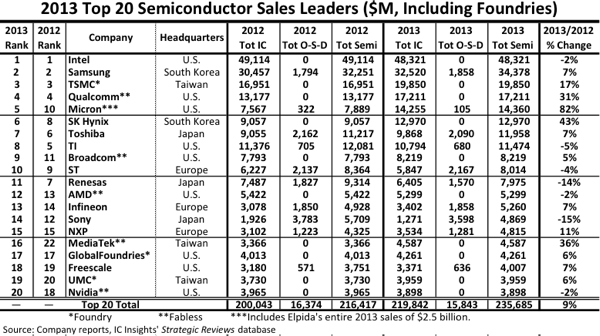
Top Semiconductor Ranking for 2013


The article below describes growth and ranking of top semiconductor companies in 2013.  


Last year growth was driven by;
  •         acquisitions such as Micron of Elpida, MediaTek merger with MStar,
  •        Mobile chip demand (processors, memory, etc.)
  •        DRAM market demand growth, Hynix was able to grow 43% even with the fire in a manufacturing plant

Qualcomm was ranked 4th, growing 31% in 2013.

NAND market growth is not well document here. For example SanDisk still is not ranked here even though it is a major NAND supplier with revenue of more than $6 Billion in 2013.


Ron
Insightful, timely, and accurate semiconductor consulting.
Semiconductor information and news at - 
http://www.maltiel-consulting.com/


IC Insights Shows Big Changes to 2013 Top 20 Semi Supplier Ranking

SK Hynix, MediaTek, Micron, and Qualcomm each registered ≥30% year-over-year growth.

IC Insights’ April Update to The 2014 McClean Report will show a ranking of the 2013 top 50 semiconductor suppliers. A preview of the top 20 companies is listed in Figure 1.  The top 20 worldwide semiconductor (includes ICs and O-S-Ds—optoelectronics, discretes, and sensors) sales leaders for 2013 included nine suppliers headquartered in the U.S., three in Japan, three in Taiwan, three in Europe, and two in South Korea, a relatively broad representation of geographic regions.

The top 20 ranking also includes three pure-play foundries (TSMC, GlobalFoundries, and UMC) and five fabless companies.  It is interesting to note that the top four semiconductor suppliers all have different business models. Intel is essentially a pure-play IDM, Samsung a vertically integrated IC supplier, TSMC a pure-play foundry, and Qualcomm a fabless company.

IC foundries are included in the top 20 semiconductor supplier ranking because IC Insights has always viewed the ranking as a top supplier list, not as a marketshare ranking, and realizes that in some cases semiconductor sales are double counted.  With many of our clients being vendors to the semiconductor industry (supplying equipment, chemicals, gases, etc.), excluding large IC manufacturers like the foundries would leave significant “holes” in the list of top semiconductor suppliers.  Foundries and fabless companies are clearly identified in Figure 1.  In the April Update to The McClean Report, “marketshare” rankings of IC suppliers by product type are presented and foundries are excluded from these rankings.

It should be noted that not all foundry sales should be excluded when attempting to create marketshare data.  For example, although Samsung had a large amount of foundry sales last year, most of its sales were to Apple.  Apple does not re-sell these devices, so counting these foundry sales as Samsung semiconductor sales does not introduce double counting.

Overall, the list shown in Figure 1 is provided as a guideline to identify which companies are the leading semiconductor suppliers, whether they are IDMs, fabless companies, or foundries.


Figure 1

Excluding the foundries of TSMC, GlobalFoundries, and UMC from the top 20 ranking would bring Fujitsu, Marvell, and Sharp into the 18th, 19th, and 20th positions, respectively (Figure 2).


Figure 2

There were numerous changes within the top 20 semiconductor supplier ranking in 2013 as compared to the top 20 ranking of 2012.  Spurred by its acquisition of Elpida last year, Micron climbed five spots and moved into the top 5 ranking.  Some of the other companies that rose in the 2013 ranking include SK Hynix, which, despite a significant fire and production setback at its largest memory fab in China, took full advantage of the 32% surge in the DRAM market last year and moved up two places into the 6th position.  Also, Broadcom moved into the top 10 while MediaTek jumped up six positions to 16th place and into the top 20 ranking for the first time. 

MediaTek is experiencing extremely strong demand for its devices in the booming low-end smartphone business in China and other Asia-Pacific locations.  In fact, MediaTek’s application processor shipments for smartphones reached over 200 million units last year, about double the 108 million units the company shipped in 2012.  Moreover, with MediaTek and MStar expected to merge in 2014, the annual post-merger sales for MediaTek should be over $6 billion, most likely enough to lift the company into the 12th spot in the 2014 ranking.

Another company expected to make a significant move up in the ranking this year by way of acquisition is Avago. After the company’s purchase of LSI Corp., the combined semiconductor sales of the two companies is likely to be well over $5 billion this year, which could propel Avago from its 27th 2013 ranking to as high as 13th in 2014!

In contrast to the semiconductor companies moving up in the ranking, Fujitsu dropped five places to fall out of the top 20 ranking in 2013, going from being ranked 16th in 2012 to 21st last year (the company sold its analog and MCU business to Spansion in August of 2013).  Renesas was another “casualty” in the top 20 ranking and fell to 11th place last year from the 7th position it held in 2012.

In total, the top 20 semiconductor companies’ sales increased by 9% in 2013 as compared to 2012, which was more than twice the 4% growth rate for total worldwide semiconductor market last year!  It took total semiconductor sales of about $3.9 billion to make the top 20 ranking in 2013.

Figure 3 shows that there was a 97-percentage-point range of growth rates among the worldwide top 20 semiconductor suppliers in 2013 (from +82% for Micron to -15% for Sony).  The continued success of the fabless/foundry business model and the strong growth of the memory market (especially the 32% DRAM market surge) last year is evident when examining the six top 20 semiconductor suppliers that logged double-digit growth. As shown, the top six performers in 2013 included two memory companies (SK Hynix and Micron), two fabless companies (MediaTek and Qualcomm), and TSMC (the largest pure-play foundry).

Figure 3 shows that the two top 20 ranked companies that registered double-digit sales declines in 2013 are headquartered in Japan (Renesas and Sony).  As previously shown, Japan-based Fujitsu also registered a double-digit decline (-16%) in 2013 and dropped out of the top 20 ranking last year.  However, it should be noted that the conversion of Japanese company semiconductor sales from yen to U.S. dollars, at 97.6 yen per dollar in 2013 versus the 79.8 yen per dollar rate in 2012, had a significant impact on the sales figures for the Japanese companies.  Using a constant 2012 U.S. dollar versus Japanese yen exchange rate for 2013, the 2013 semiconductor sales of Renesas, Sony, and Fujitsu, would have increased 5%, 4%, and 3%, respectively.

More details on the 2013 top 50 semiconductor suppliers will be provided in the April Update to The McClean Report.


Figure 3

Wednesday, November 14, 2012

Qualcomm, Globalfoundries +30% in Sales in 2012

Fabless chip manufacturer Qualcomm and foundry vendor Globalfoundries are each expected to move up IC Insights Inc.'s list of the top 20 chip vendors as ranked by sales in 2012 (see tables below.)


Both are benefitting from growth of mobile and tablet chip demands. Samsung is likely to lose sales due to Apple shifting production away from them. See more about foundaries ranking in 2011 and 2012.


Ron
www.maltiel-consulting.com


Qualcomm, Globalfoundries gain in chip sales rankings

Dylan McGrath

11/8/2012 2:02 AM EST

Fabless giant, foundry forecast to climb to top 20 rankings ladder by growing sales by 30 percent in 2012. SAN FRANCISCO—Fabless chip giant Qualcomm Inc. and foundry vendor Globalfoundries Inc. are each expected to move up IC Insights Inc.'s list of the top 20 chip vendors as ranked by sales in 2012, according to the market research firm's latest forecast.

Both firms are expected to grow sales by at least 30 percent, according to IC Insights (Scottsdale, Ariz.). Qualcomm (San Diego) is on pace for 2012 revenue of more than $12.8 billion, fourth among all chip firms, up from seventh in 2011, according to the November Update to IC Insight's McClean Report. Meanwhile, Globalfoundries (Milpitas, Calif.) is on pace to move to No. 15 this year from No. 21 last year, with projected sales of $4.56 billion, according to the report.  
Additional information

Thursday, June 21, 2012

Status of China's Fabless Model

The large demand for smartphone chips in China will cause local Chinese design houses to grow faster in the next few years.


Ron


source: IC Insights


Is China's fabless model sustainable?

http://www.eetimes.com/electronics-news/4375636/Is-China-fabless-model-sustainable?pageNumber=1
Junko Yoshida

6/19/2012 9:11 AM EDT


How many U.S. design engineers can name, say, the top 10 Chinese chip vendors destined to become their fierce competitors in three years from now? BEIJING -- Let’s face it. China’s IC industry still lacks its own superstars – equivalent to Intel, Qualcomm or Broadcom in the West – in terms of the scale, reach and quality these brands possess on the global market.

To belabor the point, how many U.S. design engineers can name, say, the top 10 Chinese chip vendors destined to become their fierce competitors in three years from now? The question is tough because Chinese fabless companies, while growing fast, are still small. Many also remain faceless.

In contrast, a Chinese executive based in Beijing, speaking with ee Times, rattled off Spreadtrum, RDA Microelectronics, GalaxyCore and GigaDevice as his “top four” picks among local fabless companies likely to become key players in the smartphone IC ecosystem. The executive, heading up a U.S.-based chip company’s R&D team, believes that will happen not within the decade, but in just a few years.


Is he right?
EE Times has talked to several movers and shakers in China’s semiconductor industry in recent weeks. While our investigation is still in progress, we’ll be reporting our ongoing findings in a two-part series. First, we examine the state of the Chinese fabless industry -- covering how they’ve gotten to where they are today. In part two, we discuss what Chinese semiconductor companies must do in order to cross the chasm – from local heroes in China to power players on the global stage.


On one hand, some multinationals like Synopsys (EDA vendor), VeriSilicon (“Design-Lite” service company) and ARM (IP supplier) are well positioned to leverage local engineering resources to respond to Chinese fabless companies’ always pressing (and almost impatient) need to get ahead more quickly.

On the other, Chinese startups, still in early days, lack a portfolio of their own IPs. Consequently, “they tend to compete on price with similar products in the same application fields,” observed Jian-Yue Pan, corporate vice president, Asia Pacific region of Synopsys.


Meanwhile, some China fabless are coming up with fresh ideas (i.e.Apexone), operating with an incredible work ethic and directing a fanatical focus on customer service (i.e. Awinic). Companies like RDA, Spreadtrum and Rockchip are growing like gangbusters.


It’s important to note that there is nothing monolithic about China or China’s fabless companies. Over the last two decades, a number of Chinese chip companies – some well known in the West – had distinct trajectories, with a full array of ups and downs. Some disappeared and others thrived, their fates depending on when each company was born, how it was managed, and whether the ecosystem in China was sufficient to spur growth.

Synopsys’ Pan turns out to be as good a student and observer of the Chinese semiconductor industry as any, since he has lived through the rise of the industry over the last 17 years while working at Synopsys in China.

Pan isn’t a returnee – like many other China fabless executives today who were born in China and came to the United States for graduate degrees, before going home again to help nurture the Chinese industry.

Pan is home-grown. He has worked his entire professional life in China, rather than in Silicon Valley, after graduation from the nation’s elite Tsinghua University in early the 1990’s.


Chinese fabless companies have come a long way


In the interview, Pan said, “A lot of things have happened. Over the last 17 years, we saw the rise of the Korean chip industry, and the decline of Japanese companies.” To illustrate the rise of the Chinese semiconductor industry, Pan divided the last 17 years in three periods: “incubation” (1995 – 2001); “breakthrough” (2001 – 2007); and “acceleration” (2007 – 2012).
Incubation

During the incubation period, virtually all the companies taking part in the Chinese semiconductor industry were state-owned. They were largely pushed, prompted and nurtured by Chinese government’s industrial policy and technology transfers from other countries including the United States, Europe and Japan.
During this period, the total revenue of the Chinese IC design houses was “less than $100 million,” according to Pan.


Nonetheless, several important milestones helped pave the way for the birth of the Chinese semiconductor industry. They include: the completion of technology transfer between Lucent and Huajing in 1997, allowing Huajing—located in Wuxi in Jiangsu Province—to start producing 6-inch CMOS wafers with 0.9 micron design rules. By 1999, SDRAM production started on the 8-inch wafer fab at HHNEC (Hua Hong NEC Electronics Co.) using a 0.35 micron process technology. These were days when few indigenous fabless companies existed in China. These fabs had to depend on the international semiconductor community for consumption, as well as for technical support.


But the most significant milestone of all during this period, according to Pan, was the emergence of the Chinese central government’s “Policy No. 18.” Put in place in July, 2000, the directive was a top-down order to “encourage the development of the IC industry in China,” explained Pan. Under Policy 18, the government offered favorable tax treatment to domestically produced IC chips, while providing heavy government investment in infrastructure, education and basic research.

As a result, seven state-owned incubation centers for IC design sprang up, with Synopsys coming out as one of the big beneficiaries. It turns out that the seven state-owned IC design centers standardized their design flow environment on Synopsys tools, making Synopsys the government’s favored tool designer.


Breakthrough

The following six years (2001 – 2007) is when the Chinese semiconductor industry saw a number of breakthroughs, fueled by the growth of the Chinese economy and adherence to Policy 18. Pan observed that in 2000, there were fewer than 100 fabless companies in China. But 2003, more than 450 fabless had vendors popped up. Also emerging was China’s strategic mimicry of the Silicon Valley model, using stock-based compensation to incentivize managers and engineers in high-tech companies.


In 2003, Hangzhou Silan Microelectronics Co., Ltd, popularly known as Silan Corporation, became the first IC vendor on the Shanghai Stock Exchange. Silan successfully made an IPO, initiated with 26 million shares of series A-stock
By 2006, both Vimicro International Corporation and Actions Semiconductor had gone through a rigorous IPO process and got listed in Nasdaq. In 2007, Spreadtrum went public and joined the Nasdaq club.


Acceleration

Pan now sees the Chinese semiconductor industry in its third phase, where everything is accelerating. There are five more Chinese companies on a wait-list to go public on Nasdaq.As of 2011, China had close to 500 fabless chip companies, with total revenue last year at “give or take, close to $10 billion,” Pan said.

Where do they go from here?
Over the last three years, “some startups – including GigaDevice, GalaxyCore, RDA and Rockchip – have grown very fast,” according to Datong Chen, co-founder and managing director of West Summit Capital in Beijing. There is no dispute about that
The question, however, is how sustainable it is for these companies to continue to grow so rapidly. How many more years can Chinese companies continuously keep gross margin low and perpetually work harder in order to bring down the cost of their products in hopes of beating out foreign competition?
In the top 20 fabless IC companies’ ranking for 2011 (put together by IC Insights), only two from China, HiSilicon and Spreadtrum, showed up.
Top 20 fabless IC companies in 201


source: IC Insights

Datong has experienced firsthand the rise of the Chinese chip industry, as he was the co-founder and CTO of Spreadtrum Communications. Prior to Spreadtrum, Datong was the co-founder and senior vice present for Omnivision, a leading developer of CMOS imaging sensor.

For Chinese fabless companies to sustain current growth, Datong said, “They need a bigger platform.” By “platform,” he means, “Money, a larger market size, and a bigger customer base.” Then, he added, “Of course, it’s better if they do IPOs – because that will allow them to get fair market value, it would make it much easier for them to do acquisitions, and they will get more trust from the market.”
The potential for Chinese fabless companies to reap greater rewards are already here, according to Allen Wu, president of ARM China. ARM-based SoCs, designed by Chinese fabless companies and shipped globally, jumped from 30 million units in 2007 to 615 million units in 2011.
And yet, Wayne Dai, president and CEO of VeriSilion, calls the Chinese semiconductor industry a “no-man’s-land of fabless companies.” He explained that most of the 400+ China fabless companies are living through a 'no man’s land,' which he describes "an inflection point for a start up’s life cycle.

In his view, "[Chinese fabless companies] are too big to be small, but too small to be big." In other words, "If they can’t continue to grow, evolving into firms that dramatically change their marketplace or define a new category, they have to either stay small or sell to a larger company. Otherwise, they are going out of business within the next two years."
In essence, most Chinese fabless companies remain too stubbornly small to exploit the market’s size. There lies the conundrum.
In part two of this article, we’ll discuss prescriptions—what steps Chinese fabless companies must take, and conversely, what actions multinationals should take to survive among all those Chinese go-getters.