Showing posts with label semiconductor expert. Show all posts

Wednesday, January 7, 2015

Top Semiconductor in 2014 and 2015?


The article below summarizes results of Gartner's top semiconductor vendors in 2014. It is interesting that a 26% growth was shown by Hynix, due to strength in DRAM memory chips market (which accounts for about 80% of its revenues). Also Micron had a very large growth. Micron acquisition of Elpida strengthens their DRAM position.  DRAM memory is currently about 70% of its revenue.

Intel will continue to have largest semiconductor revenues for at least several more years since it will be hard for Samsung to grow fast while Apple has been reduces its dependence on Samsung chips in the last few years for the iPhones (see October 2012 Next iPhone A7 Made by TSMC not Samsung. 


Would MediaTek (see January 2013 - Apples' Cook in China (MediaTek Impact) or SanDisk make the top 10 in 2015 ( Top Semiconductor Ranking for 2013 )?


Ron
Insightful, timely, and accurate semiconductor consulting.
Semiconductor information and news at - http://www.maltiel-consulting.com/


Boom in RAM helped chip sales grow 7.9 per cent in 2014, as Gartner lists Top 10 vendors

Summary:Intel held on to its chip industry leadership in 2014, but it faces a challenge from Samsung and, in the long run, perhaps from Qualcomm, as smartphones and tablets compete against traditional PCs.

Thanks to booming memory chip markets, worldwide semiconductor revenues grew by 7.9 percent to $339.8 billion last year, according to preliminary numbers that Gartner released today (Tuesday). The top 25 chip vendors did even better, with revenues up by 11.7 percent compared with 2013.
Things didn't go quite as well for Intel, the biggest chip manufacturer by revenues, in spite of the PC industry's mini-recovery. However, it managed to grow sales by 4.6 percent in 2014, which contrasts with the 10.1 percent decline it suffered in 2013.
According to Gartner, "Intel continued to gain market share from AMD" in laptops and desktops, and it was also "on pace to reach its goal of 40 million tablet processors in 2014, although these processors are being shipped at significantly discounted prices with incentives." Many of these chips are appearing in 7in and 8in Windows 8.1 tablets that cost less than $100/£100.
Intel held its place as the No 1 semiconductor company for the 23rd consecutive year, with 15.0 percent of the market, though it remains to be seen how much longer its lead will last. Samsung, the No 2 chip vendor, grew revenues by 15.1 percent last year, and it's currently spending $15 billion on a new fab in South Korea to expand sales. Qualcomm took third place with growth of 11.5 percent as its Snapdragon processor continued to dominate the smartphone market.
Gartner Semiconductor Revenue, Worldwide, 2014
However, Gartner said: "SK Hynix and Micron Technology benefited the most from the strong memory market, with the strongest growth of the top 10 vendors". Micron Technology's sales grew by 41.0 percent and SK Hynix's by 26.1 percent. DRAM chips accounted for about 80 percent of SK Hynix's revenues and about 70 percent of Micron's, with Micron shifting more production to NAND (Flash memory) chips.
With STMicroelectronics and Renesas Electronics losing ground - both saw sales decline by around 9 percent - we could well see MediaTek in the 2015 table. If so, it will be the first Taiwanese company to make the Top 10.
Finally, for AMD fans, the company saw its chip revenues slide by more than 9 percent to $4.67 billion, and it came 15th in the table with a market share of 1.4 percent.
Gartner provides more information about the top 25 semiconductor vendors in its latest report, Market Share Analysis: Preliminary Total Semiconductor Revenue, Worldwide, 2014.

Wednesday, November 19, 2014

China Cell Phone Growth in 2014-5

The growth of NAND flash consumption in China is a strong indication of cell phone, tablet, and other mobile products future growth in China. The prediction in the article below of

"The proportion of China's overall NAND Flash usage relative to the world's NAND Flash output... expected to hit 20.6 per cent in 2014, and 30 per cent or more in 2015."


This prediction will depend on a very high growth in mobile products


Ron
Insightful, timely, and accurate semiconductor consulting.
Semiconductor information and news at - http://www.maltiel-consulting.com/


Mobile device space lifts memory market in China

Posted: 18 Nov 2014  
China has consumed about 4.789 billion DRAM chips and 3.518 billion NAND Flash chips from the 2Gb category this year, accounting for a respective 19.2 per cent and 20.6 per cent of the world's total DRAM and NAND Flash output. This highlights the country's increasing business potential as a result of the appeal China generates in terms of consumer device markets such as PC, smartphone and tablets, indicated DRAMeXchange, a research arm of TrendForce.
China's PC DRAM consumption is presently at about 15 per cent. Benefiting from domestic demand, Lenovo has managed to raise the scale of its business operations over the years, and is acquiring other companies as a means to boost its presence among first tier manufacturers. While the company is still competing fiercely with HP for top position in the PC market, its overall PC shipments are ahead of all of its other competitors. For 2015, DRAMeXchange predicted that Lenovo's market share will arrive at about 17 per cent. As has been the case with the other markets, mobile DRAM is expected to gradually replace PC DRAM as the mainstream in China given the country's growing smartphone and tablet sales. Aside from ZTE and Huawei, which are doing relatively well overseas, most China-based smartphone brands are expected to place their focus on the domestic market. Based on TrendForce's 2014 market statistics, China alone accounts for 28 per cent of mobile DRAM's overall bit demand. The importance of China's economic development to the entire DRAM industry is expected to become more apparent next year as that proportion rises to over 40 per cent.
As the NAND Flash manufacturing processes are advancing to under 1ynm, many NAND Flash applications including smartphone and tablet-based eMMCs and notebook-based SSDs are showing improved growth in the market. Competition among global OEM manufacturers, meanwhile, is starting to become more intense, with brands other than Apple and Samsung starting to make their way into the country's lucrative market. The level of China's NAND Flash consumption has managed to grow considerably over recent years due to Lenovo's rise to prominence, the above-average growth shown by China's emerging brands, and the improving standards of China's hardware designs. By the end of 2014, DRAMeXchange projects that the NAND Flash market's total value in China will reach up to $6.3 billion. The proportion of China's overall NAND Flash usage relative to the world's NAND Flash output, on the other hand, is expected to hit 20.6 per cent in 2014, and 30 per cent or more in 2015.

China's efforts over the years to transform from a manufacturing-based to consumption-based economy has been largely successful. Given the consistent growth in its economy and the country's rising wage levels, many of the productions in China are bound to be outsourced to other emerging countries. The Chinese government's present goal is to improve the country's outlook by implementing strategic policies that are aimed at enhancing its industrial capabilities. One such policy involves increasing the imports of semiconductor components such as smartphone CPU, AP, DRAM and NAND Flash, the combined value of which exceeds the value of China's imports for oil. In the future, it would be interesting to see whether Unisplendour Corp. Ltd's (UNIS) efforts to integrate resources from Spreadtrum Communications, RDA and Intel will be successful.
Due to the relatively high proportion of CPU, DRAM and NAND Flash components imported by China, the government policies that are implemented with regard to these three product categories may prove critical to the country's industries. A few days ago, the Chinese government announced a policy worth nearly $20 billion that involves mastering the technologies at the upper streams of the country's semiconductor supply chain and applying these technologies to mid to lower streams. The main purpose behind this is to enable the country's supply chains to be more integrated and to allow momentum in China's domestic industries to persist.

Tuesday, August 26, 2014

Die Size, NAND, DRAM 3D Roadmaps

Die sizes of various NAND chips shown below is a good indication of potential cost advantage. However, if the smaller die is made on a more expensive fab manufacturing process, its die would not be cheaper. Only when the fab new process advance enough along the learning curve would the smaller die be cheaper .


The project roadmap for the transition to 3D manufacturing is at NAND, DRAM 3D-Transition Roadmaps


Ron
Insightful, timely, and accurate semiconductor consulting.
Semiconductor information and news at - 
http://www.maltiel-consulting.com/


Measuring Toshiba's 15nm 128Gbit MLC NAND Die Size

by Kristian Vättö on August 22, 2014 12:42 PM EST
At Flash Memory Summit, Toshiba was showcasing their latest 15nm 128Gbit MLC NAND wafer that has been developed in partnership with SanDisk. I simply could not resist to calculate the die size as Toshiba/SanDisk has not published it and die size is always the basis of any semiconductor cost analysis. 
Die Size
To estimate the die size, I used the same method as with Samsung's second generation V-NAND. Basically I just calculated the amount of dies in both X and Y axes of the wafer as that gives as an approximation of the die size since we know that the diameter of the wafer is 300mm. 
Bit Density
The 15nm node from Toshiba/SanDisk is extremely competitive. Its bit density is essentially equivalent to Samsung's V-NAND, so it is no wonder that Toshiba and SanDisk are betting heavily on their 15nm node before moving to 3D in early 2016. Compared to other 2D NAND dies, the 15nm node is a clear winner from bit density standpoint as Micron's 16nm MLC does not even come close.
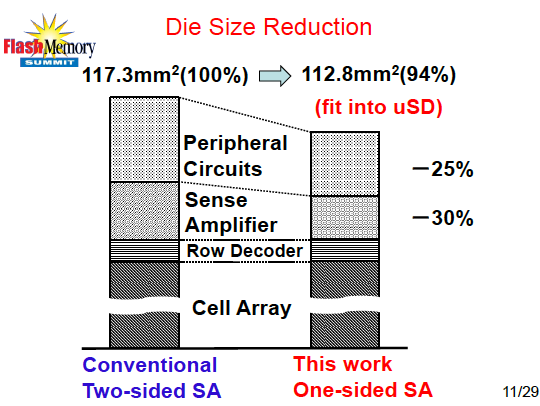
Toshiba's and SanDisk's secret lies in two-sided sense amp and all bit line (ABL) architecture, which reduce the size of the peripheral circuits and sense amplifier, resulting in higher memory array efficiency. Based on my estimation, the array efficiency (i.e. how big portion of the die is dedicated to memory cells) is about 80%, which is typical for a 128Gbit capacity. Higher capacities tend to yield better array efficiency since the peripheral circuitry does not scale as well as the memory cells do, so increasing the die capacity is one of the key solutions in lowering the cost per gigabyte.
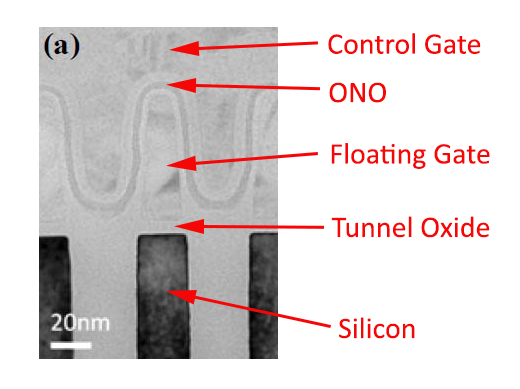
Since nobody has yet taken a cross-section of the 15nm die, it is hard to say for sure what Toshiba and SanDisk are doing to shrink the dimensions. There is no mention of high-K dielectrics, so that seems unlikely and if history is any guidance, then Toshiba/SanDisk is simply increasing the aspect ratio by making the floating gate taller to compensate for the smaller feature size and keep the overall floating gate volume similar. That also helps to maintain the gate coupling ratio because the control gate is still wrapped around the floating gate and with a taller floating gate the capacitance between the gates should remain sufficient despite the increasing proximity of the floating gates. 
The production of Toshiba/SanDisk 15nm NAND node is currently ramping up and SSDs based on the new node are expected in Q4'14.

Thursday, June 27, 2013

SSD and NAND Shortage in 2013


Considering the increased cost of manufacturing of each new generation of memory and other type of chips and the consolidation of the industry, it is not surprising that we are having a shortage of flash NAND chips as is documented in the article below.


See earlier reports for the last few years Semiconductor Moore's Law Running out of Money and Nvidia: TSMC 20nm Essentially Worthless.


Ron
Insightful, timely, and accurate semiconductor consulting.
Semiconductor information and news at - http://www.maltiel-consulting.com/


The Great SSD Flash Shortage of 2013 - EOL 25nm, the pain and the future

http://www.tweaktown.com/articles/5571/the-great-ssd-flash-shortage-of-2013-eol-25nm-the-pain-and-the-future/index.html


By: Chris Ramseye


Introduction


the_great_ssd_flash_shortage_of_2013_eol_25nm_the_pain_and_the_future

 
Within hours of visiting Crucial at CES, my phone was ringing off the hook. The people that I consult for wanted to know the inside scoop, 960GB in a $600 SSD with better than acceptable performance for their needs, companies wanted to know why and where - they were ready to place orders. Fast forward six months and they've placed orders, as has everyone else. Micron needed 20nm flash and it needed it fast. One of the biggest buyers, the government and over the past few weeks we found what they need all of this high performance storage for.
 

This story doesn't start with Micron or in 2013 for that matter. In a move to increase prices, last July Toshiba announced plans to cut NAND flash production by 30%. By September, OCZ Technology warned investors of a lower forecast citing a shortage of NAND chips used to build storage devices. In March 2013, Peter K. Hazen, Director of SSD Marketing, NVM Solutions Group sent a letter to customers with the excerpt below.
 
Intel remains very committed to our SSD business. As a leading NAND flash memory manufacturer with our IM Flash Technologies partner Micron, our NAND supply continues to grow every quarter and as a result we expect to have twice the SSD output in 2013 as we did in 2012. Through internal and industry forecasts, we originally felt this would be sufficient to meet our customers' demand.
 
Unfortunately, even 2x supply growth is not sufficient. Even in the first half of this year, we expect to ship more than 2x the units in Q1 and Q2 than the same quarters last year, but it is not enough to meet our aggregate customer demand. We recognize that this can be disruptive to your business and we are working with our customers worldwide to minimize the impact and maximize the output. This will also mean we will not necessarily be doubling output on every product line, but will focus output on the datacenter and professional client product lines to help satisfy demand on products that our customers have designed in, and will reduce the volume on products for segments that are more transactional in nature.
 
Intel has and will continue to launch new SSD products in 2013 that utilize the smallest, most cost-effective NAND available (20nm), and these products are the key to increasing capacity as we are able to ship more SSDs per wafer than prior generations. Please support the migrations to these new products as well as take advantage of their greater performance and new features, while still maintaining industry-leading quality and endurance.
 
From that point, things must have gone horribly wrong or amazingly well depending on what side of the fence you're on. Let's take a look at what the NAND flash shortage of 2013 means for manufacturers of consumer SSDs and what it means to you as well.


IMFT Customers Look to Flash Forward


The image above is from a review published by Hot Hardware on June 21, 2013. It shows an ADATA XPG SX900 256GB SSD with SanDisk 19nm Toggle Mode flash. On the surface, nothing in this image should surprise anyone. The SX900 is one of ADATA's high-performance products designed for gamers and power users. Seeing an LSI SandForce SF-2281 controller with the new B02 stepping paired with SanDisk flash is a good combination.
 
When the SX900 first launched a year ago it shipped with Micron NAND flash. The drive was later revised with Micron NAND purchased at the wafer level and packaged by ADATA. Packaging flash is a good way to reduce costs and ADATA has done it for their own and other companies' products for quite some time now. For ADATA to go back to using 'off-the-shelf' flash and invest in a radical change to the BOM, ONFi to Toggle, tells us a lot about the current state of 20nm flash from IMFT.
 
I receive emails nearly daily from shoppers trying to purchase Crucial M500 960GB SSDs. Newegg doesn't have stock at the time of writing and given the extremely low user reviews posted for this product, I'd say they've never had a steady flow of M500 in either 960GB or 480GB drives. Even Crucial.com, Crucial's own web store is 960GB-less. When you try to purchase this product SKU shoppers are met with the following message.
 
We are sorry, but the product you selected is temporarily out of stock. However, we are constantly replenishing our inventory and there's a good chance that this product will become available soon. Check back often to see when the product you selected is available, or make your purchase today�by returning to the previous page�and selecting a comparable product.


... and Hynix


Last month we talked about Corsair moving the base Neutron from 25nm IMFT flash to new Hynix 22nm flash. We rarely see SKHynix NAND in consumer SSDs. I can count the number of SSDs I've held with Hynix flash on one hand and I test more than my fair share. I would estimate TweakTown reviews roughly 80% of the consumer SSD SKUs released worldwide, around 80 products in 2012 published and many more in private tests.
 
The evidence leads us to believe that IMFT has yield issues with the new 20nm process or that the demand is so high, existing partners who once purchased in bulk simply can't get enough flash from the company to support demand.


Pain at the Manufacturing Level


Any flash shortage will increase prices for consumers; we went through the cycles in the DRAM market for years. Until recently though, consumer SSD prices were going in one direction. The transition from $1 per GB to 50c per GB was rapid, but just as fast, prices shot back up. Finding quality SSDs for less than a dollar per GB is still possible, but some products designed to sell closer to the 50 cents per GB are closer to $1 per GB mark.
 
One company we think is feeling the pain is OCZ Technology. OCZ hasn't released a consumer SSD with Toshiba Toggle flash since the Vertex 3 Max IOPS. Every product since then has shipped with IMFT flash, either 25nm or 20nm. The new OCZ Vertex 3.20 released as a low-cost SSD. OCZ has a long history of kicking every other companies' asses in the low-cost market. Not only did OCZ own that market, they drove other companies to lower flagship product prices just to compete. The new OCZ Vertex 3.20 uses IMFT 20nm flash and as you can see above, the price is much higher than the MSRP of $219.99 at this time.
 
We think that the 20nm flash shortage is hurting OCZ more than anyone else still in the consumer SSD game at this point. Patriot Memory, G.Skill and Monster Digital have already pulled out of the consumer SSD business and there are rumors of more companies to follow. The combined efforts of Patriot, G.Skill and Monster Digital don't equate to the volume of products shipped by OCZ Technology, but less competition in the consumer space hurts consumers.


... and for your Wallet

 
We don't expect consumer SSD prices to return to late 2012 prices anytime soon. This should worry anyone looking to purchase an SSD. Products designed for the mainstream performance market will hover just under $1 per GB, but high performance parts could surge when demand picks up in three to four months.
 
In our OCZ Technology Vertex 450 review we stated that OCZ plans to release a Vector 150 product and that production of the existing Vector product with 25nm flash was ending soon. Vector 150 could bring a new price premium that we haven't seen in many years.


Final Thoughts


the_great_ssd_flash_shortage_of_2013_eol_25nm_the_pain_and_the_future

 
The consumer SSD market will feel the pain from IMFT's flash cross over from 25nm to 20nm for at least a few more months. When IMFT gets their flash together, consumer SSD prices should return to 2012 levels - at least we hope so.
 

There are three bright lights at the end of the tunnel. The first is the obvious, IMFT increases yields on 20nm flash. The second comes from a report at SeekingAlpha. They speculate that Micron is converting a fab in Singapore from DRAM to NAND. This would decrease worldwide DRAM wafer production by six percent, but have a positive impact on the flash market.
 
The third light at the end of the tunnel is SanDisk and Toshiba's announcements of a transition to new 19nm 1y flash. Current Flash Forward 19nm flash is 19mm by 26mm cells. The new 1y flash moves to 19mm by 19.5mm. This will allow more flash per wafer and increase global supply.
 
Moving forward, the fabs have the rest of the SSD industry by the you know what's. SanDisk, Intel, Toshiba, Samsung, Micron and SK Hynix control the world's supply of flash. We have to wonder how long the SSD fab-less companies have left and what it will take to survive moving forward.


Wednesday, February 13, 2013

Semiconductor Moore's Law Running out of Money

New 14nm process technology and design IP development costs more than $1.5 billion, while new fabs cost several billions. Only very few companies will be able to continue developing and building new fabs. A recent forecast at Common Platform Technology Forum see  +44% growth for foundries.

More stories in March 2012 Moore's Law End? (Next semiconductors gen. cost $10 billion) and Moore's Law Slowwwing .


Ron
Insightful, timely, and accurate semiconductor consulting.
Semiconductor information and news at - http://www.maltiel-consulting.com/


Tuesday, February 12, 2013

IBM: Fab Future Beyond FinFETs

The Common Technology Platform and other vendors have been lagging Intel in process development and  integration for several years. In a recent Common Platform Technology Forum, IBM presented their latest effort to catch up - vision of Fab future.
"IBM spotlights double patterning tricks with immersion lithography, showed advances in fully depleted silicon-on-insulator".

 "IBM, GloFo and Samsung now claim they have the lion's share of today's 32/28 nm, high-K metal gate capacity."
While they are claiming to have the fab capacity lead for 28nm HKMG process, Intel, TSMC, and other foundries would feel differently.

Ron
Insightful, timely, and accurate semiconductor consulting.
Semiconductor information and news at - http://www.maltiel-consulting.com/


Monday, January 14, 2013

TSMC 28 nm Process Reverse Engineering

Chipworks has produced an interesting report with some good TEM crossections of the most advanced products of Nvidia, Altera, Xilinx, Qualcomm and others fabricated on TSMC 28nm process.


"The 28 nm generation was the first time TSMC used high-k metal gate (HKMG) transistors. The HP and HPL technologies feature HKMG transistors, while the LP uses conventional poly gates, with an ONO gate dielectric."


Ron
Insightful, timely, and accurate semiconductor consulting.
Semiconductor information and news at - http://www.maltiel-consulting.com/