Showing posts with label cell phone. Show all posts

Wednesday, November 19, 2014

China Cell Phone Growth in 2014-5

The growth of NAND flash consumption in China is a strong indication of cell phone, tablet, and other mobile products future growth in China. The prediction in the article below of

"The proportion of China's overall NAND Flash usage relative to the world's NAND Flash output... expected to hit 20.6 per cent in 2014, and 30 per cent or more in 2015."


This prediction will depend on a very high growth in mobile products


Ron
Insightful, timely, and accurate semiconductor consulting.
Semiconductor information and news at - http://www.maltiel-consulting.com/


Mobile device space lifts memory market in China

Posted: 18 Nov 2014  
China has consumed about 4.789 billion DRAM chips and 3.518 billion NAND Flash chips from the 2Gb category this year, accounting for a respective 19.2 per cent and 20.6 per cent of the world's total DRAM and NAND Flash output. This highlights the country's increasing business potential as a result of the appeal China generates in terms of consumer device markets such as PC, smartphone and tablets, indicated DRAMeXchange, a research arm of TrendForce.
China's PC DRAM consumption is presently at about 15 per cent. Benefiting from domestic demand, Lenovo has managed to raise the scale of its business operations over the years, and is acquiring other companies as a means to boost its presence among first tier manufacturers. While the company is still competing fiercely with HP for top position in the PC market, its overall PC shipments are ahead of all of its other competitors. For 2015, DRAMeXchange predicted that Lenovo's market share will arrive at about 17 per cent. As has been the case with the other markets, mobile DRAM is expected to gradually replace PC DRAM as the mainstream in China given the country's growing smartphone and tablet sales. Aside from ZTE and Huawei, which are doing relatively well overseas, most China-based smartphone brands are expected to place their focus on the domestic market. Based on TrendForce's 2014 market statistics, China alone accounts for 28 per cent of mobile DRAM's overall bit demand. The importance of China's economic development to the entire DRAM industry is expected to become more apparent next year as that proportion rises to over 40 per cent.
As the NAND Flash manufacturing processes are advancing to under 1ynm, many NAND Flash applications including smartphone and tablet-based eMMCs and notebook-based SSDs are showing improved growth in the market. Competition among global OEM manufacturers, meanwhile, is starting to become more intense, with brands other than Apple and Samsung starting to make their way into the country's lucrative market. The level of China's NAND Flash consumption has managed to grow considerably over recent years due to Lenovo's rise to prominence, the above-average growth shown by China's emerging brands, and the improving standards of China's hardware designs. By the end of 2014, DRAMeXchange projects that the NAND Flash market's total value in China will reach up to $6.3 billion. The proportion of China's overall NAND Flash usage relative to the world's NAND Flash output, on the other hand, is expected to hit 20.6 per cent in 2014, and 30 per cent or more in 2015.

China's efforts over the years to transform from a manufacturing-based to consumption-based economy has been largely successful. Given the consistent growth in its economy and the country's rising wage levels, many of the productions in China are bound to be outsourced to other emerging countries. The Chinese government's present goal is to improve the country's outlook by implementing strategic policies that are aimed at enhancing its industrial capabilities. One such policy involves increasing the imports of semiconductor components such as smartphone CPU, AP, DRAM and NAND Flash, the combined value of which exceeds the value of China's imports for oil. In the future, it would be interesting to see whether Unisplendour Corp. Ltd's (UNIS) efforts to integrate resources from Spreadtrum Communications, RDA and Intel will be successful.
Due to the relatively high proportion of CPU, DRAM and NAND Flash components imported by China, the government policies that are implemented with regard to these three product categories may prove critical to the country's industries. A few days ago, the Chinese government announced a policy worth nearly $20 billion that involves mastering the technologies at the upper streams of the country's semiconductor supply chain and applying these technologies to mid to lower streams. The main purpose behind this is to enable the country's supply chains to be more integrated and to allow momentum in China's domestic industries to persist.

Thursday, July 17, 2014

DRAM as Non Volatile Memory =>Longer Battery Life

If your cell phone has non removable batteries, its DRAM memory can be treated as as a battery backed up nonvolatile DRAM. This improve battery life time and speed of mobile devices "data committed to flash was reduced by about 40 percent." See more in the article below. 

Actually, these benefits should be achieved in any mobile device with an improved operating system.

"several innovations.
·         Quasi-NVRAM. They set aside a portion of system DRAM to act as a battery backed up nonvolatile DRAM.
·         Device driver. A new device driver and library that manage I/O between the qNVRAM and system flash memory.
·         Persistent Page Cache. A new data structure in SQLite using quasi-NVRAM to perform in-place updates to the database files. 
·         Relaxed data flushing. Absorbs repeated writes to table files to further reduce I/O."


Ron
Insightful, timely, and accurate semiconductor consulting.
Semiconductor information and news at - 
http://www.maltiel-consulting.com/


Summary: You still hear complaints about nonremovable batteries in mobile devices – mostly Apple – but there is an upside: the ability to eliminate performance overhead. Here's how.
By Robin Harris for Storage Bits | July 14, 2014 in

Three researchers, Hao Luo, Lei Tian and Hong Jiang of the University of Nebraska, asked a simple and seemingly obvious question. Since our mobile devices have non-removable batteries why don't we treat DRAM as if it were nonvolatile?
Their paper, qNVRAM: quasi Non-Volatile RAM for Low Overhead PersistencyEnforcement in Smartphones was presented at the Usenix HotStorage conference last month.

Background
Typically Android mobile devices rely on SQLite, a shared preference key value store or the filesystem API to save persistent data on local flash. These employ journaling or file-level double-writes to ensure persistency.
The problem is that these techniques require multiple writes to storage, incurring substantial system overhead in devices that are already performance and power constrained.
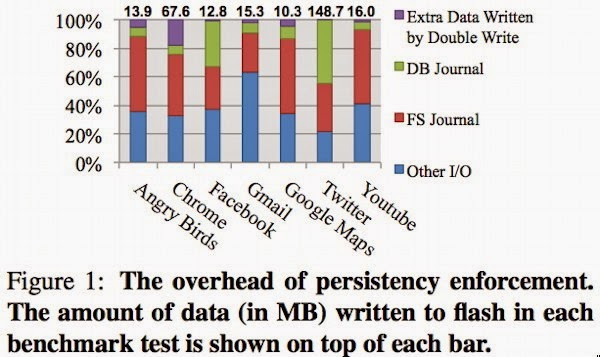
For example, they found that more than 75 percent of Twitter data was written for persistency reasons. Looking at a group of common mobile apps they found that anywhere from 37 percent to 78 percent of the data writes were for atomicity. From the paper:


Courtesy the authors.
Furthermore, it turns out that Android kernel reliability — where these data structures reside — is quite good, based on bug fixes and user support calls. They analyzed Android issue reports and found that only 10 reports or 0.05 percent of all 19,670 reported issues related to Android defects with unexpected or random power-off. That implies a small chance that unexpected power failure may occur.
The test
The researchers constructed a prototype test system with the with several innovations.
·         Quasi-NVRAM. They set aside a portion of system DRAM to act as a battery backed up nonvolatile DRAM.
·         Device driver. A new device driver and library that manage I/O between the qNVRAM and system flash memory.
·         Persistent Page Cache. A new data structure in SQLite using quasi-NVRAM to perform in-place updates to the database files. 
·         Relaxed data flushing. Absorbs repeated writes to table files to further reduce I/O.
Results
Implemented on an Android smartphone they found that
"...qNVRAM speeds up the insert, update and delete transactions by up to 16.33x, 15.86x and 15.76x respectively."

The Storage Bits take 
Furthermore, the amount of data committed to flash was reduced by about 40 percent. Given how common constant feed updates are on mobile devices, this is a significant result.
Some are miffed that many smartphones don't have easily removable batteries. This research shows the upside of such designs: all DRAM can be treated as NVRAM whether on Android or Apple's iOS.
Note that qNVRAM can't replace flash. DRAM is more power-hungry and costly than flash.
But research shows that by reducing the I/O overhead of the system with qNVRAM, significant gains in performance — and presumably battery life — can be achieved at very little cost. It also simplifies the problem of extending flash endurance.
It was obvious five years ago with the advent of non-removable batteries on phones and notebooks that engineers could take a new look at achieving persistency. Congratulations to the researchers for taking a rigorous approach to the problem.


Wednesday, July 25, 2012

Smartphone Dark Horse: Huawei

China is a vast market for smartphones. Apple is doing a good job of dominating the high end of the smart phone market there. While at the low end of Androids' phones Huawei is advancing fast.

From the article below:
"This year, the company expects to triple its smartphone sales to 60 million units, in part by taking a bigger chunk of the U.S. market...

Late last year, Huawei was No. 7 in smartphones. Now it may be No. 3—and is pushing hard to sell its inexpensive handsets in the U.S"

I wonder how many flash memory chips do their cell phone use.

Ron


The New Smartphone Powerhouse: Huawei

http://www.businessweek.com/articles/2012-07-19/the-new-smartphone-powerhouse-huawei
By Peter Burrows on July 19, 2012

Sales of smartphones are booming, though very few phone makers have been rejoicing. Nokia (NOK) and Research In Motion (RIMM) have seen their once-formidable businesses collapse into a mess of red ink and layoffs. HTC’s sales have tumbled. Once-proud Motorola Mobility has been acquired by Google (GOOG). Sony (SNE) and LG Electronics (066570) are confirmed also-rans.


Feasting on this wreckage are, of course, Apple (AAPL) and Samsung Electronics (005930), which between them have 54 percent of the global market. The other big winner: Huawei Technologies. A company many Americans haven’t even heard of may well have passed Nokia last quarter to become the third-largest smartphone maker, according to Horace Dediu, founder of equity research firm Asymco. That’s up from No. 7 at the end of last year. “They’re the guys that don’t get a lot of respect because they’re not big in the U.S.,” says Dediu. “But they’re looking at big numbers.”


After it was founded in 1987 by civil engineer Ren Zhengfei, Huawei quickly became China’s high-tech success story by selling telecom gear to phone companies, routinely beating rivals such as Alcatel-Lucent (ALU), Ericsson (ERIC), and Cisco Systems (CSCO) with good-enough products and great prices. Only in the mid-2000s did it start making cell phones. The Shenzhen-based company’s inexpensive, often unbranded models gained traction in China, the Middle East, and Africa.


Huawei kept this low-cost approach as it got serious about smartphones in 2009. The company didn’t try to build its own software operating system like Apple, Microsoft (MSFT), Nokia, or RIM. It used Android. And unlike Samsung, HTC, or Motorola, it didn’t try to differentiate Google’s mobile software with its own tweaks. “Huawei just slapped Android on some hardware and shipped it,” says ABI Research analyst Michael Morgan.


This year, the company expects to triple its smartphone sales to 60 million units, in part by taking a bigger chunk of the U.S. market. Until now, it’s sold handsets costing less than $200 to carriers such as MetroPCS and Cricket that offer pay-as-you-go plans, mostly to lower-income consumers. Last November it landed a deal with a top-tier U.S. carrier when AT&T (T) started selling Huawei’s Impulse phone for $29. On July 11, T-Mobile announced that Huawei would be building two models in the carrier’s MyTouch line of handsets. “We essentially made the market for affordable smartphones,” says William Plummer, Huawei’s U.S. vice president for external affairs. “We’re in a good position because we’ve established ourselves as a trusted partner to carriers.”


Not completely trusted, however. On Capitol Hill, the House Permanent Select Committee on Intelligence has been investigating whether efforts by Huawei and ZTE, another fast-growing Chinese telecom equipment and phone maker, to sell to U.S. carriers present a security risk, because the companies may have ties to the Chinese government. The Australian government has banned Huawei from bidding on a national broadband project. Congress has asked the State Department to investigate whether Huawei illegally exported embargoed technologies to Iran. For years, industry insiders have believed that Huawei has access to low-interest loans from the government. Huawei spokesman Francis Hopkins says the company is cooperating with the congressional investigation, gets no favorable loans from the Chinese government, and denies wrongdoing in Iran. It definitely has benefited from huge domestic broadband buildouts, says Jeff Heynen, an analyst with consulting firm Infonetics.


Succeeding in smartphones is not optional for Huawei if it wants to remain a fast-growing company. Its $23 billion-a-year telecom equipment business grew only 3.5 percent in 2011, before tumbling due to the slowdown in China’s economy this year, says Heynen. The company reorganized last year to create a separate Huawei Devices unit to drive what executives say is the company’s best growth opportunity. The division also makes laptop modems and other less-sexy gizmos.


Huawei’s growth rate may make it a plausible challenger to Samsung in smartphone sales, says Asymco’s Dediu. He argues that the Korean giant has prospered largely because of vertical integration; it makes many of the chips and screens that go into its devices. Yet he doubts Samsung has built up enough brand loyalty to withstand a much cheaper alternative. “Let’s not forget that Samsung itself was No. 4 or 5 just a few years ago,” says Dediu. “Samsung ought to be looking over its shoulder.”


As smartphones evolve from novelty technology into just another gadget, Huawei will be well positioned to benefit. “Their devices don’t have to have jet packs to do 90 percent of what most people need,” says Morgan of ABI Research. “The market is coming to them.”


The bottom line: Late last year, Huawei was No. 7 in smartphones. Now it may be No. 3—and is pushing hard to sell its inexpensive handsets in the U.S.


Monday, April 2, 2012

The Real Growth Paths for Flash Memory?

The article below addresses flash memory growth in SSD as a replacement for hard drive, which is one of the main growth areas for flash.


However, some other very large growth areas for flash memory are cell phones and consumer products.
For example, in the new iPad from Apple, the cost of  NAND Flash is between 5-18% .


April 24 Update: Apple's quarterly results highlight the impact that cell phones are having on the growth of flash.   "Surging iPhone Sales Propel Apple's latest quarter results". Total revenue of $39 billion...nearly 75% of revenue derived from the iPhone and iPad


Ron Maltiel


What are the Real Growth Paths for Flash Memory?
Tom Coughlin, 3/29/2012

Many pundits predicted that the shortage of hard disk drives would cause a significant shift to SSDs last quarter and this quarter. But as indicated in Micron’s report on its F2Q results, many OEMs ordered what became excess inventory of SSDs that will take another quarter to use up. The basic reason is economic, even with HDD supply much less than demand and higher HDD prices the price of a given amount of flash memory capacity is still much higher than that of HDDs.
Currently even the lowest price SSDs sell for about $0.70/GB while the most price impacted HDDs sell for $0.14/GB (a difference of 5:1). As the available production volume for HDDs recovers the price of HDDs in real dollars will continue to fall. In addition if higher areal density HDDs are introduced later this year, capacity prices will drop to pennies per GB while the least expensive SSDs will likely drop to $0.50/GB by the end of 2012. Economics is an important consideration for consumer and business purchases, and price does matter.

Over the next year or two there will be additional consumer and business products that shift from using HDDs to only using SSDs or flash memory. In mobile devices and automobile applications the ruggedness of flash memory and its ability to be put into smaller volumes than HDDs provide other advantages to users even if the purchase price is greater. In addition, many mobile applications have limited local storage (to control the product price) and depend upon storage and other resources from “the cloud.” Mobile consumer electronics will be a major growth area for flash memory, but likely not as much for traditional SSDs.

SSDs are storage devices that contain flash memory chips but also a separate storage controller that manages wear-leveling, memory management and interface control. It is likely that many future flash memory implementations in mobile devices will incorporate the controller into the overall system electronics and the storage device will be a collection of flash memory chips with no dedicated controller. This helps to reduce the overall system cost as the controller is part of the system electronics but also allows tighter integration and proprietary control of the controller functions by the mobile device designer. These considerations are likely a major reason for the purchase of Anobit by Apple.

The growth areas for SSDs will primarily be in two areas. In client computing applications, such as Ultrabooks, SSDs will be used alone in the most expensive machines while less expensive Ultrabooks will use a combination of a HDD and an SSD, or else flash memory cache in the HDD (a hybrid HDD), or possibly on the motherboard (although this seems less likely). These combinations of flash memory with a HDD provide performance boosts like those with pure SSD computers but offer the lower cost capacity of HDDs and will allow sub-$600 Ultrabooks, which are likely to be the most popular price point.

The other growth area for SSDs is in enterprise applications where SSDs can provide fast transaction processing, partly to support cloud services and storage in “the cloud.” Although HDDs (and even magnetic tape) will continue to supply inexpensive mass storage, intelligent storage tiering using SSDs allows must faster access to content and at lower expense than a DRAM-based solution. There are currently many storage systems available by every major enterprise storage vendor offering SSDs as part of their storage tiers and several companies offering pure flash-based appliances. These companies include EMC, HDS, HP, Oracle, NetApp, Nimble Storage, Texas Memories, X-IO and many others.

The combination of SSDs and flash memory in mobile devices and in remote data centers supporting cloud-based storage and services is important enabler of today’s information economy. However these performance and mobile applications would be very limited without access to low cost content and information storage on magnetic storage devices. Thus in a real way flash memory and HDDs are much more symbiotic than might initially appear to be the case . In a real way the growth of flash memory and SSDs is dependent upon the growth of HDD storage and likewise the growth of HDDs is enabled by the faster data access enabled by flash memory.