Showing posts with label laptop. Show all posts

Monday, August 26, 2013

Longest Battery Life Smartphone: Moto X (Teardown)

Below are some snapshot from Ifixit teardown of Google/ Motorola new cell phone. One of the key features of Motorola cell phones have been their very long battery life. Is it due to the combination of Qualcomm processor and the power management chip, some of the other chips, or their custom system architecture (software/ hardware)?

The key chips in Moto X are listed below.

Ron
Insightful, timely, and accurate semiconductor consulting.
Semiconductor information and news at -
http://www.maltiel-consulting.com/


Motorola Moto X Teardown

 
Image #1

Step 1 — Motorola Moto X Teardown 

  • The love child of Motorola and Google is here, and we are dying to crack open the little Motoroogle.
  • Technical Specifications:
    • Dual-core 1.7 GHz Qualcomm Snapdragon S4 Pro processor
    • 2 GB RAM
    • 4.7-inch 1280x720 pixels AMOLED display
    • 16 or 32 GB internal storage
    • Qualcomm Adreno 320 GPU
    • .........
    • Image #1

      Step 9 

      • Motorola claims the Moto X battery can power through an amazing 24 hours of "mixed usage."
      • How does the Moto X accomplish such a feat with a 3.8 volt, 2200 mAh Lithium ion battery? The secret is in the X8 Mobile Computing System.
      • The Motorola X8 Mobile Computing System is comprised of a Qualcomm Snapdragon S4Pro family processor, a natural language processor and a contextual computing processor.
      • Motorola developed a custom system architecture, which, when coupled with eight processor cores, allows for the delegation of processing power:
        • 4 graphics processor cores for "stunning clarity"
        • 2 application processor cores for "swift action"
        • 2 low-power cores—"awaiting your next command"
      Image #2

      Step 10 

      • Out comes the upper midframe panel, housing the speaker, headphone jack, more antennas, and pressure contacts.
        • Yay, pressure contacts! We like spring pressure contacts because they don't require any work to disconnect.
      • This is possibly the most modular headphone jack we've ever seen. It pops right out of the upper midframe panel, spring contacts and all.

      10 MP rear-facing camera

    • Image #1

      Step 15 

      • Notable ICs on the motherboard:
        • Toshiba THGBMAG7A2JBAIR 16 GB eMMC NAND Flash
        • SK Hynix H9TKNNNBPDAR RAM (we assume that the Snapdragon S4 Pro is also layered under this IC)
        • Qualcomm PM8921 Power Management IC
        • Texas Instruments TMS320C55 Digital Signal Processor
        • NXP 44701 NFC Chip
        • Skyworks 77619-12 Multiband Multimode Power Amplifier Module for Quad-Band GSM / EDGE and Penta-Band (Bands I, II, IV, V, VIII) WCDMA/ HSDPA/ HSUPA/ HSPA+/ LTE
        • Texas Instruments MSP430 F5259 Mixed Signal Microcontroller
      Image #1

      Step 16 

      • Additional ICs:
        • Qualcomm WCD9310 Audio Codec
        • Qualcomm WCN3680 802.11ac Combo Wi-Fi/Bluetooth/FM
        • NXP TFA9890 High Efficiency Class-D Audio Amplifier
        • Skyworks 77737 SkyHi™ Power Amplifier Module for LTE Bands 12/17 (698-716 MHz)
        • EPCOS 7 959 Wireless LAN / Bluetooth Filters (IF)
        • 0V00660 A56G 1B

Wednesday, June 12, 2013

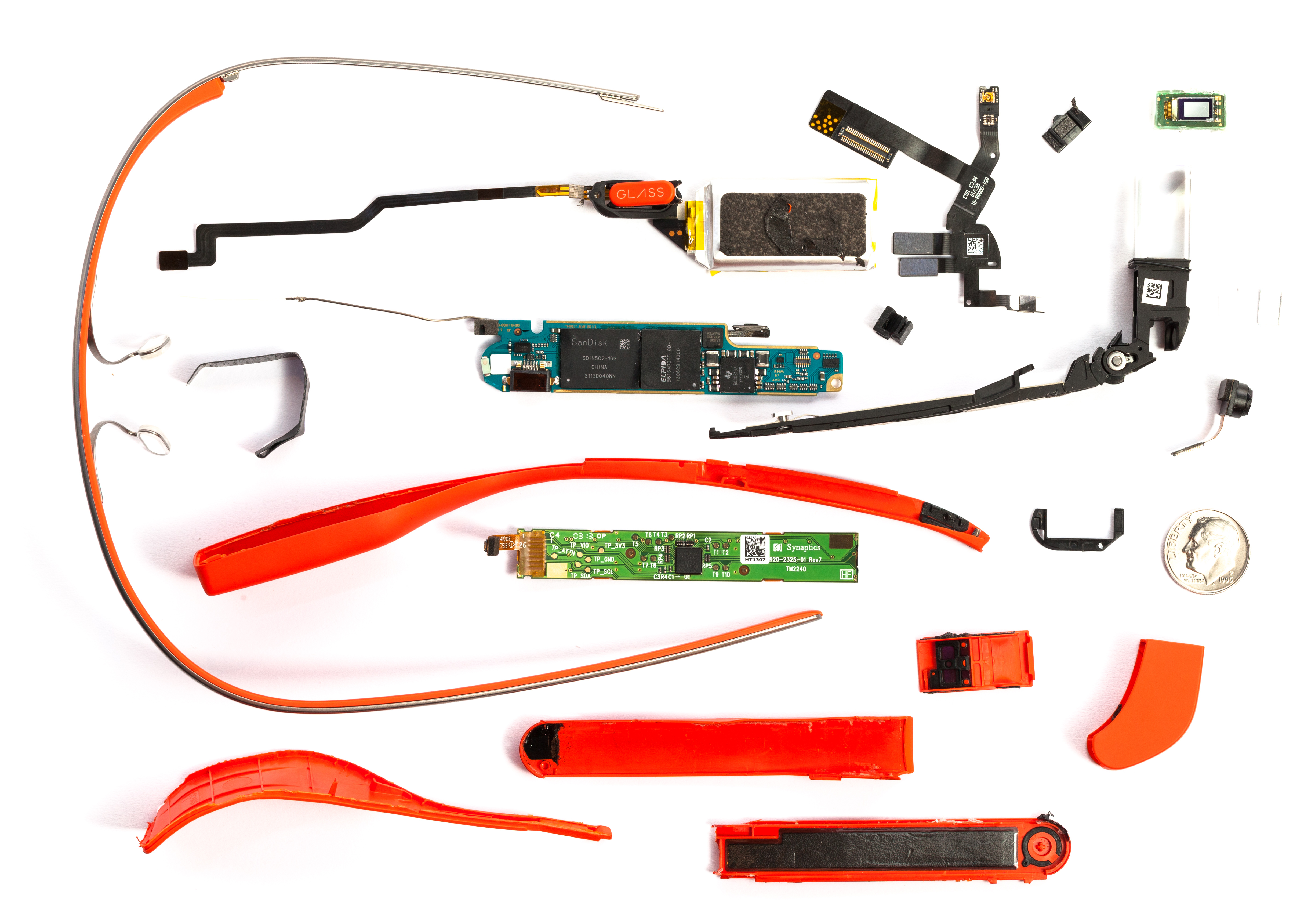
Google Glass Teardown:CPU, Flash, and DRAM

Some highlights of teardown of google glass below.

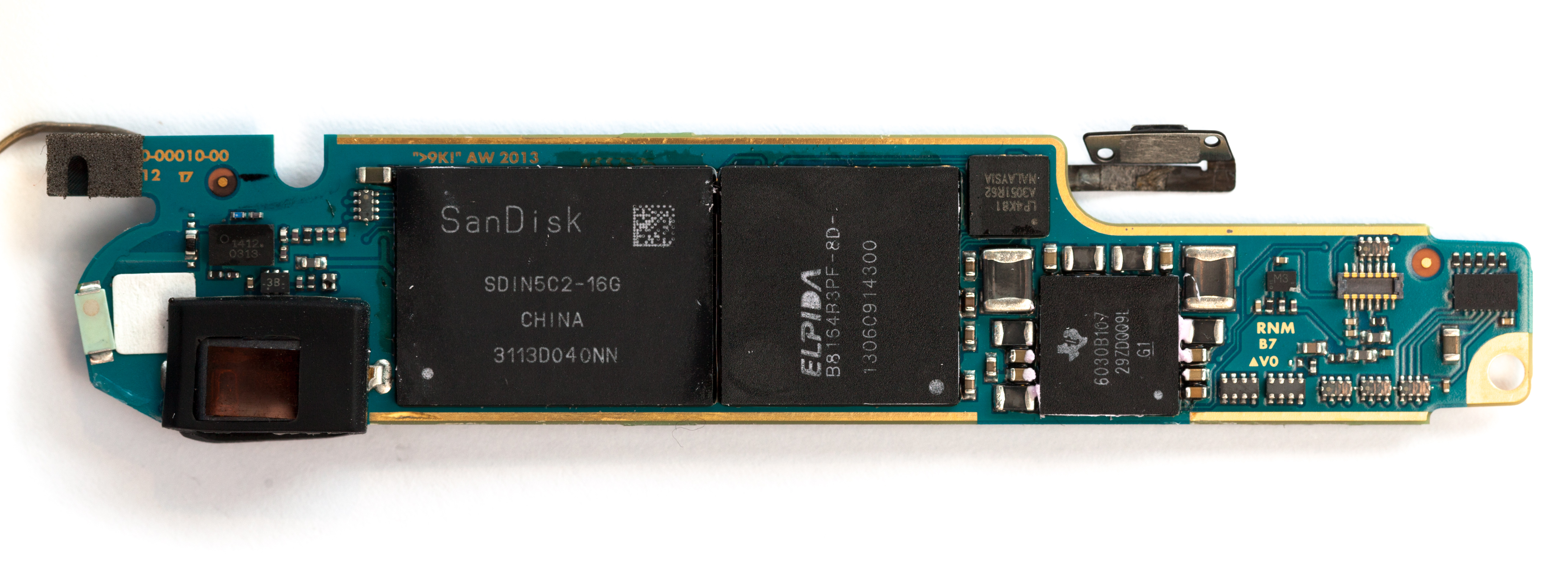
"core chips powering Glass: a TI OMAP4430, 16GB of SanDisk flash, and an Elpida mobile DRAM chip. "


Ron
Insightful, timely, and accurate semiconductor consulting.
Semiconductor information and news at - http://www.maltiel-consulting.com/

What is this Glass thing anyways?

Google's latest and hottest gadget needs little introduction.
Since its public unveiling in April 2012, the tiny head-mounted
Android computer has been collecting controversy and sociological
analysis. It is currently available in limited beta to eminent members
of the tech community and to a selection of "Glass Explorers". As
members of the latter program, we are delighted to be able to explore Glass.
.......

Side Touchpad

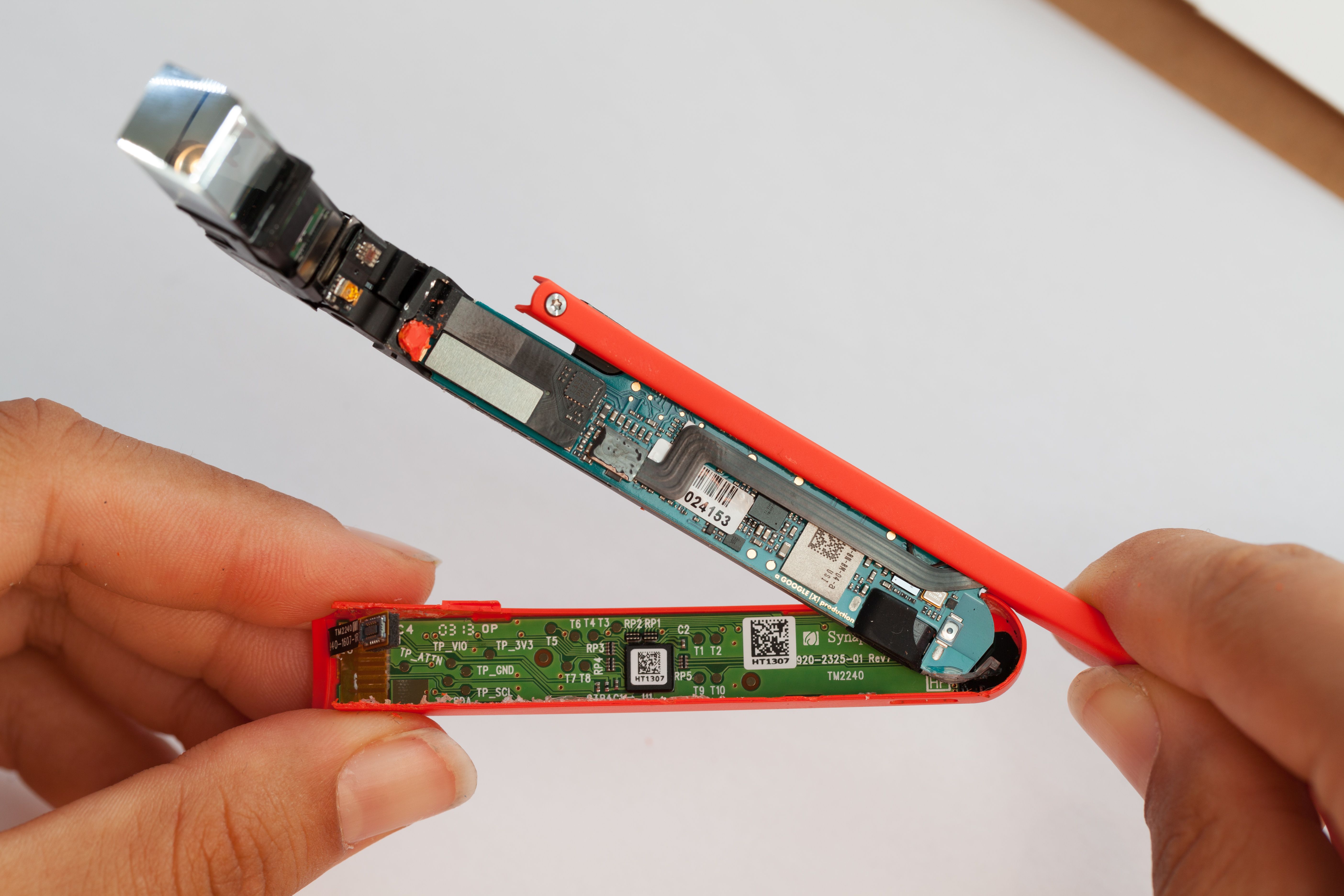
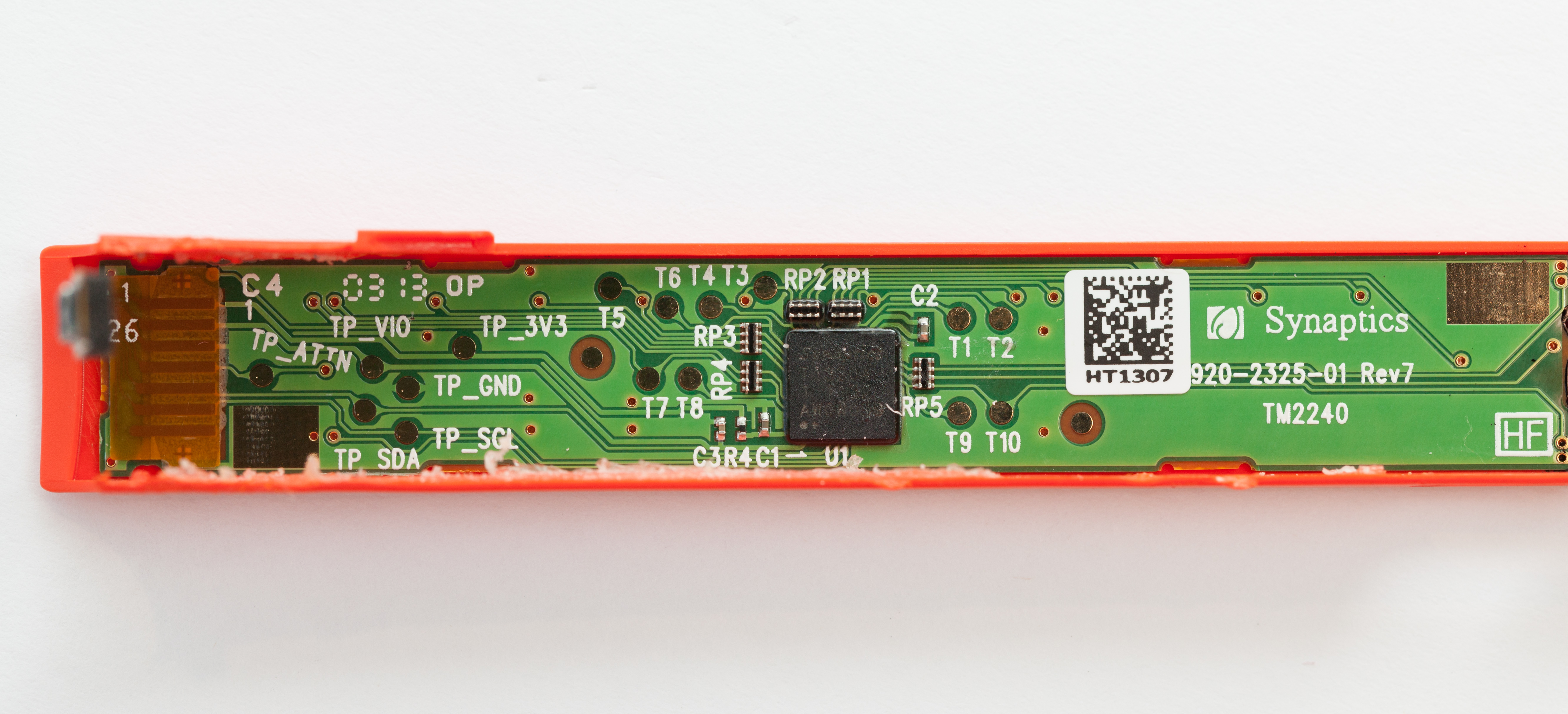
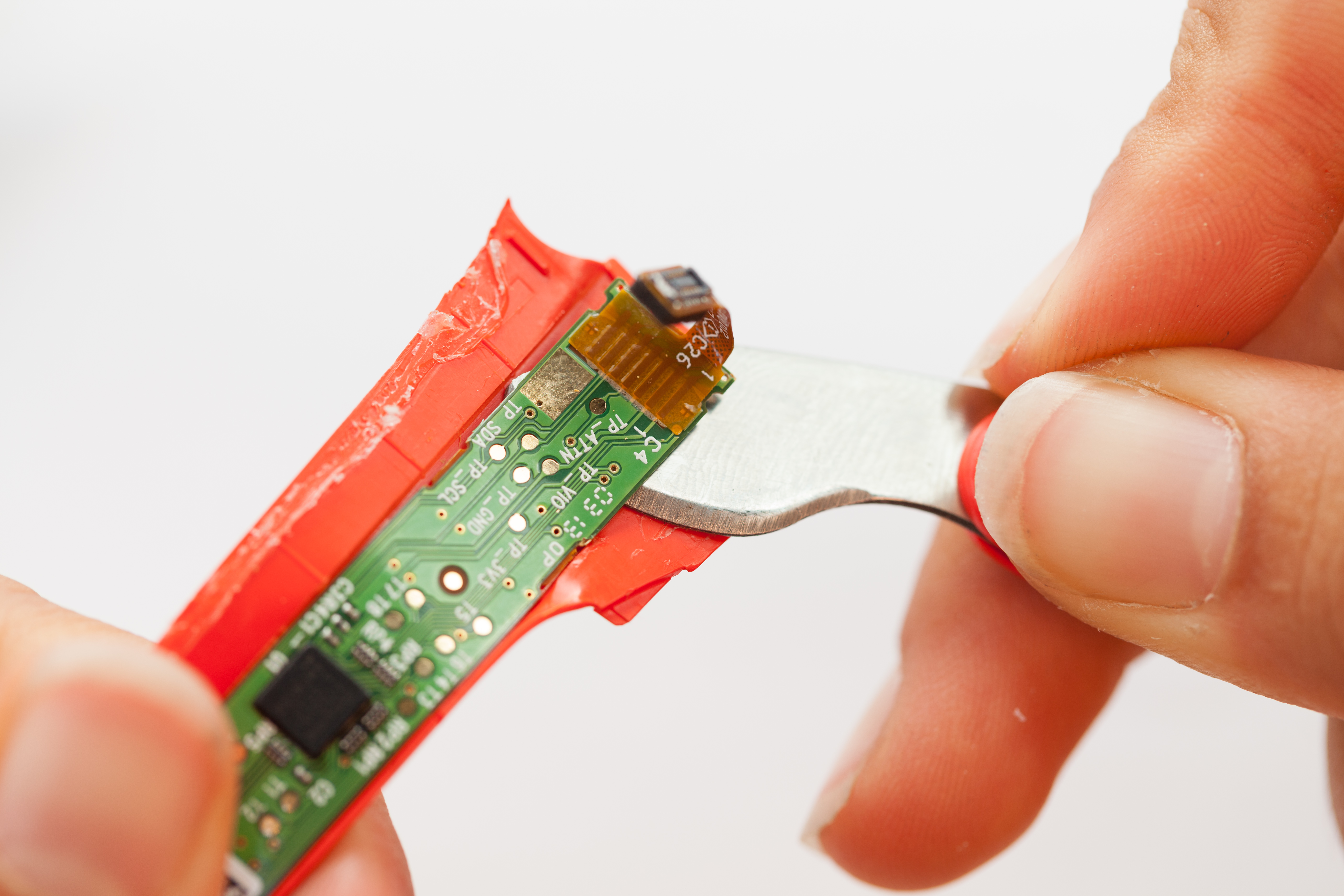
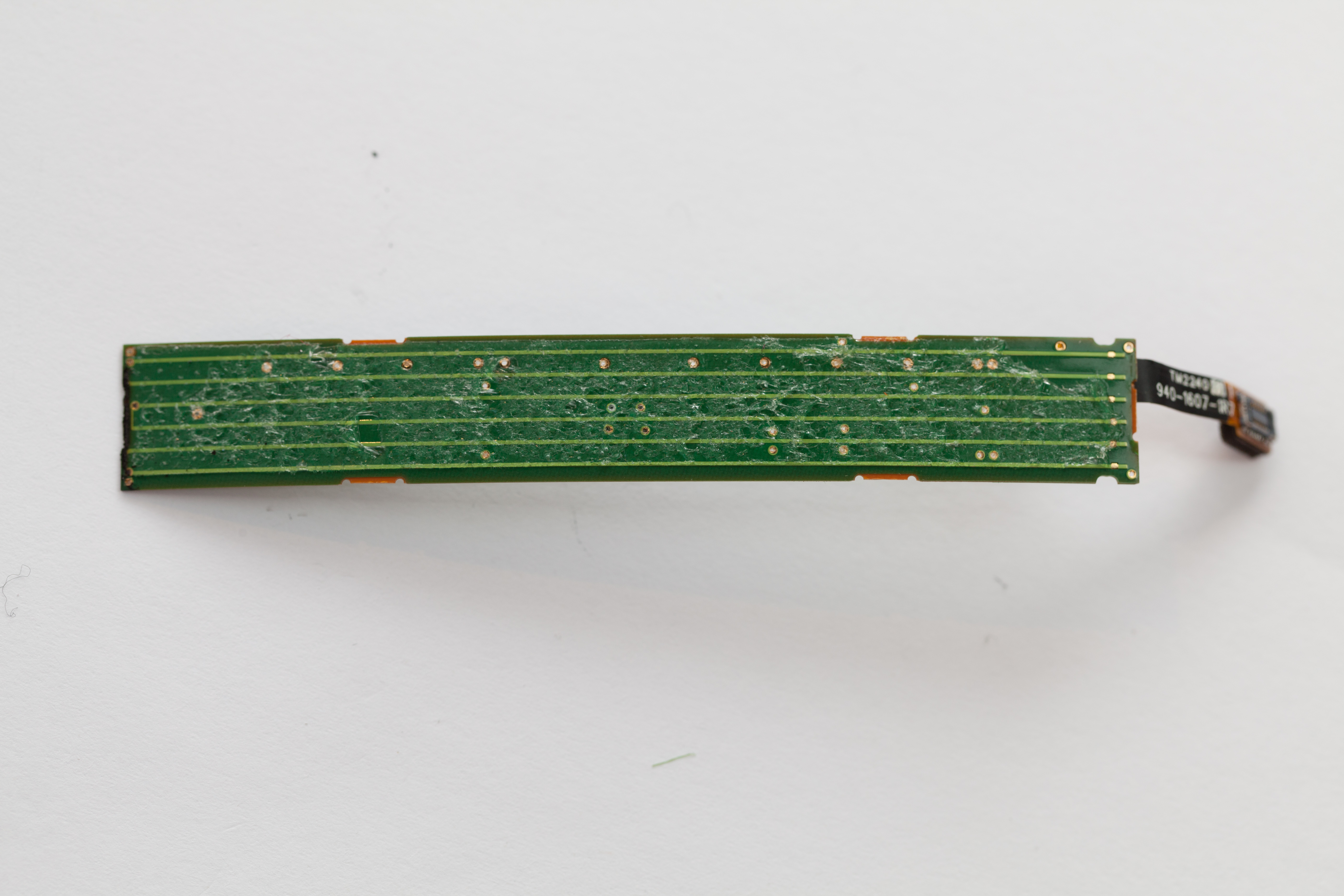
Removing the casing exposed a few parts, including the separate touchpad module on the right side of the unit. When a Glass users looks like they are pensively tapping their temple, they are interacting with this sensor. The touchpad is a full custom module made by Synaptics, and is driven by a Synaptics T1320A touchpad controller.

Main CPU Board

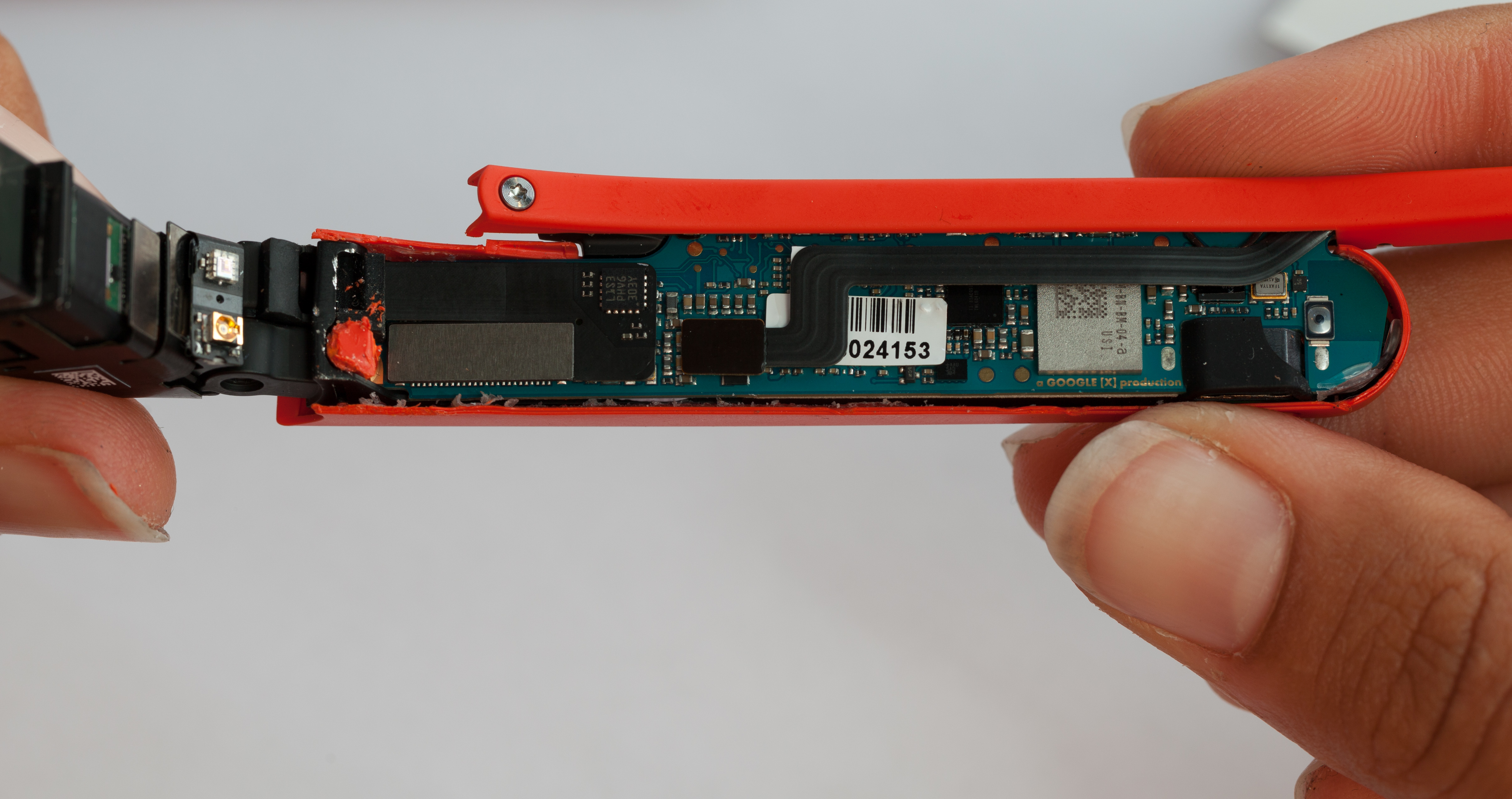
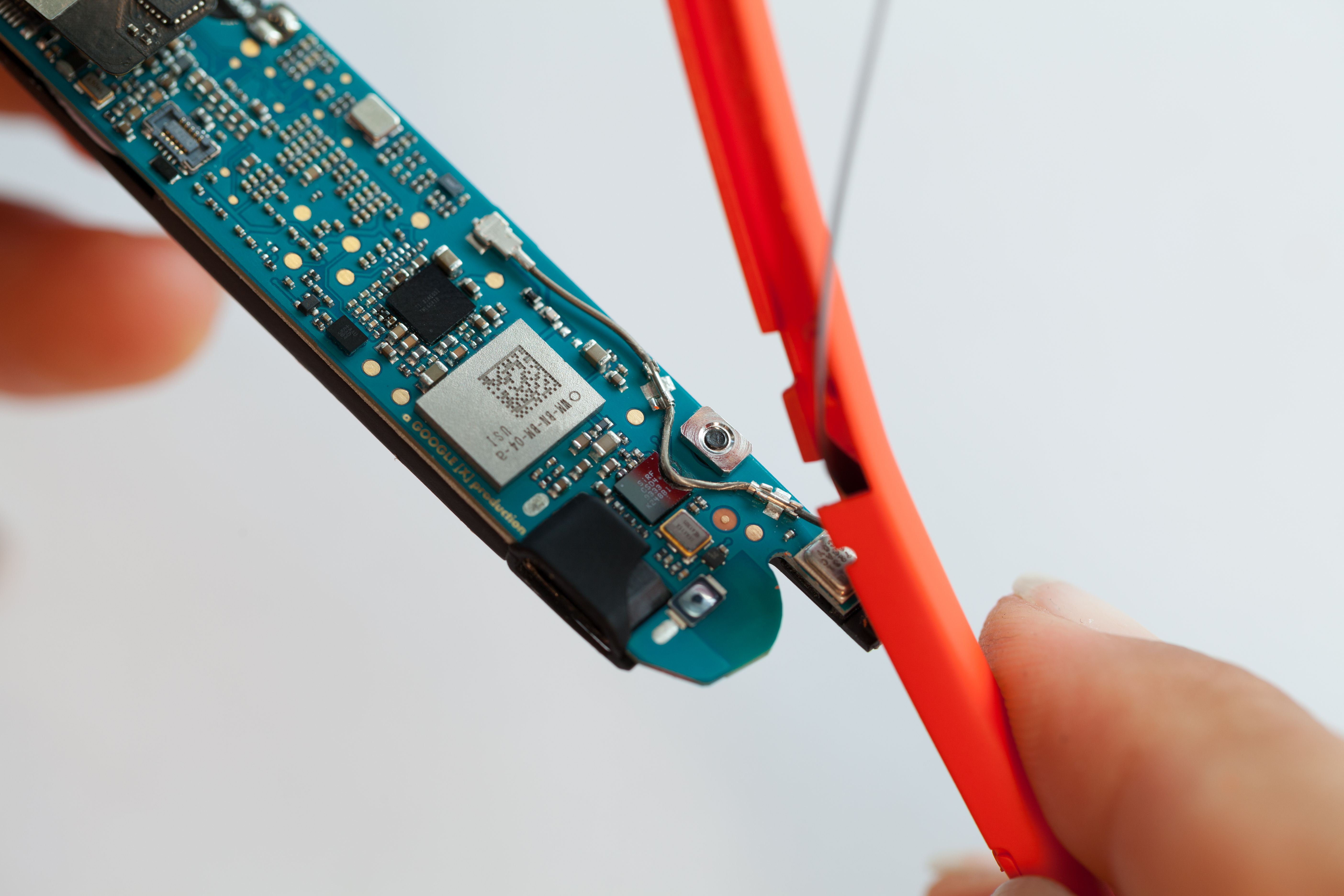
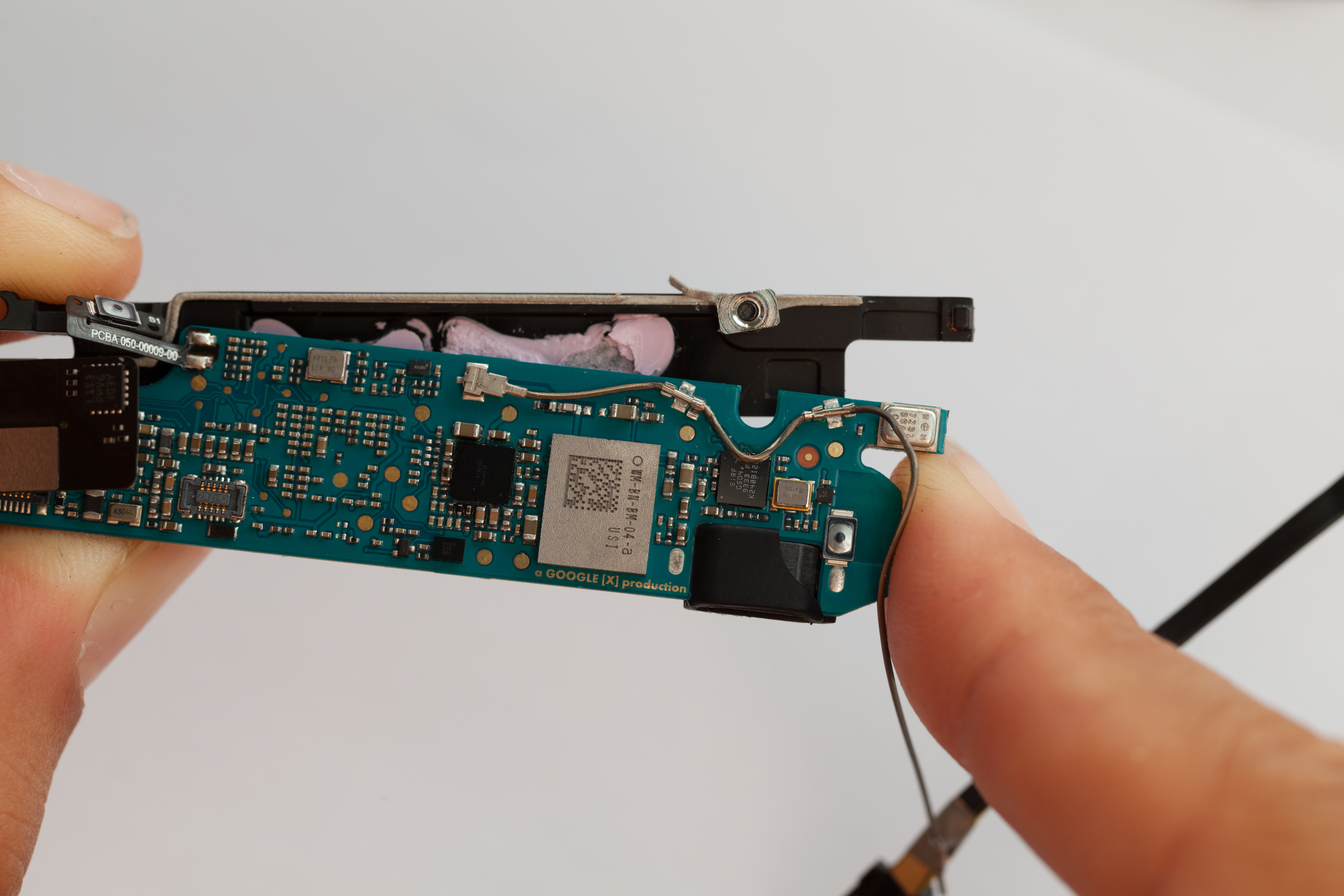
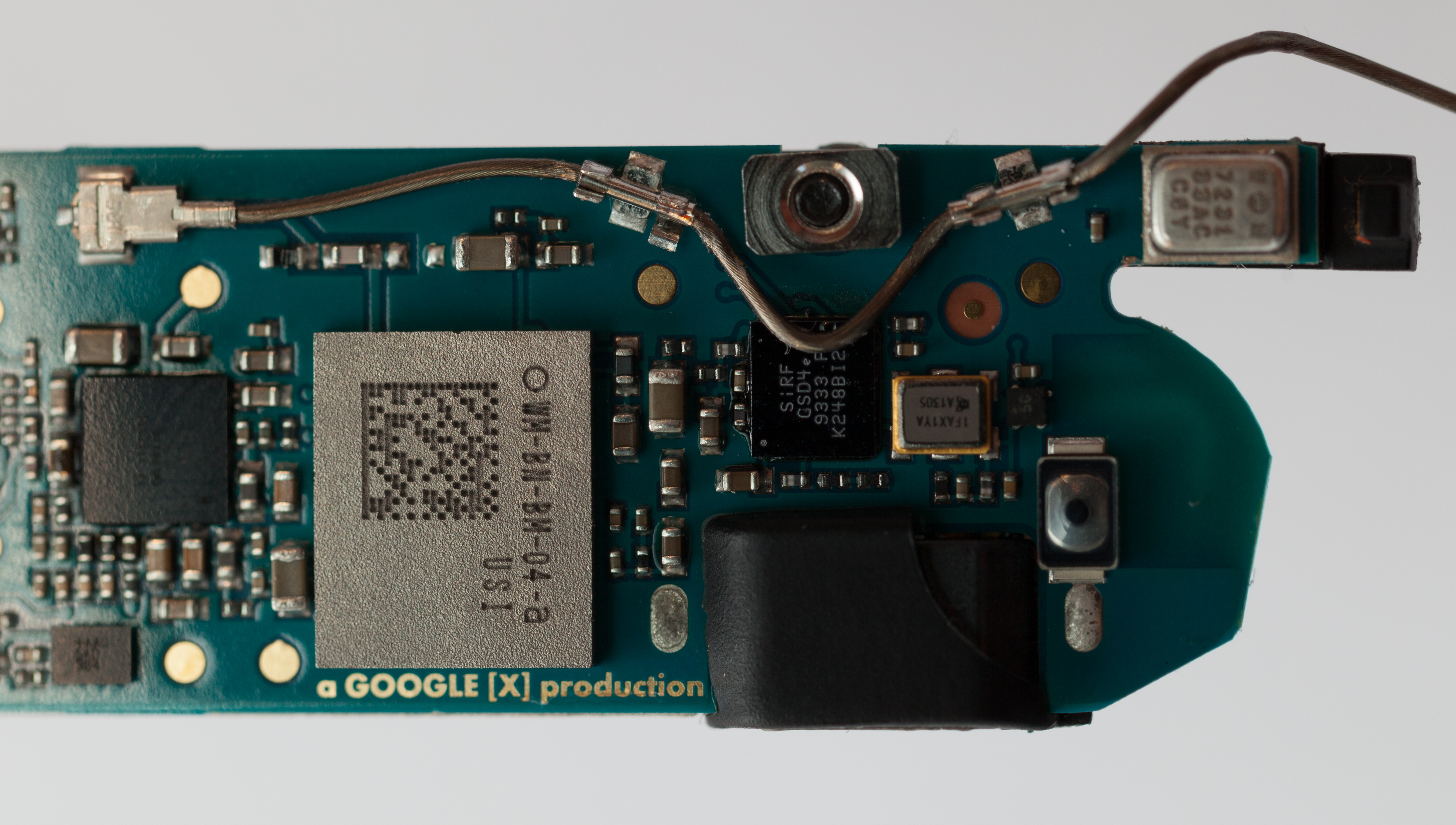
The main logic board was now exposed. The inwards-facing side holds an RF module, some small connectors and support ICs, and copper noting that this is "a GOOGLE [X] production".
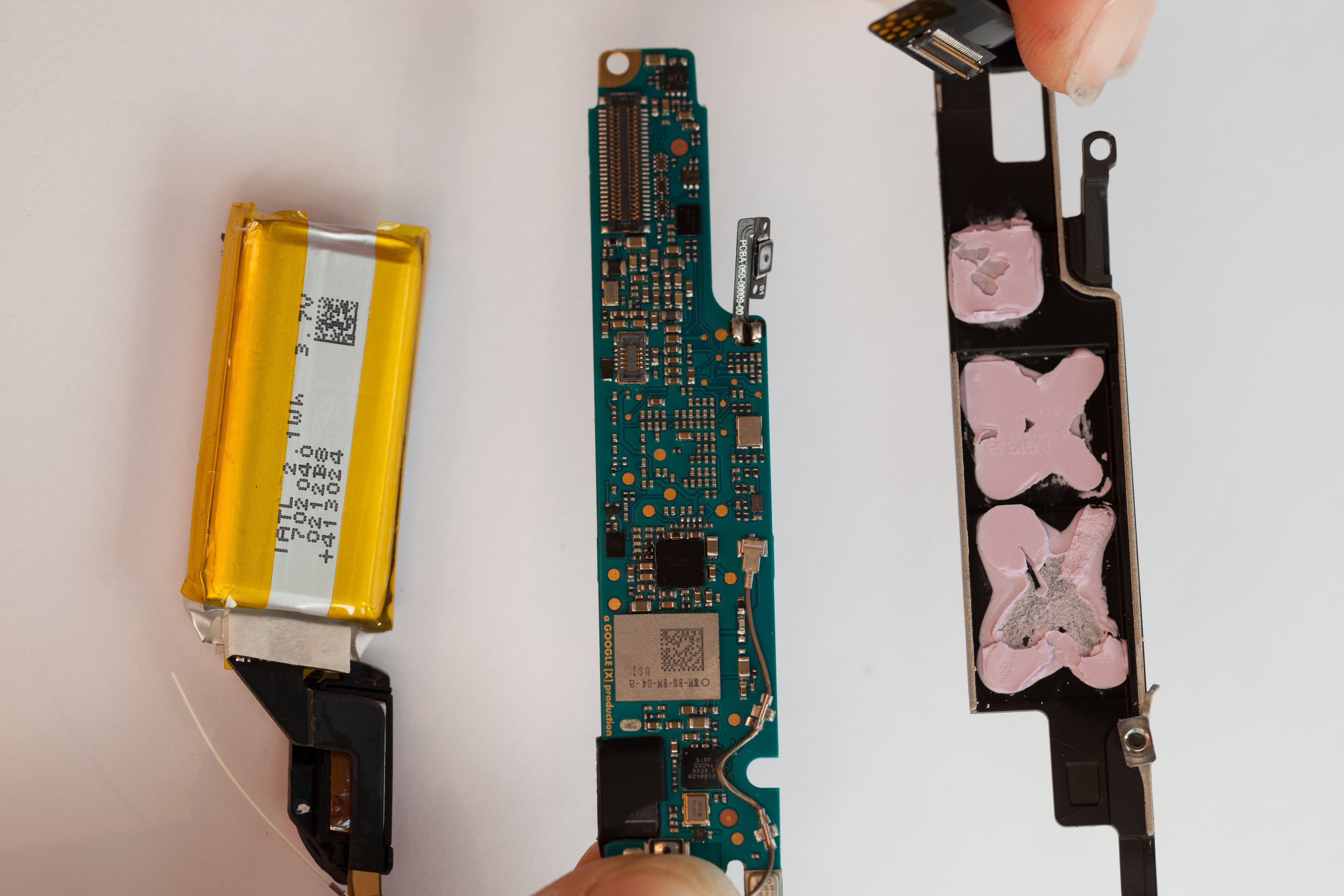
This board was stuck to a thermal pad with lots of paste. After removing it and cleaning off the pink thermal compound, we revealed the core chips powering Glass: a TI OMAP4430, 16GB of SanDisk flash, and an Elpida mobile DRAM chip. A flex PCB and an RF cable, anchored with some metal tabs and an MMCX (?) connector, trailed from this board to the behind-the-ear pod.
Some text in the copper on this board reads >9K!   It's over 9000!

Behind-Ear Module

To keep the unit's weight distributed more evenly, Glass keeps its battery in a rounded bit behind the wearer's ear. We stripped this area open, again applying destructive force to tear the plastic.
The single-cell Lithium Polymer battery sits at the end of the flexprint PCB and is marked as having a capacity of 2.1 Wh (roughly 570 mAh). It is not user-replaceable, not even a little bit.


Friday, July 13, 2012

NAND Flash +DRAM Improves Memory Sys

Fusion io's blog discusses their collaboration with computer scientists at Princeton University

"  Volatile DRAM is faster—but much more expensive at high densities—than flash. NAND flash has much greater density than DRAM, and requires substantially less power to do its job. The Extended Memory library transparently tiers data between available DRAM in the system and the persistent NAND flash tier, making it much more affordable for organizations to greatly expand the size of their in-memory data sets without re-writing their applications."

See more about this partnership below:

Intel's approach regarding  PC memory organization is discussed in How SSDs conquered mobile devices and modern OSes


Other approaches for internal PC memory organizations were covered in a May blog -

Apple NAND Storage in Upcoming MacBook Pros


"There is a room for an overall personal computer hierarchy reorganization. Maybe Apple could lead here.
Currently in PC/ Mac we have a microprocessor (with some fast DRAM memory) connected to long term storage in flash SSD or HDD.
There would be many benefits to adding a small flash NAND between the microprocessor and the long term storage. Such computer hierarchy would benefit from the faster operation of the small flash NAND storage and its long term non volatile storage. It will also reduce power consumption.
The NAND memory could support the microprocessor operations or be used for storage of the operating system."


Ron


Princeton Scientists Partner On DRAM Innovation

http://www.drdobbs.com/tools/princeton-scientists-partner-on-dram-inn/240003554
By Adrian Bridgwater, July 11, 2012


Fusion-io technology now extends memory from DRAM to NAND flash


A collaboration between computer scientists at Princeton University and Fusion-io has led to the development of a new Extended Memory subsystem to be made available as part of the firm's own brand SDK.


The Extended Memory subsystem works to extend system memory from DRAM onto flash, providing what has been described as "much more high-performance memory capacity" than currently possible with DRAM alone.


The firm's message to software programmers is that this is an extended memory option for developers who chose to customize applications to leverage ioMemory technology. Applications can then extend their in-memory data from DRAM onto ioMemory, which — generally speaking — should also save money as DRAM is argued to be cost-prohibitive, not persistent, and limited in capacity.


Will this garner interest from developers attracted to the benefits of storing all data in-memory, especially to meet the needs of web-scale, cloud, and big data computing? It is an attractive sounding option for sure, but success here will be based on whether this Extended Memory's ability to intelligently tier data between available DRAM in the system and the persistent NAND flash tier works as well as described.


"The Fusion ioMemory architecture is uniquely suited to innovation like the Extended Memory subsystem," said Chris Mason, Fusion-io director of kernel engineering and principal author of the Btrfs filesystem for Linux. "Since Fusion ioMemory has moved beyond legacy disk-era protocols, we can integrate new features like the Extended Memory subsystem to truly advance application performance for enterprise computing in ways that are simply not possible with traditional SSDs."


The Extended Memory subsystem dynamically moves frequently accessed data pages into memory on-demand while migrating rarely accessed data pages from DRAM into ioMemory. This says Fusion-io allows developers to simplify application design by assuming that entire datasets are in-memory, without the costs associated with DRAM purchase and operation.


Application developers are able to further tune performance through software development kit tools that lock selected pages into DRAM, giving access to NAND flash as memory, instead of treating it as an extension of disk storage. This allows legacy applications to scale up with flash memory, instead of scaling out, boosting performance and reducing total cost of ownership.


Wednesday, June 27, 2012

Microsoft: Million+ PC, Laptop, DRAM failures

The report below shows the results of Microsoft's analysis of the crash data sent back to Redmond from over a million PCs.

It is interesting that laptops didn't crash as often as desktops in the study. This is especially surprising considering that 1/3 of laptops fail in the first 3 years (article I read about a year ago).


Ron


Microsoft analyzes over a million PC failures, results shatter enthusiast myths

http://www.extremetech.com/gaming/131739-microsoft-analyzes-over-a-million-pc-failures-results-shatter-enthusiast-myths

By Joel Hruska on June 26, 2012 at 4:10 pm

Researchers working at Microsoft have analyzed the crash data sent back to Redmond from over a million PCs. You might think that research data on PC component failure rates would be abundant given how long these devices have been in-market and the sophisticated data analytics applied to the server market — but you’d be wrong. According to the authors, this study is one of the first to focus on consumer systems rather than datacenter deployments.


What they found is fascinating. The full study [1] is well worth a read; we’re going to focus on the high points and central findings. There are two limitations to the data collected that we need to acknowledge. First, the data set we’re about to discuss is limited to hardware failures that actually led to a system crash. Failures that don’t lead to crashes are not cataloged. Second, the data presented here is limited to hardware crashes, with no information on the relative frequency of software to hardware crashes.


CPU overclocking, underclocking, and reliability

When it comes to baseline CPU reliability, the team found that the chance of a CPU crashing within 5 days of Total Accumulated CPU Time (TACT) over an eight month period was relatively low, at 1:330. Machines with a TACT of 30 days over the same 8 months of real-time have a higher failure rate, of 1:190. Once a hardware fault has appeared once, however, its 100x more likely to happen again, with 97% of machines crashing from the same cause within a month.


Overclocking, underclocking, and the machine’s manufacturer all play a significant role in how likely a CPU crash is. Microsoft collected data on the behavior of CPUs built by Vendor A and Vendor B (no, they don’t identify which is which). Here’s the comparison chart, where Pr[1st] is the chance of the first crash, Pr[2nd1] the chance of a second subsequent crash, Pr[3rd2] the chance of a third failure. In this case, overclocking is defined as running the CPU more than 5% above stock.


Are Intel chips just as good as AMD chips? At stock speeds, the answer is yes. Once you start overclocking, however, the two separate. CPU Vendor A’s chips are more than 20x more likely to crash at OC speeds than at stock, compared to CPU Vendor B’s processors, which are still 8x more likely to crash. The report notes that “After a failure occurs, all machines, irrespective of CPU vendor or overclocking, are significantly more likely to crash from additional machine check exceptions.” The team doesn’t break out overclocking failures by percentage above , but their methodology does prevent Turbo Boost/Turbo Mode from skewing results. Does overclocking hurt CPU reliability? Obviously, yes.


So what about underclocking? Turns out, that has a significant impact on CPU failures as well.


As you can see, underclocking the CPU has a significant impact on failure rates. The impact on DRAM might seem puzzling — the researchers only reference CPU speed as a determinant of underclocking, rather than any changes to DRAM clock rate. Our guess is that the sizable impact on DRAM is caused by a slower CPU alone rather than any hand-tuning of RAM clock, RAM latency, or integrated memory controller (IMC) speed. IMC behavior varies depending on CPU manufacturer and product generation in any case, while the size of the study guarantees that a sizable number of Intel Core 2 Duo chips without IMCs would still been part of the sample data.


Laptops vs. desktops, OEM vs. white box

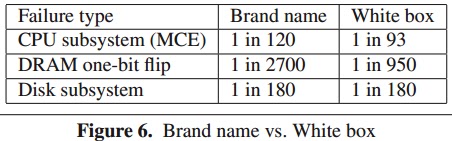
Ask enthusiasts what they think about systems built by Dell, HP, or any other big brand manufacturer, and you aren’t likely to hear much good. Actual data proves that major vendors actually have fewer problems than the systems built by everyone else. The researchers identified the Top 20 computer OEMs as “brand names” and removed overclocked machines from the analysis of the data. Only failure rates within the first 30 days of TACT were considered among machines with at least 30 days of TACT. This is critical because brand name boxes have an average of 9% more TACT than white box systems, which implies that the computers are used longer before being replaced.


White box systems don’t come off looking very good in these comparisons. CPUs are significantly more likely to fail, as is RAM. Disk reliability remains unchanged.


How about laptops? The researchers admitted that they expected desktops to prove more reliable than laptops due to the rougher handling of mobile devices and the higher temperatures such systems must endure. What they found suggests that laptop hardware is actually more reliable than desktop equipment, despite the greater likelihood that mobile systems will be dropped, sat on, or eaten by a bear. Again, overclocked systems were omitted from the comparison.


Desktops don’t come off looking very good here despite their sedentary nature. The team theorizes that the higher tolerances engineered into the CPU and DRAM, combined with better shock-absorbing capabilities in mobile hard drives may be responsible for the lower failure rate. The difference between SSDs and HDDs was not documented.


More data needed

The limitations of the study are such that we can’t draw absolute conclusions from this data, but they suggest a need for better analysis tools and indicate that adopting certain technologies, like ECC, would help improve desktop reliability. It’s one thing to say that overclocking hurts CPU longevity; something else to see that difference spelled out in data. The impact of underclocking was also quite surprising, this is the first study we’re aware of to demonstrate that running your CPU at a lower speed reduces the chance of a hardware error compared to stock.


The Microsoft team conducted the research as one step towards the goal of building operating systems and machines that are more tolerant of hardware faults. The fact that systems which throw these types of errors are far more likely to continue doing so strikes at the idea that such problems are random occurrences, as does much of the reliability information concerning DRAM.


The report throws doubt on a good deal of “conventional” wisdom and implies reliability is rather sorely lacking. More data is needed to determine why that is, and to correct the problem.


Endnotes

full study: http://research.microsoft.com/apps/pubs/default.aspx?id=144888

: http://www.extremetech.com/wp-content/uploads/2012/06/AMD-vs-Intel.png

: http://www.extremetech.com/wp-content/uploads/2012/06/Underclocking.png

: http://www.extremetech.com/wp-content/uploads/2012/06/Brand-vs-whitebox.png

: http://www.extremetech.com/wp-content/uploads/2012/06/Desktops-vs-Laptops.png

Thursday, June 21, 2012

Status of China's Fabless Model

The large demand for smartphone chips in China will cause local Chinese design houses to grow faster in the next few years.


Ron


source: IC Insights


Is China's fabless model sustainable?

http://www.eetimes.com/electronics-news/4375636/Is-China-fabless-model-sustainable?pageNumber=1
Junko Yoshida

6/19/2012 9:11 AM EDT


How many U.S. design engineers can name, say, the top 10 Chinese chip vendors destined to become their fierce competitors in three years from now? BEIJING -- Let’s face it. China’s IC industry still lacks its own superstars – equivalent to Intel, Qualcomm or Broadcom in the West – in terms of the scale, reach and quality these brands possess on the global market.

To belabor the point, how many U.S. design engineers can name, say, the top 10 Chinese chip vendors destined to become their fierce competitors in three years from now? The question is tough because Chinese fabless companies, while growing fast, are still small. Many also remain faceless.

In contrast, a Chinese executive based in Beijing, speaking with ee Times, rattled off Spreadtrum, RDA Microelectronics, GalaxyCore and GigaDevice as his “top four” picks among local fabless companies likely to become key players in the smartphone IC ecosystem. The executive, heading up a U.S.-based chip company’s R&D team, believes that will happen not within the decade, but in just a few years.


Is he right?
EE Times has talked to several movers and shakers in China’s semiconductor industry in recent weeks. While our investigation is still in progress, we’ll be reporting our ongoing findings in a two-part series. First, we examine the state of the Chinese fabless industry -- covering how they’ve gotten to where they are today. In part two, we discuss what Chinese semiconductor companies must do in order to cross the chasm – from local heroes in China to power players on the global stage.


On one hand, some multinationals like Synopsys (EDA vendor), VeriSilicon (“Design-Lite” service company) and ARM (IP supplier) are well positioned to leverage local engineering resources to respond to Chinese fabless companies’ always pressing (and almost impatient) need to get ahead more quickly.

On the other, Chinese startups, still in early days, lack a portfolio of their own IPs. Consequently, “they tend to compete on price with similar products in the same application fields,” observed Jian-Yue Pan, corporate vice president, Asia Pacific region of Synopsys.


Meanwhile, some China fabless are coming up with fresh ideas (i.e.Apexone), operating with an incredible work ethic and directing a fanatical focus on customer service (i.e. Awinic). Companies like RDA, Spreadtrum and Rockchip are growing like gangbusters.


It’s important to note that there is nothing monolithic about China or China’s fabless companies. Over the last two decades, a number of Chinese chip companies – some well known in the West – had distinct trajectories, with a full array of ups and downs. Some disappeared and others thrived, their fates depending on when each company was born, how it was managed, and whether the ecosystem in China was sufficient to spur growth.

Synopsys’ Pan turns out to be as good a student and observer of the Chinese semiconductor industry as any, since he has lived through the rise of the industry over the last 17 years while working at Synopsys in China.

Pan isn’t a returnee – like many other China fabless executives today who were born in China and came to the United States for graduate degrees, before going home again to help nurture the Chinese industry.

Pan is home-grown. He has worked his entire professional life in China, rather than in Silicon Valley, after graduation from the nation’s elite Tsinghua University in early the 1990’s.


Chinese fabless companies have come a long way


In the interview, Pan said, “A lot of things have happened. Over the last 17 years, we saw the rise of the Korean chip industry, and the decline of Japanese companies.” To illustrate the rise of the Chinese semiconductor industry, Pan divided the last 17 years in three periods: “incubation” (1995 – 2001); “breakthrough” (2001 – 2007); and “acceleration” (2007 – 2012).
Incubation

During the incubation period, virtually all the companies taking part in the Chinese semiconductor industry were state-owned. They were largely pushed, prompted and nurtured by Chinese government’s industrial policy and technology transfers from other countries including the United States, Europe and Japan.
During this period, the total revenue of the Chinese IC design houses was “less than $100 million,” according to Pan.


Nonetheless, several important milestones helped pave the way for the birth of the Chinese semiconductor industry. They include: the completion of technology transfer between Lucent and Huajing in 1997, allowing Huajing—located in Wuxi in Jiangsu Province—to start producing 6-inch CMOS wafers with 0.9 micron design rules. By 1999, SDRAM production started on the 8-inch wafer fab at HHNEC (Hua Hong NEC Electronics Co.) using a 0.35 micron process technology. These were days when few indigenous fabless companies existed in China. These fabs had to depend on the international semiconductor community for consumption, as well as for technical support.


But the most significant milestone of all during this period, according to Pan, was the emergence of the Chinese central government’s “Policy No. 18.” Put in place in July, 2000, the directive was a top-down order to “encourage the development of the IC industry in China,” explained Pan. Under Policy 18, the government offered favorable tax treatment to domestically produced IC chips, while providing heavy government investment in infrastructure, education and basic research.

As a result, seven state-owned incubation centers for IC design sprang up, with Synopsys coming out as one of the big beneficiaries. It turns out that the seven state-owned IC design centers standardized their design flow environment on Synopsys tools, making Synopsys the government’s favored tool designer.


Breakthrough

The following six years (2001 – 2007) is when the Chinese semiconductor industry saw a number of breakthroughs, fueled by the growth of the Chinese economy and adherence to Policy 18. Pan observed that in 2000, there were fewer than 100 fabless companies in China. But 2003, more than 450 fabless had vendors popped up. Also emerging was China’s strategic mimicry of the Silicon Valley model, using stock-based compensation to incentivize managers and engineers in high-tech companies.


In 2003, Hangzhou Silan Microelectronics Co., Ltd, popularly known as Silan Corporation, became the first IC vendor on the Shanghai Stock Exchange. Silan successfully made an IPO, initiated with 26 million shares of series A-stock
By 2006, both Vimicro International Corporation and Actions Semiconductor had gone through a rigorous IPO process and got listed in Nasdaq. In 2007, Spreadtrum went public and joined the Nasdaq club.


Acceleration

Pan now sees the Chinese semiconductor industry in its third phase, where everything is accelerating. There are five more Chinese companies on a wait-list to go public on Nasdaq.As of 2011, China had close to 500 fabless chip companies, with total revenue last year at “give or take, close to $10 billion,” Pan said.

Where do they go from here?
Over the last three years, “some startups – including GigaDevice, GalaxyCore, RDA and Rockchip – have grown very fast,” according to Datong Chen, co-founder and managing director of West Summit Capital in Beijing. There is no dispute about that
The question, however, is how sustainable it is for these companies to continue to grow so rapidly. How many more years can Chinese companies continuously keep gross margin low and perpetually work harder in order to bring down the cost of their products in hopes of beating out foreign competition?
In the top 20 fabless IC companies’ ranking for 2011 (put together by IC Insights), only two from China, HiSilicon and Spreadtrum, showed up.
Top 20 fabless IC companies in 201


source: IC Insights

Datong has experienced firsthand the rise of the Chinese chip industry, as he was the co-founder and CTO of Spreadtrum Communications. Prior to Spreadtrum, Datong was the co-founder and senior vice present for Omnivision, a leading developer of CMOS imaging sensor.

For Chinese fabless companies to sustain current growth, Datong said, “They need a bigger platform.” By “platform,” he means, “Money, a larger market size, and a bigger customer base.” Then, he added, “Of course, it’s better if they do IPOs – because that will allow them to get fair market value, it would make it much easier for them to do acquisitions, and they will get more trust from the market.”
The potential for Chinese fabless companies to reap greater rewards are already here, according to Allen Wu, president of ARM China. ARM-based SoCs, designed by Chinese fabless companies and shipped globally, jumped from 30 million units in 2007 to 615 million units in 2011.
And yet, Wayne Dai, president and CEO of VeriSilion, calls the Chinese semiconductor industry a “no-man’s-land of fabless companies.” He explained that most of the 400+ China fabless companies are living through a 'no man’s land,' which he describes "an inflection point for a start up’s life cycle.

In his view, "[Chinese fabless companies] are too big to be small, but too small to be big." In other words, "If they can’t continue to grow, evolving into firms that dramatically change their marketplace or define a new category, they have to either stay small or sell to a larger company. Otherwise, they are going out of business within the next two years."
In essence, most Chinese fabless companies remain too stubbornly small to exploit the market’s size. There lies the conundrum.
In part two of this article, we’ll discuss prescriptions—what steps Chinese fabless companies must take, and conversely, what actions multinationals should take to survive among all those Chinese go-getters.

Friday, June 15, 2012

Hynix Developing PCM, MRAM, and ReRAM Flash

To cut down cost and development risk Hynix is working with IBM on PCM type of flash memory. Hynix is already working on other future approaches such as PCM, MRAM, and ReRAM Flash (see more below).

Some background information on PCM, MRAM, and ReRAM Flash at Pushing the PRAM: when chips just can't get any smaller more information is at Flash educational links


Ron


SK Hynix, IBM form chip development alliance
http://www.zdnetasia.com/sk-hynix-ibm-form-chip-development-alliance-62305070.htm
By Ellyne Phneah , ZDNet Asia on June 11, 2012 (9 hours ago)

Summary

Korean chipmaker and Big Blue to develop phase-change random access memory (PcRAM), a non-volatile chip that can store high data volumes, amid rising popularity of mobile devices.


SK Hynix has formed an alliance with IBM to develop phase-change random access memory (PcRAM), which is considered to be the next generation of memory chips and capable of storing high data volumes.

According to Song Hyeon-jeong, head of the SK Hynix's future strategy office in the Korea Times on Sunday, the collaboration will help the Korean chip manufacturer strengthen its capabilities to better compete with rivals in next-generation chips. PcRAM is a non-volatile memory chip which uses the property of chalcogenide glass to switch between both states, and is touted to be able to store a lot of data but is slower than convential dynamic random access-memory (DRAM) chip.

The alliance also reflects efforts to develop advanced chips in light of the rising popularity of smartphones and tablets. SK Hynix said it was unable to survive with existing chips--NAND flash and DRAM--which were expected to be obsolete in a few years, the report noted.


As the chip-making structure of PcRAM was simple, the company said it would save on manufacturing as PcRAM applications would need the corresponding phase-change process to be induced by an electricial current and a significant-higher packing density of information.


SK Hynix since last year also had been working with Japanese chipmaker, Toshiba, on the development of magnetoresistive random access memory (MRAM), which is able to pack memory in a denser manner, according to a seperate report by the Korea Times. The Korean chipmaker had been developing resistive random access memory (ReRAM) with Hewlett-Packard (HP) since 2010, which was found to store twice as much data and use less energy than flash memory.

Wednesday, June 13, 2012

Apple's iPad, iCloud Drive Semiconductor Industry


Apple's increased usage of  NAND flash memory for storage is changing the semiconductor industry.

"Apple's top-end MacBook Pro won't have a hard drive -- the new ones will run only solid-state drives -- marks the latest, and perhaps most important move in an an industry trend towards SSD-only systems that use cloud-based storage services"....

"Apple's iPad tablet is expected to dominate worldwide demand for NAND flash in media tablets at least through 2015" (in millions of Gigabytes).

Ron


Apple's all-flash MacBook Pro, iCloud drive industry changes

http://www.computerworld.com/s/article/9227960/Apple_s_all_flash_MacBook_Pro_iCloud_drive_industry_changes
The MacBook Pro now comes with a 768GB SSD option, and automatic access to Apple's iCloud services

By Lucas Mearian

June 11, 2012 03:41 PM ET7 Comments. What's this?.Computerworld - Today's announcement that Apple's top-end MacBook Pro won't have a hard drive -- the new ones will run only solid-state drives -- marks the latest, and perhaps most important move in an an industry trend towards SSD-only systems that use cloud-based storage services.

Pricing for Apple's top-end MacBook Pro starts at $2,199 and includes a 2.3GHz quad-core chip, 8GB of RAM and 256GB SSD. Apple also announced 512GB and 768GB SSD MacBook Pro models.

The new MacBook Pro is 0.71 inches thick, weighs 4.46 pounds and uses Apple's latest Retina display technology.
Apple also announced a 512GB SSD option for its MacBook Air netbook, which doubles capacity from the previous 256GB maximum flash capacity.
Apple Monday also announced that its iCloud online storage service will be included with its laptops, doing for data and applications what the iTunes service did for digital music.


From here on out, anytime a user signs into a new MacBook Pro or Air with their Apple ID, the systems will automatically configure apps to work with iCloud. Anything stored in its cloud will be accessible on any other devices with the iCloud download.

The combination of SSD and cloud should be a powerful driver of laptop systems, said Andrew Reichmann, an analyst with Forrester Research.


Large hard drives will no longer be considered an advantage in laptops, as higher performing machines store frequently accessed data locally and everything else in the cloud.

Apple is currently the world's largest consumer of semiconductor technology. Apple currently uses NAND flash in its iPad, iPod, iPhone, MacBook Air and MacBook Pro lines. The iPad alone accounted for 78% of global NAND technology shipments in 2011.


According to IHS iSuppli, Apple's iPad tablet is expected to dominate worldwide demand for NAND flash in media tablets at least through 2015.

Ryan Chien, an SSD and storage analyst with IHS iSuppli, said today's MacBook Pro announcement is not as significant as last year's MacBook Air redesign or Intel s Ultrabook introduction because the SSD-equipped MacBook Pros are very premium products.

He said the MacBook Pro's use of SSD really won't "move the needle" in terms of the competitive landscape for PC storage or flash procurement, "as NAND usage from SSDs is far outpaced by smartphones and tablets."


"I believe what today signifies is a reaffirmation of Apple's commitment toward an aggressive Mac roadmap, and another step in aligning its computers with the runaway success of its mobile devices," Chien said

"And, increased SSD penetration on the Mac side is key to helping accentuate the unified Apple experience across all client devices in terms of performance and capabilities," he added.

The aggressive move into SSDs also sets the stage for deeper implementation of device-agnostic systems like iCloud and AirPlay, Chien said.

2012 Q1 Ranking: Toshiba Outperforms NAND Market

Toshiba grew faster than other manufacturers in the NAND market during Q1 of 2012 (see below). 

The patent wars between Samsung and Apple helped Toshiba advance since Apple is currently the world's largest consumer of semiconductor technology and probably increased its purchases from Toshiba. 

Apple currently uses NAND flash in its iPad, iPod, iPhone, MacBook Air and MacBook Pro lines. The iPad alone accounted for 78% of global NAND technology shipments in 2011.

I am wondering how Sandisk did in Q1 since IHS iSuppli does not includes it in its NAND ranking.

Ron


Toshiba shines in Q1 NAND rankings

http://eetimes.com/electronics-news/4375298/Toshiba-shines-in-Q1-NAND-rankings-
Dylan McGrath

6/13/2012 11:33 AM EDT

Japan's Toshiba posted NAND flash memory sales of $1.71 billion in the first quarter, up 19 percent from the fourth quarter of 2011, the highest growth rate among all NAND suppliers, and good for a 34 percent share of the NAND market, according to IHS iSuppli. BELLEVUE, Wash.—Japan's Toshiba Corp. posted NAND flash memory sales of $1.71 billion in the first quarter, up 19 percent from the fourth quarter of 2011, the highest growth rate among all NAND suppliers, and good for a 34 percent share of the NAND market, according to IHS iSuppli.

Toshiba retained its No. 2 position among NAND suppliers in the first quarter, trailing only South Korea's Samsung Electronics Co. Ltd., which held 37 percent of the market, according to IHS.

Toshiba's robust NAND sales growth in the first quarter was even more impressive considering that the NAND flash market as a whole declined by 1 percent during the quarter, according to IHS. All other NAND suppliers experienced sales decreases in the quarter, the firm said.

Overall first-quarter NAND flash sales amounted to $4.99 billion, from $5.05 billion in the fourth quarter last year, IHS said.

In achieving 34 percent first quarter growth, Toshiba shook off troubles experienced in 2011, when Toshiba's production was disrupted by the March 11 earthquake and tsunami in Japan and later, when Toshiba's sales—like all NAND suppliers—were hurt by market conditions that caused a carryover of inventory into the first quarter of this year, according to Dee Nguyen, memory analyst at IHS.

"Toshiba’s strong results show that the company has regained its footing and has put a tumultuous year behind it," Dee said, in a statement.


Overall, the NAND market was dragged down in the first quarter by weak pricing, which reflected the mismatch between an industry-wide growth in supply and a seasonally slow quarter for consumer demand, IHS said. With the exception of Toshiba, NAND suppliers experienced revenue declines that ranged from a soft landing for Samsung to a steep drop-off for Powerchip Technology Corp., IHS said.

Samsung logged first quarter NAND sales of $1.86 billion, down 4 percent from $1.94 billion in the fourth quarter of 2011, IHS said. The firm's market share decreased by one point in the first quarter compared to the fourth quarter of 2011, IHS said.
Powerchip's NAND sales declined 35 percent sequentially in the first quarter, while SK Hynix Inc. and Micron Technology Inc. saw sequential NAND sales declines of 14 percent and 17 percent, respectively, IHS said.

IHS blamed Samsung’s decline on a10 percent fall in the average selling price (ASP) of its NAND product and Samsung's throttling production in one of its fabs while preparing to transition to the firm’s System LSI division that makes processors and chip sets. The company is optimistic, however, about a better environment in the second quarter, as handset and PC manufacturers launch new products for the upcoming high-demand seasons, IHS said.

Thursday, May 31, 2012

Apple NAND Storage in Upcoming MacBook Pros

There is a room for an overall personal computer hierarchy reorganization. Maybe Apple could lead here.

Currently in PC/ Mac we have a microprocessor (with some fast DRAM memory) connected to long term storage in flash SSD or HDD.

There would be many benefits to adding a small flash NAND between the microprocessor and the long term storage. Such computer hierarchy would benefit from the faster operation of the small flash NAND storage and its long term non volatile storage. It will also reduce power consumption.

The NAND memory could support the microprocessor operations or be used for storage of the operating system.

There were rumors a couple of years ago about Intel working on such system. It never made it out due to legacy software optimization issues.

Ron


Apple likely to use NAND storage in upcoming MacBook Pros, analyst says
http://www.appleinsider.com/articles/12/05/30/apple_likely_to_use_nand_storage_in_upcoming_macbook_pros_analyst_says.html
By Mikey Campbell
Published: 05:35 PM EST (02:35 PM PST)

A research analyst from Barclays believes that Apple's success in NAND adoption will drive the company to use the technology in a rumored refresh of its MacBook Pro line, a move that will disrupt the business of of both hard drive and PC makers.

In a note to investors released on Wednesday, Ben Reitzes of Barclays Equity Research said that the adoption rate of Apple devices using SSDs, along with a continuing move to cloud computing, will push consumer laptop demand toward flash-based storage.

Perhaps the single greatest setback to flash adoption is that the price of solid state solutions grossly outweigh comparable HDDs, keeping the technology out of reach for everyday consumers. This cost ratio may tilt in the physical hard drive's favor, however consumers have recently started giving up storage space and low cost for design and performance benefits, evidenced by the success of the thin and light MacBook Air.

Reitzes believes that the advent of cloud computing will help ease consumers in the transition from physical drives to flash by offloading storage to servers, thus diminishing the need for pricey high-capacity NAND drives. Apple's iCloud is already well in-place and has the potential of filling offsite storage needs if the company chooses to move to a NAND-heavy laptop lineup.

For these reasons, the analyst expects Apple to reveal a NAND-equipped MacBook Pro as well as MacBook Airs with increased storage options in the near future.

"We believe these products combined can ramp quarterly demand for Macs by up to 1 million incremental units on a run rate basis - taking over a point of share from HDD-based PCs," Reitzes said.

He goes on to say that an estimated 5 to 10 percent of notebook PC sales have been cannibalized by NAND-carrying iPads and iPhones, further impacting HDD demand for PCs. The move to portable products has been dubbed as the "post-PC era," as consumers begin to replace computers with tablets and handset. Interestingly, this trend toward flash in consumer devices is seen as fueling data growth, which helps to augment sales of enterprise-class HDDs.