Friday, April 4, 2014

Top Semiconductor Ranking for 2013


The article below describes growth and ranking of top semiconductor companies in 2013.  


Last year growth was driven by;
  •         acquisitions such as Micron of Elpida, MediaTek merger with MStar,
  •        Mobile chip demand (processors, memory, etc.)
  •        DRAM market demand growth, Hynix was able to grow 43% even with the fire in a manufacturing plant

Qualcomm was ranked 4th, growing 31% in 2013.

NAND market growth is not well document here. For example SanDisk still is not ranked here even though it is a major NAND supplier with revenue of more than $6 Billion in 2013.


Ron
Insightful, timely, and accurate semiconductor consulting.
Semiconductor information and news at - 
http://www.maltiel-consulting.com/


IC Insights Shows Big Changes to 2013 Top 20 Semi Supplier Ranking

SK Hynix, MediaTek, Micron, and Qualcomm each registered ≥30% year-over-year growth.

IC Insights’ April Update to The 2014 McClean Report will show a ranking of the 2013 top 50 semiconductor suppliers. A preview of the top 20 companies is listed in Figure 1.  The top 20 worldwide semiconductor (includes ICs and O-S-Ds—optoelectronics, discretes, and sensors) sales leaders for 2013 included nine suppliers headquartered in the U.S., three in Japan, three in Taiwan, three in Europe, and two in South Korea, a relatively broad representation of geographic regions.

The top 20 ranking also includes three pure-play foundries (TSMC, GlobalFoundries, and UMC) and five fabless companies.  It is interesting to note that the top four semiconductor suppliers all have different business models. Intel is essentially a pure-play IDM, Samsung a vertically integrated IC supplier, TSMC a pure-play foundry, and Qualcomm a fabless company.

IC foundries are included in the top 20 semiconductor supplier ranking because IC Insights has always viewed the ranking as a top supplier list, not as a marketshare ranking, and realizes that in some cases semiconductor sales are double counted.  With many of our clients being vendors to the semiconductor industry (supplying equipment, chemicals, gases, etc.), excluding large IC manufacturers like the foundries would leave significant “holes” in the list of top semiconductor suppliers.  Foundries and fabless companies are clearly identified in Figure 1.  In the April Update to The McClean Report, “marketshare” rankings of IC suppliers by product type are presented and foundries are excluded from these rankings.

It should be noted that not all foundry sales should be excluded when attempting to create marketshare data.  For example, although Samsung had a large amount of foundry sales last year, most of its sales were to Apple.  Apple does not re-sell these devices, so counting these foundry sales as Samsung semiconductor sales does not introduce double counting.

Overall, the list shown in Figure 1 is provided as a guideline to identify which companies are the leading semiconductor suppliers, whether they are IDMs, fabless companies, or foundries.
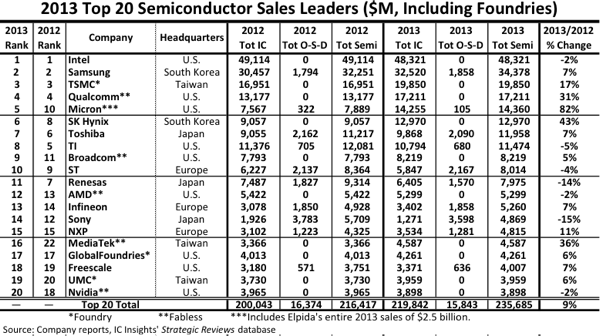


Figure 1

Excluding the foundries of TSMC, GlobalFoundries, and UMC from the top 20 ranking would bring Fujitsu, Marvell, and Sharp into the 18th, 19th, and 20th positions, respectively (Figure 2).


Figure 2

There were numerous changes within the top 20 semiconductor supplier ranking in 2013 as compared to the top 20 ranking of 2012.  Spurred by its acquisition of Elpida last year, Micron climbed five spots and moved into the top 5 ranking.  Some of the other companies that rose in the 2013 ranking include SK Hynix, which, despite a significant fire and production setback at its largest memory fab in China, took full advantage of the 32% surge in the DRAM market last year and moved up two places into the 6th position.  Also, Broadcom moved into the top 10 while MediaTek jumped up six positions to 16th place and into the top 20 ranking for the first time. 

MediaTek is experiencing extremely strong demand for its devices in the booming low-end smartphone business in China and other Asia-Pacific locations.  In fact, MediaTek’s application processor shipments for smartphones reached over 200 million units last year, about double the 108 million units the company shipped in 2012.  Moreover, with MediaTek and MStar expected to merge in 2014, the annual post-merger sales for MediaTek should be over $6 billion, most likely enough to lift the company into the 12th spot in the 2014 ranking.

Another company expected to make a significant move up in the ranking this year by way of acquisition is Avago. After the company’s purchase of LSI Corp., the combined semiconductor sales of the two companies is likely to be well over $5 billion this year, which could propel Avago from its 27th 2013 ranking to as high as 13th in 2014!

In contrast to the semiconductor companies moving up in the ranking, Fujitsu dropped five places to fall out of the top 20 ranking in 2013, going from being ranked 16th in 2012 to 21st last year (the company sold its analog and MCU business to Spansion in August of 2013).  Renesas was another “casualty” in the top 20 ranking and fell to 11th place last year from the 7th position it held in 2012.

In total, the top 20 semiconductor companies’ sales increased by 9% in 2013 as compared to 2012, which was more than twice the 4% growth rate for total worldwide semiconductor market last year!  It took total semiconductor sales of about $3.9 billion to make the top 20 ranking in 2013.

Figure 3 shows that there was a 97-percentage-point range of growth rates among the worldwide top 20 semiconductor suppliers in 2013 (from +82% for Micron to -15% for Sony).  The continued success of the fabless/foundry business model and the strong growth of the memory market (especially the 32% DRAM market surge) last year is evident when examining the six top 20 semiconductor suppliers that logged double-digit growth. As shown, the top six performers in 2013 included two memory companies (SK Hynix and Micron), two fabless companies (MediaTek and Qualcomm), and TSMC (the largest pure-play foundry).

Figure 3 shows that the two top 20 ranked companies that registered double-digit sales declines in 2013 are headquartered in Japan (Renesas and Sony).  As previously shown, Japan-based Fujitsu also registered a double-digit decline (-16%) in 2013 and dropped out of the top 20 ranking last year.  However, it should be noted that the conversion of Japanese company semiconductor sales from yen to U.S. dollars, at 97.6 yen per dollar in 2013 versus the 79.8 yen per dollar rate in 2012, had a significant impact on the sales figures for the Japanese companies.  Using a constant 2012 U.S. dollar versus Japanese yen exchange rate for 2013, the 2013 semiconductor sales of Renesas, Sony, and Fujitsu, would have increased 5%, 4%, and 3%, respectively.

More details on the 2013 top 50 semiconductor suppliers will be provided in the April Update to The McClean Report.


Figure 3

Monday, March 24, 2014

Apple 64 bits,Mobile DRAM Market, and Masking Lithography


"mass producing what the company said is the most advanced 4Gb DDR3 memory based on a new 20 nanometer process technology using immersion ArF lithography...

key element of the new design and manufacturing technology is a modified double patterning and atomic layer deposition that allows for continued scaling. The new approach to double patterning enables 20nm DDR3 production using current photolithography equipment, Kadivar said. “We have found the most efficient way to manufacture high density DDR3 technology, in this case 4Gb.” Samsung has also created ultrathin dielectric layers of cell capacitors with a very high level of uniformity, which is an important contributor to higher cell performance."

While in the ecosystem of mobile DRAM products sale and marketing -

 “After the 64bit AP was first applied to the iPhone 5S by Apple last year, it was expected to become the basic performance of premium smartphones. However, companies in the Android camp cannot bring themselves to use the 64bit AP. The 64bit AP is not compatible with the Google Android OS yet…

Qualcomm has already unveiled the 64bit Snapdragon, and SEC is known to have almost developed the 64bit AP. If the OS problem is solved, it appears that Android smartphones will not have much difficulty adopting the 64bit AP.

The delayed commercialization of the 64bit mobile AP impacted on the DRAM market. 1~2GB mobile DRAMs are used in 32bit AP smartphones, but 64bit AP smartphones come with 3GB or bigger DRAMs. Memory semiconductor makers established the mobile DRAM production plan for this year in consideration of the demands for the 64bit AP. As demands are not picking up, the Q2 contract prices of mobile DRAMs are expected to go down. (http://english.etnews.com/device/2933349_1304.html)


Ron
Insightful, timely, and accurate semiconductor consulting.
Semiconductor information and news at - http://www.maltiel-consulting.com/


Korea's DRAM Market Suffers as Google Delays Android 64-bit


Apple introduced the first smartphone in the world to run on a 64 bit architecture last September. The iPhone 5S lead the way. Thereafter it was simply expected to become the basic performance of premium smartphones. However, Android OEMs can't match Apple's offering because Android isn't 64bit compatible at the moment even though Qualcomm has a 64bit processor ready to ship. While Samsung is hoping to be the first Android OEM to deliver a 64bit based smartphone this fall, industry Insiders aren't so sure it'll be ready in time. In fact they believe that will be pushed into sometime in 2015.


Those in the DRAM market have suffered a direct blow due to Google's inability to deliver a 64bit version of Android. 

Wednesday, March 19, 2014

16nm Split Gate NV (Non Volatile) Memory Cell Advance

Split gate nonvolatile memory is often used in embedded flash IC chips. An advance in nonvolatile split gate memory technology by CEA-Leti is discussed below. 

By using a self-aligned of the transistor gate above the nitride charge trapping layer, the number of masks required to make the memory cell is reduced, and the bias and size of the critical mask is also reduced. The new smaller embedded memory cell is smaller and more efficient.

"this self-aligned technology concern the precise control of the spacer memory gate shape and of the memory gate length. Spacer gate has to fulfill two difficult requirements: being as flat as possible in order to get a silicidation surface as large as possible while insuring a functional contact, and getting a steep edge in order to control the drain-junction doping."

A key issue is how manufacturable would be this new masking  process integration. For example controlling the properties of the charge trapping layer in large volume manufacturing could be difficult.

Ron
Insightful, timely, and accurate semiconductor consulting.
Semiconductor information and news at - 
http://www.maltiel-consulting.com/


CEA-Leti builds 16nm self-aligned split-gate memory

Posted: 17 Mar 2014  
CEA-Leti has developed what it says are ultra-scaled split-gate memories with a gate length of 16nm. According to the research centre, the memories demonstrate good writing and erasing performances with memory windows greater than 6V.
Split-gate flash memories are made of two transistors: an access transistor and a memory transistor with a charge-trapping layer (nitride, Si nanocrystals etc.). Split-gate architectures use a low-access voltage and minimize drain current during programming, which leads to a decrease of the programming power compared to standard one-transistor NOR memories, stated the research centre. Because programming energy decreases when memory gate length decreases, ultra-scaling is particularly relevant for contactless applications.
The memory gate has been reduced down to 16nm thanks to a poly-Si spacer formed on the sidewall of the select transistor. This approach avoids costly lithography steps during fabrication and solves misalignment issues, which are responsible for a strong variation of the electrical performances, such as the memory window.
The main challenges of this self-aligned technology concern the precise control of the spacer memory gate shape and of the memory gate length. Spacer gate has to fulfil two difficult requirements: being as flat as possible in order to get a silicidation surface as large as possible while insuring a functional contact, and getting a steep edge in order to control the drain-junction doping.
TEM images of ultra-scaled self-aligned split-gate device


TEM images of ultra-scaled self-aligned split-gate device, with a memory 
gate length of 16nm.

Monday, March 17, 2014

Self Encrypting SSD (SED) to Rescue Security/ Privacy?

The article below discusses benefits of integrating encrypting in the hardware.

"Samsung claims that self-encrypting drives are the solutions to better security...can protect sensitive data better than software solutions because self-encrypting SSDs automatically encrypt information as it's saved to the drive.

A key benefit of SED (Self Encrypting Drive) is the automated process, which makes it difficult for human error leaving the data vulnerable (see Missed Alarms, 40 Mil. Stolen Credit Card Numbers: Target Blew It). In addition, the additional security level of the hardware on silicon chip increase the difficulty for anybody trying to access the data.

Remaining issues in protecting the data:
Is there any way to replicate the encryption key stored on the silicon chip?

Can a government or a malicious vendor duplicate the encryption and transmit it through a back door?

Ron
Insightful, timely, and accurate semiconductor consulting.
Semiconductor information and news at - http://www.maltiel-consulting.com/


Will Self-Encrypting Drives Help Stop Data Breaches?

  • Mar 14, 2014 8:00 AM EST
In light of all the security breaches last year, companies are looking for ways to protect their own and their clients' data. Samsung claims that self-encrypting drives are the solutions to better security software protection. In a recent infographic, the company outlines a few reasons why self-encrypting drives are better for businesses.
In 2012, well over 250 million records with personal information were compromised in security breaches. That same year, the average cost of a data breach was more than five million dollars. Samsung claims this devastating problem can be alleviated with an easy solution: swapping out a PC's hard disk drive for a solid state drive (SSD) with self-encrypting drive (SED) technology. These drives can protect sensitive data better than software solutions because self-encrypting SSDs automatically encrypt information as it's saved to the drive. 
The Perks of SSD with SEDFirst off, data encryption and key management happen in drive hardware so putting in an SSD with SED leads to better security and system performance. Software encryption is just another process on a host device, which makes it more vulnerable to attacks and hinders PC performance when it encrypts data.
Oftentimes employees will turn off software-based encryption, which leads to noncompliance risk. SEDs, on the other hand, cannot be disabled, and encryption transparent to users. There's no need to download special security software to use SEDs either; they meet requirements for enterprise applications and can be controlled by security management software.
Why Self-Encrypting SSD Is the SolutionUsing Crypto Erase technology to wipe out data on your SED is a quick and painless process: the drive simply deletes the active encryption key. Trying to render data unreadable on a hard drive with software-based encryption, on the other hand, can take up a lot more of your time and money.
An additional perk is that SEDs fulfill government and industry requirements that laws like FACTA and HIPAA implement to regulate the security of private electronic data. Several laws also include a Safe Harbor convention for encrypted data, which spares organizations the embarrassment and expense of a public notification of data breaches.
Self-encrypting SSDs costs less than 80 cents per gigabyte, potentially saving millions of dollars for many companies. These drives could be a great tool for companies to use to protect consumer information and avoid the headaches of data breaches. 

Monday, March 3, 2014

Flash NAND, NOR, eMMC Market Growth

NAND market continues to grow while NOR continue to shrink (see article below). 

The reason for NAND dominance were explained on my May 2007 article on Long Term Trends in the NOR and NAND Markets .


Highlights from review of the IHS report in the article below:
"NAND product known as embedded multimedia card (eMMC) enjoyed record shipments in 2013 of more than 1 billion units, up a hefty 49 percent from 687 million in 2012. NAND revenue rose 28 percent to US$25.8 billion.
In comparison, NOR shipments last year fell 10 percent to 606 million units, with revenue down 15 percent to approximately US$3.0 billion....
The evolution of eMMC, in particular, has been rapid, with nearly annual enhancements to performance. As an economical choice for greater flash-memory densities, eMMC has become viable in high-end markets like smartphones and tablets, in which high-density storage capacity is required along with low-power consumption and a small footprint.
Embedded NAND’s utility has also now carried over from smartphones in its early use, to tablets. Last year, eMMC was the standard memory configuration for a vast majority of tablets, the only exception being the Surface Pro from Microsoft, which employs a SATA-interface solid-state drive.
The billion-unit shipment level of eMMC last year is a milestone, Yang remarked, and the product shows the way forward for managed NAND solutions by its deft handling of error correction and enhanced reliability at the solution level."
Ron
Insightful, timely, and accurate semiconductor consulting.
Semiconductor information and news at - http://www.maltiel-consulting.com/


NAND eMMC hits a record year, while NOR Flash shrinks further

 
NAND eMMC hits a record year, while NOR Flash shrinks further
Source: IHS Technology, February 2014

The global memory market presented a vivid picture of contrast last year given the wildly divergent fortunes of its two main segments, with spritely NAND offset by the sobering continued downturn of beleaguered NOR flash, according to a new report from IHS Technology.
On the one hand, the NAND product known as embedded multimedia card (eMMC) enjoyed record shipments in 2013 of more than 1 billion units, up a hefty 49 percent from 687 million in 2012. NAND revenue rose 28 percent to US$25.8 billion.
In comparison, NOR shipments last year fell 10 percent to 606 million units, with revenue down 15 percent to approximately US$3.0 billion.
The overall flash market in 2013 was worth US$28.8 billion, up from US$23.7 billion a year earlier, as shown in the attached figure.
“The key driver to NAND lies in its proliferating use for mobile consumer electronics, exemplified by the memory’s increasingly widespread application in devices like smartphones, tablets and notebook PCs,” said Michael Yang, senior principal analyst for memory & storage at IHS.
“Meanwhile, NOR’s once-broad portfolio of applications in low-end mobile handsets and desktop PCs has mostly matured, and its next killer market has yet to manifest.”
These findings are contained in the report, “Mobile & Embedded Memory Tracker – Q4 2013,” from the Semiconductors & Components service of IHS.
NAND memory, in the form of either raw NAND or eMMC, is now the standard memory used for most smartphones. The only exception is Apple’s iPhone, which uses its own managed NAND memory product.
The evolution of eMMC, in particular, has been rapid, with nearly annual enhancements to performance. As an economical choice for greater flash-memory densities, eMMC has become viable in high-end markets like smartphones and tablets, in which high-density storage capacity is required along with low-power consumption and a small footprint.
Embedded NAND’s utility has also now carried over from smartphones in its early use, to tablets. Last year, eMMC was the standard memory configuration for a vast majority of tablets, the only exception being the Surface Pro from Microsoft, which employs a SATA-interface solid-state drive.
The billion-unit shipment level of eMMC last year is a milestone, Yang remarked, and the product shows the way forward for managed NAND solutions by its deft handling of error correction and enhanced reliability at the solution level.
The rise of eMMC has also bred a new cast of suppliers. While Samsung remains dominant, players like SK Hynix, SanDisk and Toshiba are fiercely competitive and poised to gain ground.
The eMMC space, however, could see challenges this year. With growth slowing in the smartphone and tablet markets, there could be a possible oversupply of the memory type, in the process also leading to a possible large drop in eMMC average selling prices.
The steady decline of the NOR flash market began in 2007 and hasn’t stopped since. At its peak, the NOR market exceeded US$9 billion a year and last hit US$8 billion back in 2006—a far cry from its current numbers.
The NOR picture is also complicated by the contrasting outlook for its two sub-segments.
Parallel NOR, long used in computers for boot-code execution or serving as a storage medium for entry-level cellphones, will see its run in wireless devices come to an end sometime next year.
Parallel NOR will continue to be used in high-level industrial, medical, networking and military applications, but its exit from wireless will be a blow.
Meanwhile, serial peripheral interface (SPI) NOR, rival to parallel NOR, will go on to wider use in both wireless and consumer devices.
SPI NOR’s relative simplicity in design and low manufacturing cost will prove appealing, and the memory will be especially attractive to manufacturers of low-cost cellphones that need to keep a lid on expenses.
The shift from parallel to SPI NOR has also impacted their respective suppliers. Micron Technology and Spansion, the foremost producers of parallel NOR, now also have SPI offerings.
However, both companies have been at pains to differentiate their SPI product from the rest of the pack, in order to stave off the aggressive penetration of other SPI NOR suppliers such as Macronix, Winbond Electronics and GigaDevice.
The ongoing growth of SPI NOR will help offset a shrinking parallel NOR market, but the industry would be healthier if consolidation took place and reduced the number of players to four, IHS believes.
There are five suppliers at present that command 75 percent of the market, along with a spattering of smaller producers that make up the rest of the market.
Even so, there are no quick fixes, with the largest NOR applications disappearing or on their way out, and new deployments like automotive NOR still facing an uphill climb.

Monday, February 24, 2014

Qualcom, MediaTek Processor Chip Race

Apple 64 bit CPU used in its cell phones (see September 2013 iPhone 5s $199 Manufacturing Cost (BOM)) led Qualcomm to advance to 4 and 8 core Snapdragon processor with 64 bit support (see below).


Similarly, MediaTek, a chipset manufacturer based out of Taiwan, has been making some huge moves lately. Just over two months ago, it came out with the "world's first true octa-core" processor, which consisted of eight Cortex-A7 cores capable of operating simultaneously. Now that ARM has announced Cortex-A17 technology, (see second article below).

More about MediaTek see July 2013 Smartphone: MediaTek Overtaking Qulacomm


Ron
Insightful, timely, and accurate semiconductor consulting.
Semiconductor information and news at - http://www.maltiel-consulting.com/


Qualcomm’s 4- and 8-core Snapdragon 610 and 615 trade CPU power for 64-bit

Cortex A53 won't stand up to Krait, but Qualcomm adds a capable GPU to the mix.


The Snapdragon 610 will be equipped with four ARM Cortex A53 CPU cores running at an unspecified clock speed, rather than one of Qualcomm's custom ARM architectures. Snapdragon 615 takes a classic more-is-better approach, adding four more Cortex A53 CPU cores to the 610 for a total of eight. (Update:According to AnandTech, each group of four cores in the Snapdragon 615 will be optimized for a different performance level. One group will offer faster performance and one will offer lower power consumption, but both groups can theoretically be active at the same time.) For reference, the original Snapdragon 600 included four 32-bit Krait 300 CPU cores running at 1.7 or 1.9GHz, depending on the specific model.Qualcomm's first 64-bit chip wasn't a record-breaking high-end Snapdragon, but rather the modest, mid-range Snapdragon 410. Today at the Mobile World Congress in Barcelona, the company announced its next two 64-bit mobile SoCs, the Snapdragon 610 and 615. Rather than introducing 64-bit at the top of its product lineup and letting it trickle down, Qualcomm seems to be taking the opposite approach.
The list of CPU architectures that ARM offers is getting difficult to keep track of, but here's what you need to know: Cortex A53 is a replacement of sorts for the Cortex A7. It's the first of two CPU designs from ARM that supports the new, more efficient ARMv8 instruction set and, by extension, the traditional benefits of a 64-bit architecture (not all ARMv8 chips are 64-bit, but everything we've seen so far has been). Cortex A7 and A53 are both small cores designed for low power rather than high performance, which means that Snapdragon 610 and 615 may actually be slower than last year's Snapdragon 600 for many tasks. For software that can use all of the CPU cores at once, it's possible that the eight-core 615 will be able to gain an edge, but the CPUs will likely be more remarkable for their ARMv8 support than their raw performance.
Luckily for Qualcomm, the chips' custom GPUs and LTE modems will be more compelling for partners and consumers (and will differentiate the 610 and 615 from theSnapdragon 410, which also uses four Cortex A53 CPU cores). The Adreno 405 GPU is a relative of the Adreno 420 in the upcoming Snapdragon 805, and while it will probably be a little slower, it still supports OpenGL ES 3.0 (also included in Adreno 300 GPUs), DirectX 11.2 (good for Windows phones), H.265 video decoding, and displays up to 2560×1600 in resolution.
On the wireless side, the 610 and 615 support LTE speeds of up to 150Mbps and are compatible with Qualcomm's "RF360 Front End Solution," which allows phone manufacturers to support multiple worldwide LTE bands with a single phone rather than having to customize multiple configurations for different markets. Bluetooth 4.1 and 802.11ac Wi-Fi are also included.
Qualcomm says that the 410, 610, and 615 will all be supported by the same software and will be pin-compatible, meaning that any phone designed for one of these three chips can be upgraded or downgraded at will. This should be handy for OEMs looking to spruce up an older handset, or phone-makers who want to experiment a bit to find the best balance between performance, power consumption, and cost.
Both the Snapdragon 610 and 615 are scheduled to begin sampling in the third quarter of 2014 and will appear in shipping phones and tablets in the fourth quarter; the Snapdragon 410 and 805 are scheduled to be released in a similar timeframe. Those of you waiting for a true high-end 64-bit part from Qualcomm will have to keep waiting. The new-ish Snapdragon 801 and the Snapdragon 805 will be the company's flagship SoCs through the end of 2014, but by the end of the year we'd expect to hear something about some kind of 64-bit Snapdragon 810-series part based on either the high-performance Cortex A57 architecture or a new version of Qualcomm's custom Krait architecture.

MediaTek, a chipset manufacturer based out of Taiwan, has been making some huge moves lately. Just over two months ago, it came out with the "world's first true octa-core" processor, which consisted of eight Cortex-A7 cores capable of operating simultaneously. Now that ARM has announced Cortex-A17 technology, however, MediaTek is ready to start sampling a new octa-core chip that consists of four 2.2-2.5GHz A17 cores and four 1.7GHz A7s, and comes with a Rogue PowerVR Series6 GPU to take care of any graphical needs you might have.
As an aside, the A17 cores come with a 60 percent improvement in performance over the current-gen A9s, and are primarily designed to make midrange smartphones and tablets even faster. That said, MediaTek tells us that its new chips, known as the MT6595, are actually meant to be featured in premium devices and will square off directly against Qualcomm's Snapdragon 800 and 805. And it's certainly got a few noteworthy features: first, the chip will use ARM's big.LITTLE architecture and Heterogeneous Multi-Processing, which means you can use all eight cores for the most intense tasks, or you can use just one or two at a time for incredibly basic activities. The company claims that this chip will be faster and more power efficient than the octa-core Exynos options, which feature four A15 cores and four A7s at lower frequencies.
Additionally, the MT6595 claims to be the first octa-core LTE system-on-chip with an H.265 Ultra HD Codec built-in to the platform, which offers 4K2K video recording and playback capabilities. In much the same way that most manufacturers don't enable all of a chip's features, however, it'll be up to each individual company to add it in. The chips will begin sampling to phone makers and carriers in the first half of this year, and it's expected to arrive in products during the second half. And while it should find its way into smartphones and tablets around the world, MediaTek wants the MT6595 to enjoy a huge presence in the US.

Monday, February 10, 2014

IBM Selling Foundry Fabs

The article below discuss IBM announcement that it is selling its manufacturing operations. It will impact SOI (Silicon on Insulator), a process  that IBM specialized in.

It is not likely that Intel will buy an existing fab. Intel always duplicates an existing process in a current fab when they build a new fab 


It is just another example of consolidation chip manufacturing see in March 2012 Moore's Law End? (Next semiconductors gen. cost $10 billion
" chip industry without IBM will be a diminished industry."

IBM has been number 10 in foundry ranking for several years ( Top Semiconductor Ranking 2012 (Sales, Growth) 

More recent IBM dropped to number 11 in ranking (Top 13 Foundries Account for 91% of Total Foundry Sales in 2013)


Ron
Insightful, timely, and accurate semiconductor consulting.
Semiconductor information and news at - http://www.maltiel-consulting.com/


IBM fabs for sale – the semiconductor shockwave

Following the semiconductor shock of IBM pulling out of chip manufacturing, David Manners considers who could buy and run the IBM fabs, whose processes include SOI and SiGe, and which supply manufacturing process technology to half the world’s major companies: Samsung, GloFo, UMC, ST, Renesas, NEC, Freescale, Toshiba and Infineon.
The biggest shockwave the semiconductor industry has had for years is the IBM announcement that it is pulling out of chip manufacturing.

IBM CEO Ginni Rometty has decided that IBM’s future is in software and services and chip manufacturing clearly doesn’t fall in either of these categories .

Moreover IBM’s chip manufacturing business lost $130 million last year and is slated to lose another $130 million this year while the capital costs to stay in the game are $5 billion a factory and rising.
That’s one way of looking at it.

The other way of looking at it is that IBM has been a stalwart of the world semiconductor industry, inventing the DRAM, mastering SiGe, SOI and much more besides and supplies manufacturing process technology to half the world’s major companies: Samsung, GloFo, UMC, ST, Renesas, NEC, Freescale, Toshiba and Infineon.
It is shocking to think IBM’s legendary R&D operation may be curtailed but, without the justification of a business outlet for its innovations, it may be.

One rather assumes that the obvious candidates for buying IBM’s fabs have already been tapped and that the announcement that Goldman Sachs has been appointed to look for a buyer for the fabs is to find an unobvious candidate.

The obvious candidates are Intel, TSMC, GloFo and Samsung.

However, Intel has net cash of only $7 billion and makes only CMOS chips, while IBM’s capacity includes processes like SOI and SiGe which Intel won’t need and the IBM fabs are not as advanced as Intel’s.

TSMC says it doesn’t want to operate foreign fabs; GloFo’s owners are said to be getting fed up with their capital-greedy chip investment and may not want to expose themselves further to the chip industry; Samsung already has as much operational and planned capacity in the USA as it needs.

So how about the non-obvious candidates?
Suggestions have been that Apple could enter into a jv with IBM to run the fabs. This would involve Apple putting a lot of money in to upgrade the fabs to the latest processes, but Apple has lots of money and IBM has the latest processes.
TowerJazz is another suggestion. The company has just formed a jv with Panasonic in which TowerJazz has a 51% share and which will own three Panasonic fabs in Japan.

The Panasonic deal gives TowerJazz’s already impressive array of specialty processes the addition of Panasonic’s specialty flows such as High Definition FSI for sensors and high voltage SOI power management technologies.
If TowerJazz now added IBM’s specialty processes like SiGe and SOI to its stable, it would become the world’s No.1 specialty fab.

Another suggestion is China. China has been trying, unsuccessfully, to build an indigenous chip industry for 30 years. Following the successful integration of IBM’s PC business into Lenovo, followed by the recent sale of IBM’s x86 server business to Lenovo, it would seem quite logical that a sale of IBM’s chip manufacturing would be to China.
Of course the European authorities, wedded to the idea of gaining 20% world market share in IC manufacturing, may see the opportunity to acquire IBM’s world-class process development capabilities as a sufficient reason to buy the fabs. IBM’s proficiency in SOI would give a boost to the European-developed FD-SOI process.
Then, of course, there are other emerging national tech players like Brazil and India who could see this as a once in a lifetime opportunity to acquire the basis for a chip industry.

Whatever the outcome of this, a chip industry without IBM will be a diminished industry.