Tuesday, April 15, 2014

Galaxy S5 BOM $256, iPhone $191, $173

IHS released a teardown of Samsung’s Galaxy S5, the estimated bill of materials of $256 BOM keeps going up from previous cell phone generations. See more in the article below;

"IHS found that the Galaxy S3 had a BOM of $205, while the S4 ended up at $233 (LTE version with Qualcomm 600 SoC). On top of that, a Galaxy S series phone costs upwards of $8 to assemble."

While "the iPhone 5S had a BOM of $191 when it launched last September, while the iPhone 5C had $173 worth of components inside its unapologetically plastic body."

Like in Apple's phone DRAM and NAND are a high cost items and as semiconductor manufacturing advance along its learning curve it will increase Samsung margin.
  1. 1080p display is the most expensive component, costing about $65
  2. DRAM and NAND memory is around $33
  3. Unclear how much the Snapdragon 801 SoC costs, should be about $30


See more at iPhone Teardown Updated,  iPhone 5s Teardown, and some more about the processor iPhone A6 Teardown Update


Ron

Insightful, timely, and accurate semiconductor consulting.
Semiconductor information and news at - http://www.maltiel-consulting.com/
Research firm IHS got hold of Samsung’s new flagship smartphone and took it apart to the last bolt to figure out how much it actually costs to build. According to the teardown, the Galaxy S5 has a bill of material (BOM) of $256. 
Of course, this is not the full cost of the device, as it does not cover logistics, R&D, marketing and a range of other expenses that Samsung has to cover before the device makes it to retail.

Galaxy S5 BOM higher than usual


The $256 figure sounds a tad too high. Most flagship phones tend to have a BOM of about $200 or less. Most iPhones usually end up south of $200. For example, the iPhone 5S had a BOM of $191 when it launched last September, while the iPhone 5C had $173 worth of components inside its unapologetically plastic body. 
The Galaxy S5 retails for $699. Samsung does not have as much room to jack up margins as Apple does on the iPhone 5S, but it still has quite a bit more than many manufacturers. What’s more, Samsung’s BOM keeps going up. IHS found that the Galaxy S3 had a BOM of $205, while the S4 ended up at $233 (LTE version with Qualcomm 600 SoC). On top of that, a Galaxy S series phone costs upwards of $8 to assemble.
High-end smartphones are pricey, but at least it’s nice to see that Samsung’s consumers get a bit more value for money with each new generation.

Display remains the priciest component


Unsurprisingly Samsung’s 5-inch 1080p display is the most expensive component in the Galaxy S5. IHS puts its cost at $65. The cost of DRAM and NAND memory is around $33, but it’s unclear how much the Snapdragon 801 SoC costs. IHS puts the price of the Snapdragon 600 used in the S4 at $20, while the big Exynos 5 was estimated to cost $30. The Snapdragon 801 is probably closer to the Exynos in terms of overall cost.
“Inside we see mostly a lot of recycled components that we’ve seen before. There’s really nothing special inside where Samsung is pushing the envelope,” IHS analyst Andrew Rassweiler toldRe/code. “There’s no breakthroughs, there’s nothing earth-shattering. It’s really just a continuation of what has come before.”
However, although there are no breakthroughs, the Galaxy S5 features a few new sensors, including a $4 fingerprint sensor and a biosensor from Maxium, with an estimated cost of $1.45. In addition to the new components which were not used in previous Galaxy S phones, the S5 also features a somewhat sturdier body, which also happens to be waterproof. This probably added a few more bucks to the BOM. 

Monday, April 7, 2014

Qualcomm's SoC Road Map for 2014, 2015

The table in the article below documents Qualcomm direction in response to Apple 64 bit processor (see in September 2013 iPhone 5s Teardown ).

"Today Qualcomm is rounding out its 64-bit family with the Snapdragon 808 and 810. Like the previous 64-bit announcements (Snapdragon 410, 610 and 615), the 808 and 810 leverage ARM's own CPU IP in lieu of a Qualcomm designed microarchitecture. We'll finally hear about Qualcomm's own custom 64-bit architecture later this year, but it's clear that all 64-bit Snapdragon SoCs shipping in 2014 (and early 2015) will use ARM CPU IP."

A key issue for Qualcomm is "Qualcomm's sharing the roadmap to its premium Snapdragon chipset lineup much earlier than it usually does; the 810 and 808 won't be available on devices until the first half of 2015. This is largely due to competitive pressure: MediaTek, Intel and NVIDIA are going big by pushing out chips with 64-bit support and, in some cases, eight cores. Given how fast the industry is iterating, it's not hard to see that Qualcomm -- which currently dominates much of the mobile chipset market -- doesn't want to lose momentum or popularity." Qualcomm's 2015 chips may make you regret getting a new phone this year

See more from September 2013 on iPhone 5s Teardown ,

While Qualcomm grew 31% last year, Media Tek already grew 36% semiconductor vendors ranking - Top Semiconductor Ranking for 2013

Ron

Insightful, timely, and accurate semiconductor consulting.
Semiconductor information and news at - http://www.maltiel-consulting.com/


by Anand Lal Shimpi on April 7, 2014

Today Qualcomm is rounding out its 64-bit family with the Snapdragon 808 and 810. Like the previous 64-bit announcements (Snapdragon 410, 610 and 615), the 808 and 810 leverage ARM's own CPU IP in lieu of a Qualcomm designed microarchitecture. We'll finally hear about Qualcomm's own custom 64-bit architecture later this year, but it's clear that all 64-bit Snapdragon SoCs shipping in 2014 (and early 2015) will use ARM CPU IP.
While the 410, 610 and 615 all use ARM Cortex A53 cores (simply varying the number of cores and operating frequency), the 808 and 810 move to a big.LITTLE design with a combination of Cortex A53s and Cortex A57s. The latter is an evolution of the Cortex A15, offering anywhere from a 25 - 55% increase in IPC over the A15. The substantial increase in performance comes at around a 20% increase in power consumption at 28nm. Thankfully both the Snapdragon 808 and 810 will be built at 20nm, which should help offset some of the power increase.
Qualcomm's 64-bit Lineup

Snapdragon 810
Snapdragon 808
Snapdragon 615
Snapdragon 610
Snapdragon 410
Internal Model Number
MSM8994
MSM8992
MSM8936
MSM8939
MSM8916
Manufacturing Process
20nm
20nm
28nm LP
28nm LP
28nm LP
CPU
4 x ARM Cortex A57 + 4 x ARM Cortex A53 (big.LITTLE)
2 x ARM Cortex A57 + 4 x ARM Cortex A53 (big.LITTLE)
8 x ARM Cortex A53
4 x ARM Cortex A53
4 x ARM Cortex A53
ISA
32/64-bit ARMv8-A
32/64-bit ARMv8-A
32/64-bit ARMv8-A
32/64-bit ARMv8-A
32/64-bit ARMv8-A
GPU
Adreno 430
Adreno 418
Adreno 405
Adreno 405
Adreno 306
H.265 Decode
Yes
Yes
Yes
Yes
No
H.265 Encode
Yes
No
No
No
No
Memory Interface
2 x 32-bit LPDDR4-1600
2 x 32-bit LPDDR3-933
2 x 32-bit LPDDR3-800
2 x 32-bit LPDDR2/3-533
Integrated Modem
9x35 core, LTE Category 6/7, DC-HSPA+, DS-DA
9x25 core, LTE Category 4, DC-HSPA+, DS-DA
Integrated WiFi
-
-
Qualcomm VIVE 802.11ac 1-stream
eMMC Interface
5.0
5.0
4.5
4.5
4.5
Camera ISP
14-bit dual-ISP
12-bit dual-ISP
?
?
?
Shipping in Devices
1H 2015
1H 2015
Q4 2014
Q4 2014
Q3 2014
The Snapdragon 808 features four Cortex A53s and two Cortex A57s, while the 810 moves to four of each. In both cases all six/eight cores can be active at once (Global Task Scheduling). The designs are divided into two discrete CPU clusters (one for the A53s and one for the A57s). Within a cluster all of the cores have to operate at the same frequency (a change from previous Snapdragon designs), but each cluster can operate at a different frequency (which makes sense given the different frequency targets for these two core types). Qualcomm isn't talking about cache sizes at this point, but I'm guessing we won't see anything as cool/exotic as a large shared cache between the two clusters. Although these are vanilla ARM designs, Qualcomm will be using its own optimized cells and libraries, which may translate into better power/performance compared to a truly off-the-shelf design.
The CPU is only one piece of the puzzle as the rest of the parts of these SoCs get upgraded as well. The Snapdragon 808 will use an Adreno 418 GPU, while the 810 gets an Adreno 430. I have no idea what either of those actually means in terms of architecture unfortunately (Qualcomm remains the sole tier 1 SoC vendor to refuse to publicly disclose meaningful architectural details about its GPUs). In terms of graphics performance, the Adreno 418 is apparently 20% faster than the Adreno 330, and the Adreno 430 is 30% faster than the Adreno 420 (100% faster in GPGPU performance). Note that the Adreno 420 itself is something like 40% faster than Adreno 330, which would make Adreno 430 over 80% faster than the Adreno 330 we have in Snapdragon 800/801 today.
Also on the video side: both SoCs boast dedicated HEVC/H.265 decode hardware. Only the Snapdragon 810 has a hardware HEVC encoder however. The 810 can support up to two 4Kx2K displays (1 x 60Hz + 1 x 30Hz), while the 808 supports a maximum primary display resolution of 2560 x 1600.
The 808/810 also feature upgraded ISPs, although once again details are limited. The 810 gets an upgraded 14-bit dual-ISP design, while the 808 (and below?) still use a 12-bit ISP. Qualcomm claims up to 1.2GPixels/s of throughput, putting ISP clock at 600MHz and offering a 20% increase in ISP throughput compared to the Snapdragon 805.
The Snapdragon 808 features a 64-bit wide LPDDR3-933 interface (1866MHz data rate, 15GB/s memory bandwidth). The 810 on the other hand features a 64-bit wide LPDDR4-1600 interface (3200MHz data rate, 25.6GB/s memory bandwidth). The difference in memory interface prevents the 808 and 810 from being pin-compatible. Despite the similarities otherwise, the 808 and 810 are two distinct pieces of silicon - the 808 isn't a harvested 810.
Both SoCs have a MDM9x35 derived LTE Category 6/7 modem. The SoCs feature essentially the same modem core as a 9x35 discrete modem, but with one exception: Qualcomm enabled support for 3 carrier aggregation LTE (up from 2). The discrete 9x35 modem implementation can aggregate up to two 20MHz LTE carriers in order to reach Cat 6 LTE's 300Mbps peak download rate. The 808/810, on the other hand, can combine up to three 20MHz LTE carriers (although you'll likely see 3x CA used with narrower channels, e.g. 20MHz + 5MHz + 5MHz or 20MHz + 10MHz + 10MHz).
Enabling 3x LTE CA requires two RF transceiver front ends: Qualcomm's WTR3925 and WTR3905. The WTR3925 is a single chip, 2x CA RF transceiver and you need the WTR3905 to add support for combining another carrier. Category 7 LTE is also supported by the hardware (100Mbps uplink), however due to operator readiness Qualcomm will be promoting the design primarily as category 6.
There's no integrated WiFi in either SoC. Qualcomm expects anyone implementing one of these designs to want to opt for a 2-stream, discrete solution such as the QCA6174.

Qualcomm refers to both designs as "multi-billion transistor" chips. I really hope we'll get to the point of actual disclosure of things like die sizes and transistor counts sooner rather than later (the die shot above is inaccurate).
The Snapdragon 808 is going to arrive as a successor to the 800/801, while the 810 sits above it in the stack (with a cost structure similar to the 805). We'll see some "advanced packaging" used in these designs. Both will be available in a PoP configuration, supporting up to 4GB of RAM in a stack. Based on everything above, it's safe to say that these designs are going to be a substantial upgrade over what Qualcomm offers today.
Unlike the rest of the 64-bit Snapdragon family, the 808 and 810 likely won't show up in devices until the first half of 2015 (410 devices will arrive in Q3 2014, while 610/615 will hit in Q4). The 810 will come first (and show up roughly two quarters after the Snapdragon 805, which will show up two quarters after the recently released 801). The 808 will follow shortly thereafter. This likely means we won't see Qualcomm's own 64-bit CPU microarchitecture show up in products until the second half of next year.
With the Snapdragon 808 and 810, Qualcomm rounds out almost all of its 64-bit lineup. The sole exception is the 200 series, but my guess is the pressure to move to 64-bit isn't quite as high down there.
What's interesting to me is just how quickly Qualcomm has shifted from not having any 64-bit silicon on its roadmap to a nearly complete product stack. Qualcomm appeared to stumble a bit after Apple's unexpected 64-bit Cyclone announcement last fall. Leaked roadmaps pointed to a 32-bit only future in 2014 prior to the introduction of Apple's A7. By the end of 2013 however, Qualcomm had quickly added its first 64-bit ARMv8 based SoC to the roadmap (Snapdragon 410). Now here we are, just over six months since the release of iPhone 5s and Qualcomm's 64-bit product stack seems complete. It'll still be roughly a year before all of these products are shipping, but if this was indeed an unexpected detour I really think the big story is just how quickly Qualcomm can move.
I don't know of any other silicon player that can move and ship this quickly. Whatever efficiencies and discipline Qualcomm has internally, I feel like that's the bigger threat to competing SoC vendors, not the modem IP.

Friday, April 4, 2014

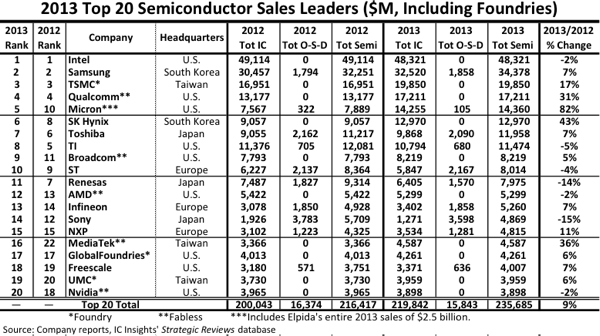
Top Semiconductor Ranking for 2013


The article below describes growth and ranking of top semiconductor companies in 2013.  


Last year growth was driven by;
  •         acquisitions such as Micron of Elpida, MediaTek merger with MStar,
  •        Mobile chip demand (processors, memory, etc.)
  •        DRAM market demand growth, Hynix was able to grow 43% even with the fire in a manufacturing plant

Qualcomm was ranked 4th, growing 31% in 2013.

NAND market growth is not well document here. For example SanDisk still is not ranked here even though it is a major NAND supplier with revenue of more than $6 Billion in 2013.


Ron
Insightful, timely, and accurate semiconductor consulting.
Semiconductor information and news at - 
http://www.maltiel-consulting.com/


IC Insights Shows Big Changes to 2013 Top 20 Semi Supplier Ranking

SK Hynix, MediaTek, Micron, and Qualcomm each registered ≥30% year-over-year growth.

IC Insights’ April Update to The 2014 McClean Report will show a ranking of the 2013 top 50 semiconductor suppliers. A preview of the top 20 companies is listed in Figure 1.  The top 20 worldwide semiconductor (includes ICs and O-S-Ds—optoelectronics, discretes, and sensors) sales leaders for 2013 included nine suppliers headquartered in the U.S., three in Japan, three in Taiwan, three in Europe, and two in South Korea, a relatively broad representation of geographic regions.

The top 20 ranking also includes three pure-play foundries (TSMC, GlobalFoundries, and UMC) and five fabless companies.  It is interesting to note that the top four semiconductor suppliers all have different business models. Intel is essentially a pure-play IDM, Samsung a vertically integrated IC supplier, TSMC a pure-play foundry, and Qualcomm a fabless company.

IC foundries are included in the top 20 semiconductor supplier ranking because IC Insights has always viewed the ranking as a top supplier list, not as a marketshare ranking, and realizes that in some cases semiconductor sales are double counted.  With many of our clients being vendors to the semiconductor industry (supplying equipment, chemicals, gases, etc.), excluding large IC manufacturers like the foundries would leave significant “holes” in the list of top semiconductor suppliers.  Foundries and fabless companies are clearly identified in Figure 1.  In the April Update to The McClean Report, “marketshare” rankings of IC suppliers by product type are presented and foundries are excluded from these rankings.

It should be noted that not all foundry sales should be excluded when attempting to create marketshare data.  For example, although Samsung had a large amount of foundry sales last year, most of its sales were to Apple.  Apple does not re-sell these devices, so counting these foundry sales as Samsung semiconductor sales does not introduce double counting.

Overall, the list shown in Figure 1 is provided as a guideline to identify which companies are the leading semiconductor suppliers, whether they are IDMs, fabless companies, or foundries.


Figure 1

Excluding the foundries of TSMC, GlobalFoundries, and UMC from the top 20 ranking would bring Fujitsu, Marvell, and Sharp into the 18th, 19th, and 20th positions, respectively (Figure 2).


Figure 2

There were numerous changes within the top 20 semiconductor supplier ranking in 2013 as compared to the top 20 ranking of 2012.  Spurred by its acquisition of Elpida last year, Micron climbed five spots and moved into the top 5 ranking.  Some of the other companies that rose in the 2013 ranking include SK Hynix, which, despite a significant fire and production setback at its largest memory fab in China, took full advantage of the 32% surge in the DRAM market last year and moved up two places into the 6th position.  Also, Broadcom moved into the top 10 while MediaTek jumped up six positions to 16th place and into the top 20 ranking for the first time. 

MediaTek is experiencing extremely strong demand for its devices in the booming low-end smartphone business in China and other Asia-Pacific locations.  In fact, MediaTek’s application processor shipments for smartphones reached over 200 million units last year, about double the 108 million units the company shipped in 2012.  Moreover, with MediaTek and MStar expected to merge in 2014, the annual post-merger sales for MediaTek should be over $6 billion, most likely enough to lift the company into the 12th spot in the 2014 ranking.

Another company expected to make a significant move up in the ranking this year by way of acquisition is Avago. After the company’s purchase of LSI Corp., the combined semiconductor sales of the two companies is likely to be well over $5 billion this year, which could propel Avago from its 27th 2013 ranking to as high as 13th in 2014!

In contrast to the semiconductor companies moving up in the ranking, Fujitsu dropped five places to fall out of the top 20 ranking in 2013, going from being ranked 16th in 2012 to 21st last year (the company sold its analog and MCU business to Spansion in August of 2013).  Renesas was another “casualty” in the top 20 ranking and fell to 11th place last year from the 7th position it held in 2012.

In total, the top 20 semiconductor companies’ sales increased by 9% in 2013 as compared to 2012, which was more than twice the 4% growth rate for total worldwide semiconductor market last year!  It took total semiconductor sales of about $3.9 billion to make the top 20 ranking in 2013.

Figure 3 shows that there was a 97-percentage-point range of growth rates among the worldwide top 20 semiconductor suppliers in 2013 (from +82% for Micron to -15% for Sony).  The continued success of the fabless/foundry business model and the strong growth of the memory market (especially the 32% DRAM market surge) last year is evident when examining the six top 20 semiconductor suppliers that logged double-digit growth. As shown, the top six performers in 2013 included two memory companies (SK Hynix and Micron), two fabless companies (MediaTek and Qualcomm), and TSMC (the largest pure-play foundry).

Figure 3 shows that the two top 20 ranked companies that registered double-digit sales declines in 2013 are headquartered in Japan (Renesas and Sony).  As previously shown, Japan-based Fujitsu also registered a double-digit decline (-16%) in 2013 and dropped out of the top 20 ranking last year.  However, it should be noted that the conversion of Japanese company semiconductor sales from yen to U.S. dollars, at 97.6 yen per dollar in 2013 versus the 79.8 yen per dollar rate in 2012, had a significant impact on the sales figures for the Japanese companies.  Using a constant 2012 U.S. dollar versus Japanese yen exchange rate for 2013, the 2013 semiconductor sales of Renesas, Sony, and Fujitsu, would have increased 5%, 4%, and 3%, respectively.

More details on the 2013 top 50 semiconductor suppliers will be provided in the April Update to The McClean Report.


Figure 3