Showing posts with label tear down. Show all posts

Tuesday, April 15, 2014

Galaxy S5 BOM $256, iPhone $191, $173

IHS released a teardown of Samsung’s Galaxy S5, the estimated bill of materials of $256 BOM keeps going up from previous cell phone generations. See more in the article below;

"IHS found that the Galaxy S3 had a BOM of $205, while the S4 ended up at $233 (LTE version with Qualcomm 600 SoC). On top of that, a Galaxy S series phone costs upwards of $8 to assemble."

While "the iPhone 5S had a BOM of $191 when it launched last September, while the iPhone 5C had $173 worth of components inside its unapologetically plastic body."

Like in Apple's phone DRAM and NAND are a high cost items and as semiconductor manufacturing advance along its learning curve it will increase Samsung margin.
  1. 1080p display is the most expensive component, costing about $65
  2. DRAM and NAND memory is around $33
  3. Unclear how much the Snapdragon 801 SoC costs, should be about $30


See more at iPhone Teardown Updated,  iPhone 5s Teardown, and some more about the processor iPhone A6 Teardown Update


Ron

Insightful, timely, and accurate semiconductor consulting.
Semiconductor information and news at - http://www.maltiel-consulting.com/
Research firm IHS got hold of Samsung’s new flagship smartphone and took it apart to the last bolt to figure out how much it actually costs to build. According to the teardown, the Galaxy S5 has a bill of material (BOM) of $256. 
Of course, this is not the full cost of the device, as it does not cover logistics, R&D, marketing and a range of other expenses that Samsung has to cover before the device makes it to retail.

Galaxy S5 BOM higher than usual


The $256 figure sounds a tad too high. Most flagship phones tend to have a BOM of about $200 or less. Most iPhones usually end up south of $200. For example, the iPhone 5S had a BOM of $191 when it launched last September, while the iPhone 5C had $173 worth of components inside its unapologetically plastic body. 
The Galaxy S5 retails for $699. Samsung does not have as much room to jack up margins as Apple does on the iPhone 5S, but it still has quite a bit more than many manufacturers. What’s more, Samsung’s BOM keeps going up. IHS found that the Galaxy S3 had a BOM of $205, while the S4 ended up at $233 (LTE version with Qualcomm 600 SoC). On top of that, a Galaxy S series phone costs upwards of $8 to assemble.
High-end smartphones are pricey, but at least it’s nice to see that Samsung’s consumers get a bit more value for money with each new generation.

Display remains the priciest component


Unsurprisingly Samsung’s 5-inch 1080p display is the most expensive component in the Galaxy S5. IHS puts its cost at $65. The cost of DRAM and NAND memory is around $33, but it’s unclear how much the Snapdragon 801 SoC costs. IHS puts the price of the Snapdragon 600 used in the S4 at $20, while the big Exynos 5 was estimated to cost $30. The Snapdragon 801 is probably closer to the Exynos in terms of overall cost.
“Inside we see mostly a lot of recycled components that we’ve seen before. There’s really nothing special inside where Samsung is pushing the envelope,” IHS analyst Andrew Rassweiler toldRe/code. “There’s no breakthroughs, there’s nothing earth-shattering. It’s really just a continuation of what has come before.”
However, although there are no breakthroughs, the Galaxy S5 features a few new sensors, including a $4 fingerprint sensor and a biosensor from Maxium, with an estimated cost of $1.45. In addition to the new components which were not used in previous Galaxy S phones, the S5 also features a somewhat sturdier body, which also happens to be waterproof. This probably added a few more bucks to the BOM. 

Wednesday, March 20, 2013

Samsung Galaxy S4 BOM $236 (Manufacturing Cost)


The article below discusses "latest model of Samsung's flagship phone costs $236 to produce, according to information analyzed by IHS...

Samsung manufactures at least $149 worth ( 63%) of the parts needed for the S4, and IHS thinks Intel and Broadcom supply the rest" 

As Samsung improves yield of their manufacturing process, the cost will go down significantly. For example, the cell phone microprocessor Exynos die "cost is $30, compared with the S3's chip, which costs $17.50."

As Samsung advances dies yield riding down along the learning curve of the manufacturing process, it will reduce the BOM 5%. Similar improvements in manufacturing of other chips made by Samsung will bring Galaxy S4 cost closer to that of S3.

Ron

Insightful, timely, and accurate semiconductor consulting.Semiconductor information and news at - www.maltiel-consulting.com


At $236, Galaxy S4 costlier to produce than S3, says report

by Donna Tam


IHS iSuppli's virtual teardown of the lasted Samsung smartphone shows it's 15 percent more expensive for Samsung to produce than last year's model.


The Samsung Galaxy S4's production costs are 15 percent higher than those of its predecessor, thanks to an upgraded display, sensors, processor, and memory, according to an IHS iSuppli teardown.

The latest model of Samsung's flagship phone costs $236 to produce, according to information analyzed by IHS. The firm said its estimates could change with a physical teardown, but for now the improvements equal a heftier cost. The HSPA+ version of the S4 has 16 gigabytes of NAND flash memory and costs $244 in materials plus $8.50 to manufacture. The LTE version is a bit cheaper at $233.

"Among the upgrades are a larger, full high-definition (HD) display; a beefed-up Samsung processor; and a wealth of new sensors that set a record high for the number of such devices in a smartphone design," Vincent Leung, senior analyst for cost benchmarking at IHS, said in a press release.


Click to enlarge

The S4's new AMOLED 1,920x1,080-pixel display is where a bulk of the increased costs came from for both the HSPA+ and LTE versions. It costs $75 versus the S3's $65 display. IHS' analysts said it's the first phone to have an AMOLED display with this resolution, since it's been a challenge to squeeze pixels into this type of display in the past.
IHS also notes the high number of sensors on the S4. It's not surprising given the smartphone's multiple new features, such as integrated eye-tracking software and the ability to monitor health stats. In addition to sensors that were available in the S3 -- geomagnetic and proximity sensors, as well as an accelerometer, gyroscope, and barometer, among others -- Samsung added a new infrared gesture sensor and a humidity and temperature sensor. The barrage of sensors costs $16, up from $12.70 in the S3.
To run the HSPA+ phone's apps, Samsung "is believed to be" using an eight-core chip of its own design, the Exynos 5 Octa, according to IHS. The cost is $30, compared with the S3's chip, which costs $17.50.
Wayne Lam, senior analyst for wireless communications at IHS, said in the release that the processor integrates two quad-core processors into one chip. This lets the phone assign less intensive tasks, like phone calls and social-media apps, to the less powerful processor, saving power. The more powerful processor is used only for things like video gaming.
The 4G LTE version uses the Qualcomm Snapdragon 600, a quad-core apps processor and LTE radio solution, which costs $20.
Samsung manufactures at least $149 worth -- or 63 percent -- of the parts needed for the S4, and IHS thinks Intel and Broadcom supply the rest.

Monday, March 19, 2012

iPad Teardown - Flash NAND Memory is a Major Profit Source


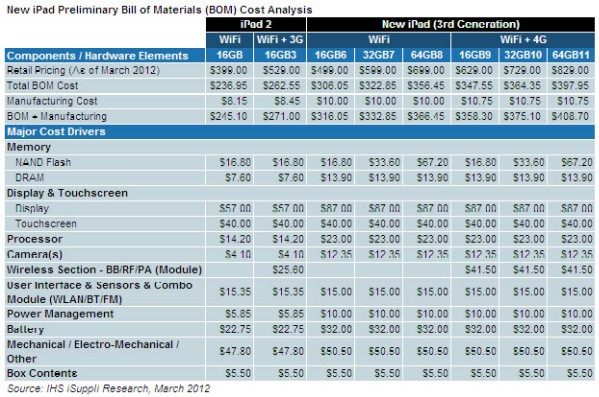
IHS iSuppli's teardown of  the new iPad, equipped with 32 Gigabytes (GB) of NAND flash memory and 4G Long Term Evolution (LTE) wireless capability, carries a bill of materials (BOM) of $364.35. When the $10.75 manufacturing costs are added in, the cost to produce the new iPad rises to $375.10. The BOM of the 16GB 4G LTE version amounts to $347.55, and the 64GB version is estimated at $397.95.
(more below)

The $364.35 BOM represents 50 percent of the $729.00 retail price of the 32GB LTE version of the new iPad.


“The NAND flash memory is one of the key profit-generating components for Apple in the new iPad line, as it has been in previous iPads and in the iPhone family,” Rassweiler noted. “Apple makes far and away more money in selling consumers NAND flash than NAND flash manufacturers make selling it to Apple. And the more flash in the iPad, the higher the profit margin there is for Apple.”

For example, the retail price of the 32GB LTE-enabled new iPad is $100 higher than the 16GB model. However, Apple’s BOM for the 32GB version is only $16.80 more compared to the 16GB model.

Ron Maltiel


New iPad 32GB + 4G Carries $364.35 Bill of Materials
http://www.isuppli.com/Teardowns/News/Pages/New-iPad-32-GB-4G-Carries-364-35-Bill-of-Materials.aspx

Andrew Rassweiler, March 16, 2012

The new iPad, equipped with 32 Gigabytes (GB) of NAND flash memory and 4G Long Term Evolution (LTE) wireless capability, carries a bill of materials (BOM) of $364.35. When the $10.75 manufacturing costs are added in, the cost to produce the new iPad rises to $375.10. The BOM of the 16GB 4G LTE version amounts to $347.55, and the 64GB version is estimated at $397.95.

The $364.35 BOM represents 50 percent of the $729.00 retail price of the 32GB LTE version of the new iPad.

The very lowest-end version of the new iPad, with 16GB memory and no LTE, carries a combined BOM and manufacturing cost of $316. The highest-end model, with 64GB memory and integrated LTE, has a total BOM and manufacturing expense of $408.70.

Please note that these teardown assessments are preliminary in nature, account only for hardware and manufacturing costs and do not include additional expenses such as software, licensing, royalties or other expenditures.


The new iPad is more expensive to produce than the iPad 2 at the time of product launch, even though the retail price points are the same. The 32GB LTE model’s BOM is nearly 9 percent higher than an iPad 2 equipped with 32GB and 3G wireless, which carried a cost of approximately $335 at the time of product launch. Major factors driving up the BOM include the addition of the high-resolution Retina display, LTE wireless and a larger-capacity battery.


The table below summarizes the major components in the new iPad.


Among all component suppliers, Samsung Electronics continues its reign as the big winner in the individual iPad analyzed by the IHS iSuppli Teardown Analysis Service. Samsung supplied both the display and the applications processor. The new iPad’s Retina display represents the most expensive single component in the tablet, at $87, while the applications processor costs an estimated $23. Combined, this gives Samsung a 30.2 percent share of the 32GB LTE version of the new iPad’s bill of materials, the largest for any supplier.

In the individual new iPad analyzed, the NAND flash was supplied by Toshiba Corp. However, Samsung also is a source of NAND for the new iPad. In a 32GB LTE iPad where Samsung is also the supplier of the NAND, Samsung’s share of the BOM rises by $33.60 to a total of $143.60, amounting to 39.4 percent of the total BOM. However, Toshiba, Hynix Semiconductor and others also are all NAND suppliers to Apple, and each will claim a portion of those revenues.

Although we are not certain, IHS believes that the battery cells are supplied by Samsung. If this turns out to be the case, Samsung will account for nearly 50 percent of the new iPad’s BOM.

“The Retina display represents the centerpiece of the new iPad and is the most obvious enhancement in features compared to previous-generation models,” said Andrew Rassweiler, senior principal analyst, teardown services, at IHS. “The first two generations of the iPad employed the same type of display—a screen with resolution of 1,024 by 768 pixels. For the third-generation new iPad, Apple has taken a significant step up in display capabilities and expense, at four times the resolution and 53 percent more cost.”

The new iPad’s Retina display has a resolution of 2,048 by 1,536 pixels. It costs $87, compared to $57 for the screen used in the iPad 2. The $87 cost accounts for 24 percent of the BOM of the new iPad with 32GB NAND and LTE, making the Retina display the most expensive single component in the tablet.

As IHS announced in a previous release, we believe Apple likely has qualified three sources for the display in the new iPad: Samsung, LG Display and Sharp Corp. (see Apple Display Spending Expected to Nearly Double in 2012, Helped by Surging iPad Sales). However, it is likely that all the volume shipments of the new iPad display are currently coming from Samsung. In line with this view, the individual new iPad torn down by IHS includes a Samsung-sourced Retina display.

The touch screen for the new iPad costs an estimated $40, or 10.9 percent of the total BOM. As in the iPad 2, the main suppliers in this area are still TPK, Wintek and Chi Mei.

The wireless section costs $41.50 and accounts for 11.4 percent of the BOM. Because this section provides support for the LTE capabilities of the new iPad, it is significantly more expensive than the $25.60 wireless section of the iPad 2, which supported the 3G air standard. The big winner in this section is Qulcomm Inc., whose MDM9600 baseband processor provides the core LTE functionaility. IHS believes that the wireless section is the same for both AT&T and Verizon versions of the new iPad, although that hasn’t been confirmed yet.

The A5X applications processor costs $23, and represents 6.3 percent of the total BOM. Samsung manufactures the A5X for Apple. However, for this device, Samsung serves as a foundry partner to Apple, and not as an independent semiconductor supplier. Apple is the designer and owner of the intellectual property of the A5X, and Samsung manufactures the part on a contract basis. This means that Samsung likely commands a lower margin on the device that it would otherwise.


“The NAND flash memory is one of the key profit-generating components for Apple in the new iPad line, as it has been in previous iPads and in the iPhone family,” Rassweiler noted. “Apple makes far and away more money in selling consumers NAND flash than NAND flash manufacturers make selling it to Apple. And the more flash in the iPad, the higher the profit margin there is for Apple.”

For example, the retail price of the 32GB LTE-enabled new iPad is $100 higher than the 16GB model. However, Apple’s BOM for the 32GB version is only $16.80 more compared to the 16GB model.

The new iPad camera module design and cost is the same as in the iPhone 4 camera module. The two camera modules cost a combined $12.35, representing 3.4 percent of the BOM.

The battery delivers a major upgrade from the previous model. The lithium polymer battery in the new iPad supports 42.5 watt hours, up about 75 percent from 25 watt hours in the iPad 2. However, because of price decreases during the past year, the new battery costs only 40 percent more than the old one, at $32.00, compared to $22.75 for the one in the iPad 2.