Showing posts with label Tablets. Show all posts

Friday, January 11, 2013

Samsung Foundry Replacing Apple

The article below discusses Samsung's efforts to supply chips to Chinese and other emerging smartphone makers to reduce their dependence on Apple. More about Chinese smart phones at Apples' Cook in China (MediaTek Impact) . It would makes sense for Samsung to diversify their chip production to other smart phone vendors. Other semiconductor areas such as DRAM memory are not growing as they used to (Flash Memory Growth & Sales Surpass DRAM).

It takes years to shift from one foundry vendor to another. Designing the A6x or A7 new processor and the details and design rules of the manufacturing process is slow and complicated.
I already discussed this in September 2012 Apple Cutting Out Samsung Chips?

("Teardown of iPhone 5 reveals that none of the DRAM, and NAND memory and other chips on the iPhone were made by Samsung. Already in the iPad (See March iPad teardown) Samsung had fewer parts than in the prior Apple products. Samsung is still making the A6 processor for Apple.").

Additional information - iPhone A6 Teardown Update .

Ron
Insightful, timely, and accurate semiconductor consulting.
Semiconductor information and news at - http://www.maltiel-consulting.com/


Samsung seeks broader chip base as Apple cuts loose
Credit: Reuters/Steve Marcus, By Miyoung Kim, Wed Jan 9, 2013 5:03pm EST

Stephen Woo, president of Device Solutions Business for Samsung Electronics, talks about the new Samsung Exynos 5 Octa processor during a keynote address at the Consumer Electronics Show (CES) in Las Vegas January 9, 2013. The processor is faster and uses less power than Samsung's previous models, Woo said.

LAS VEGAS (Reuters) - Samsung Electronics Co is looking to supply chips to more Chinese and other emerging smartphone makers, the head of its system chip business said, to counter any fall-off in demand from Apple Inc, which is weaning itself off Samsung chips used in its iPhones and iPads.

Samsung and its main U.S. rival, and biggest customer, together account for more than half the global smartphone market, and the South Korean group is the main supplier of mobile processors, or application processors (AP), powering both Apple devices and its own range of Galaxy phones and tablets.

But, as Apple looks to be less reliant on its rival for parts for its gadgets - it is already buying fewer Samsung memory chips and display screens as the two have gone to war over patents - concerns have grown that Samsung may see its processor revenues tumble.

"As there are just two smartphone makers that are doing really well, chipmakers supplying them have grown in tandem. So we plan to bolster our relationship with those key customers," Stephen Woo, president of Samsung's System LSI business, which makes processors for Apple products, said in an interview.

Supplying processors for Apple products has been the mainstay of Samsung's system chips business.

Goldman Sachs estimates Samsung's AP chip sales to Apple will rise to 9.3 trillion won ($8.8 billion) this year, or nearly 80 percent of Apple's spending on Samsung processing chips, memory chips and flat screens. But that could tumble to just 2.5 trillion won next year, as Apple will shift 30 percent of its AP business from Samsung and eventually 80 percent by 2017, according to Goldman.

"(We) should diversify our customer base and are making such efforts already, adding some Chinese customers," Woo told Reuters ahead of his first keynote speech at the annual Consumer Electronics Show in Las Vegas on Wednesday.

China's Meizu, one of the local smartphone newcomers, uses Samsung's Exynos quad-core chip for its MX smartphone, and Lenovo's K860 LePhone is also powered by Exynos.

Still, Samsung's mobile processor business is almost entirely tied to the fortunes of Apple and its own mobile business - the Galaxy range. By comparison, chip rivals such as Qualcomm Inc, Texas Instruments and Nvidia have a broader client base - from LG Electronics Inc and Nokia to HTC Corp, Huawei Technologies Co and Google's Motorola.

"We see emerging players who have potential to grow in smartphones and we will continue to make efforts to supply them with our chips," Woo said.

The mobile processor market, driven by roaring sales of smartphones and tablets, is a bright spot for a semiconductor industry that is struggling with falling computer sales. Research firm Gartner estimates the mobile processor market will grow 30 percent this year to $13.5 billion and hit $16.5 billion next year.

To strengthen its chip capability, Samsung bought UK chipmaker CSR Plc's mobile phone connectivity and location technology for $310 million last year, and it is now looking at how it can improve modem chip technology, especially the baseband chip solution that enables wireless devices' radio communications.

"Baseband is a very important segment, but we don't have it. Given its importance, we're reviewing various options," Woo said, suggesting Samsung could be scouting for potential targets.

Qualcomm is the biggest baseband chip company with nearly 50 percent of the market, followed by the likes of Mediatek, Texas Instruments and Broadcom.

Chipmakers are increasingly seeking to produce a single chip solution that combines AP, modem chip and connectivity chips that support Wi-Fi, Bluetooth and near-field communication functions, in one chipset. This combo-package is popular among low-end smartphones as it allows phone makers to cram various chips into compact devices.

Woo said Samsung, however, was not considering expanding into a single chip solution and will instead continue to focus on pure AP chips favored for high-end phones, as it allows manufacturers to differentiate their hardware offerings with various chip combinations.

The explosion of mobile devices has opened a big opportunity to Samsung as Intel Corp, the world's top chipmaker, struggles to crack the mobile processor market dominated by the makers of ARM Holdings licensed chips. Samsung is the biggest maker of ARM-based chips, such as Apple chips and Samsung's Exynos brand.

Intel's market share in mobile devices is just 1 percent, as UK chip designer ARM holds a near monopoly.

Woo said Samsung was not looking to break into the desktop computer or server processor market - which Intel dominates, but is under threat from ARM-based chips that boast low-power consumption and compact design.

"For the time being, our focus will pretty much be on enhancing our AP offering, especially for high-end mobile devices," he said.. At his keynote speech, Woo unveiled Samsung's latest "Exynos 5 Octa" processor, tailored for high-end smartphones and tablets.

The new processor boasts eight cores: four to handle processing-intensive tasks and four to take on lighter workloads, to conserve battery life.

Glenn Roland, vice president and head of new platforms at Electronic Arts, demonstrated its processing power by running the high-octane, fast-paced "Need for Speed: Most Wanted", on a Samsung reference tablet.

Other guests at Woo's speech included ARM Chief Executive Warren East, Microsoft chief technical strategy officer Eric Rudder, and former U.S. president Bill Clinton.

Samsung also unveiled a prototype phone with a flexible display that can be folded back and forth - almost like paper - by replacing a glass panel with super-thin plastic to make it bendable and unbreakable, as well as a smartphone equipped with a curved display.

"It won't break even if it's dropped. This new form-factor will really begin to change how people interact with their devices, opening up new lifestyle possibilities ... allow our partners to create a whole new ecosystem of devices," said Brian Berkeley, senior vice president of Samsung Display, a flat-screen unit of Samsung Electronics.

($1 = 1062.9500 Korean won)
(Editing by Ian Geoghegan, Bernard Orr)

Monday, September 24, 2012

NAND:Prices, Market Shares (Micron Up, Toshiba Down..)


NAND flash market share in July 2011
 Micron was able to increase its market share in NAND flash to 20.7%. based on IHS's report:

"Micron was able to claim some of the market share ceded by Toshiba. The Japanese maker in the second quarter saw its share decline by 9.5 percentage points sequentially, which occurred after strong growth in the first quarter....
Micron accounted for 80 percent of production from its joint venture with Intel, up from 62 percent in the first quarter. The increase was part of a revised capacity agreement between the two companies."


The pie chart shows how much Micron's market share improved since July 2011. (via https://www.semiconportal.com/en/archive/news/main-news/110715-toshiba-fab5-nand.html).


Since July 2011, NAND prices have been trending down. From the second article below:

"over the last two or so years, Micron, Samsung, SK Hynix and Toshiba began to expand their NAND production at a dramatic pace. The goal was to meet the anticipated demand for the next wave of product drivers, such as smartphones, solid-state drives (SSDs), tablets and ultrabooks.
Seeking to drive down product costs, particularly for SSDs, NAND vendors took the lead in process technology. For example, the Toshiba-SanDisk duo has been ramping up parts based on the world’s most advanced process, a 19nm technology.
The bottom fell out of the NAND market in recent times. NAND vendors built up too much fab capacity. Average selling prices (ASPs) for NAND fell by 46% in the first half of 2012. Demand for NAND in smartphones and tablets remains overwhelming, but SSD and ultrabook shipments have been disappointing thus far."


Ron
http://www.maltiel-consulting.com/


In a First, U.S.-Based Micron Takes 20 Percent Share of the NAND Flash Market

http://www.isuppli.com/Memory-and-Storage/News/Pages/In-a-First-US-Based-Micron-Takes-20-Percent-Share-of-the-NAND-Flash-Market.aspx
Dee Nguyen,     September 21, 2012

For the first time since it entered the industry seven years ago, U.S.-based Micron Technology Inc. managed to cross the 20 percent market share threshold in the NAND flash memory business during the second quarter.

Micron posted the strongest sequential performance of all NAND suppliers, with second-quarter revenue amounting to $897 million, up 6 percent from $846 million in the first quarter, according to an IHS iSuppli
In comparison, the other ranked suppliers all suffered revenue declines during the same period.

Despite overall NAND flash market revenue declining by 13 percent, Boise, Idaho-based Micron increased its market share to 20.7 percent in the second quarter, up from 17 percent in the first quarter, as presented in the table below.


“Defying weak demand and falling prices in the overall business, Micron expanded its NAND revenue and market share to reach the key 20 percent milestone for the first time since it started selling the memory in 2005,” said Dee Nguyen, memory analyst at IHS. “Micron not only successfully increased its bit shipments of NAND flash by a whopping 68 percent, it also benefitted from a reallocation in production from the NAND joint venture partner with Intel Corp., while capitalizing on the travails at its close competitor—No. 2-ranked Toshiba Corp.”

Intel and Toshiba Benefit Micron

See the rest at www.maltiel-consulting.com/nandprices-market-shares-micron-up.html


NAND Enters Tough Cycle

http://semimd.com/blog/2012/09/20/nand-enters-tough-cycle/
By Mark LaPedus

The NAND flash memory market is entering into a new and painful cycle, a period that will impact suppliers, OEMs and fab tool vendors alike.

For some time, there has been an oversupply and depressed pricing in the NAND market. In mid-2011, Micron, Samsung, SK Hynix and Toshiba put on the brakes in their capital spending plans. And in recent months, NAND suppliers in total have announced plans to cut 150,000 wafer starts per month, or about 12% of the world’s NAND capacity, amid ongoing losses and sluggish demand.

Just as suppliers moved to cut their production, spot shortages of NAND surfaced at some OEMs in early September. Most OEMs are not seeing any shortages, but that could all change. Apple, the world’s largest buyer of NAND, could cause some gyrations in the channels as it ramps up its new iPhone 5.

So what’s the outlook in the fluid and confusing NAND market? Amid a bitter legal battle with Samsung, speculation is rampant throughout the NAND industry about whether Apple will swap suppliers from Samsung to SK Hynix, Toshiba and Micron. If that happens, Samsung would face an oversupply in NAND, while others may see capacity shortfalls.

The outlook is also not so rosy for fab tool vendors, which counted on a big capital spending cycle for NAND. In fact, NAND suppliers are expected to push out their capital spending plans until June of 2013 and perhaps beyond, said Vijay Rakesh, an analyst with Sterne Agee.

The lack of capital spending is expected to create a shortfall in NAND capacity, creating perhaps a long cycle of acute shortages. Presently, there is a capacity glut for NAND. “Demand should catch up with capacity by mid-2013,” said Jim Handy, an analyst with Objective-Analysis. “Then, there could be NAND shortages from then until the middle of 2015.”

See the rest at www.maltiel-consulting.com/nandprices-market-shares-micron-up.html

Friday, September 7, 2012

Apple Cuts Samsung Orders: Lawsuits Impact?

Considering all the legal patent fights between Apple and Samsung, it would make sense that Apple would want to diversify away from Samsung.

Taking into account the very long lead time and tightening demand for chips, it will be very slow for Apple to separate.

More on the crosscurrents for DRAM and flash chips demand


Ron Maltiel
www.maltiel-consulting.com


Apple reportedly cuts order for Samsung chips for new iPhone
iPhone maker has reduced its order for NAND and DRAM chips from its courtroom foe, industry sources report
http://news.cnet.com/8301-13579_3-57508009-37/apple-reportedly-cuts-order-for-samsung-chips-for-new-iphone/
by Steven Musil  September 6, 2012 9:47 PM PDT

Apple has cut its orders for memory chips from Samsung for its next-generation iPhone as it tries to reduce its dependence on its legal foe and competitor, according to industry sources.
Samsung has been a primary supplier of both DRAM and NAND storage for iPhones, iPads, and iPhones, but Apple has been reducing its orders to the South Korean electronics giant in an effort to diversify its supply lines, according to a Reuters report.

Meanwhile, the Korea Economic Daily reported that Apple had completely dropped Samsung from its list of memory chip suppliers for the first shipment of the new iPhones, choosing instead to go with Toshiba, Elpida Memory, and Korea's SK Hynix.

However, Reuters' source said Samsung remains on Apple's list of initial suppliers for the iPhone but is making up for the reduction with orders from other handset makers, notably Samsung's. The source also said the decision was unrelated to the recent courtroom clashes between the two tech titans.


Apple is said to be trying to reduce its dependence on Samsung, the world's largest consumer electronics maker by market value. Apple reportedly tried to secure exclusive access to Taiwan Semiconductor Manufacturing Co. smartphone chips by making a $1 billion investment in the chipmaker -- possibly in a bid to replace Samsung's contract for the A6 processor. TSMC reportedly rejected the offer, saying it had no need for investment capital and was unwilling to sell part of itself.

iPad, iPhone and Tablets=> Flash, DRAM Markets Crosscurrents

The article below discuss shifting crosscurrents in the flash and DRAM markets. iPad, iPhone and Tablets impact Flash, DRAM chip markets. Expected demand for iPhone, iPad, Amazon fire and other tablets drive up expectation for chip markets.

Some of the key crosscurrents
"Many of the leading NAND flash suppliers, including Toshiba, Samsung and Micron have significant commitments to Apple Inc. to supply NAND flash. Apple is reported to have recently cut its order of NAND flash memory from Samsung. It is not clear whether OCZ's "industry-wide" supply shortage could have resulted from NAND flash memory inventory being taken up for use by Apple in its forthcoming model of iPhone expected to launch on Sept. 12."


Impact of legal patent figths of Apple and Samsung are discussed in the next blog.

Ron Maltiel


NAND flash memory in short supply

http://www.eetimes.com/electronics-news/4395618/NAND-flash-in-short-supply-after-production-cuts
Peter Clarke  9/7/2012 6:22 AM EDT


LONDON – Just six weeks after Toshiba Corp. announced it was cutting its production of NAND flash chips by about 30 percent due to market oversupply and chip price concerns, a maker of solid-state drives has signaled it can't get enough of the memory chips.

"Despite achieving bookings in excess of our expectations for our second fiscal quarter, we were not able to meet our previously stated revenue guidance due primarily to constraints in NAND flash supply," said Ryan Petersen, CEO of OCZ Technology Group Inc. (San Jose, Calif.), in a statement on the company's second fiscal quarter financial results, issued Wednesday (Sept. 5). "During the month of August we experienced a significant shortage on certain NAND flash components, based on industry-wide tightening of supply, leaving OCZ with an undersupply of the 2X-nm MLC NAND used in our Vertex and Agility Line of products," Petersen said.

"While we believe that the situation will resolve itself, subject to market conditions, we plan to hasten our transition to new process nodes in order to help ease these supply constraints," added Petersen.
When Toshiba announced the immediate cut in production in July it said it expected the supply and demand balance to improve in the third quarter due to growth of PC and smartphone shipments and that it would continue to monitor the situation and resume production ahead of increasing demand.

Many of the leading NAND flash suppliers, including Toshiba, Samsung and Micron have significant commitments to Apple Inc. to supply NAND flash. Apple is reported to have recently cut its order of NAND flash memory from Samsung. It is not clear whether OCZ's "industry-wide" supply shortage could have resulted from NAND flash memory inventory being taken up for use by Apple in its forthcoming model of iPhone expected to launch on Sept. 12.

Wednesday, August 22, 2012

Flash Memory Sales Surpass DRAM

Combined NOR and NAND flash Flash memory together already surpassed DRAM sales. See from the article below NAND and DRAM market size -

"the size of the markets is now relatively similar (about $26 billion to $28 billion for NAND, and about $28 billion to $30 billion for DRAM)"

While the NOR market size is not growing as fast as NAND market it is still big enough to make the combined flash market bigger than DRAM market.

More on NOR market in a previous comments Flash NOR Memory Revival and in my May 2007 article on Long Term Trends in the NOR and NAND Markets


Ron
http://www.maltiel.com/flash-news.html


When will NAND sales surpass DRAM?

Dylan McGrath , 8/16/2012 9:08 PM EDT

Mobility—smartphones and media tablets—is the driving force in electronics today. PC sales, meanwhile, are sluggish, with a forecast growth rate of only about 5 percent, according to International Data Corp.
Despite that, sales of DRAM—the main memory in PCs—remain greater that those of NAND, and are likely to stay that way for at least the next couple of years, according to market researchers. IC Insights, which expects total flash memory sales to eclipse DRAM sales for the first time this year, expects NAND to overtake DRAM sales in 2014. IHS iSuppli, however, forecasts that DRAM will remain in the lead through at least 2016.

Mike Splinter, chairman and CEO of chip equipment vendor Applied Materials Inc., was asked during a conference call following Applied's quarterly report Wednesday (Aug. 15) when he expected the NAND market to overtake the DRAM market.

"I think that's really totally dependent on solid-state drives," Splinter said. He had noted earlier in the call that adoption of SSDs is not happening as quickly as forecast.
"We've been quite disappointed that tablets and smartphones haven't accelerated the use of flash capacity," Splinter said. He added that Applied's hope now is that SSDs will take off with the introduction of ultrabooks—the thin, low power notebook PC concept being driven by Intel Corp.

Splinter noted that the size of the markets is now relatively the similar (about $26 billion to $28 billion for NAND, and about $28 billion to $30 billion for DRAM). Despite analysts' forecasts, Splinter suggested that a surge of NAND buying could cause it to overtake DRAM as quickly as next year.
Is such a surge in the cards? According to Splinter, that's up to SSDs.

Monday, July 16, 2012

Flash NOR Memory Revival

NOR flash memory is being replaced by NAND in smart phones.  NOR, however, is finding new growth opportunities in tablets, automotive, and industrial computers as the article below discusses.  These new markets will help strengthen NOR's market share but it will not become as big as the NAND market.

Additional info is in my May 2007 article on Long Term Trends in the NOR and NAND Markets .


Ron


NOR Flash Makers Find New Growth Areas to Compensate for Slowing Sales in Cellphones, Teardown Results Reveal


July 13, 2012
http://www.isuppli.com/Memory-and-Storage/News/Pages/NOR-Flash-Makers-Find-New-Growth-Areas-to-Compensate-for-Slowing-Sales-in-Cellphones-Teardown-Results-Reveal.aspx
Ryan Chien


NOR flash memory sales growth may be tapering off in mobile handsets and smartphones, but lucrative embedded applications in the tablet, automotive and industrial markets are picking up the slack, according to the IHS iSuppli Storage Service at information and analytics provider IHS (NYSE: IHS).


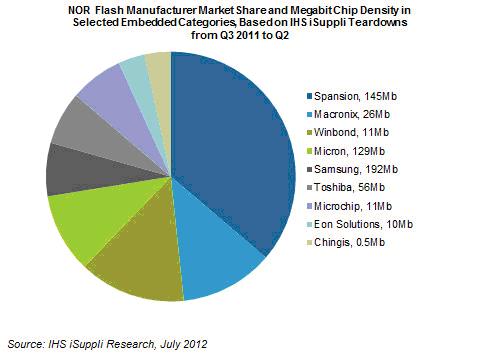
Based on a sample of 55 embedded products dissected by the IHS iSuppli Teardown Analysis Services over the course of three quarters, California-based Spansion Inc. led all NOR suppliers in terms of design wins. The company accounted for more than one-third of the NOR chips in the torn-down devices, as shown in the figure below.


Spansion, together with Samsung Electronics Co. Ltd. of South Korea and Micron Technology Inc. from Idaho, offered NOR chips in densities averaging in the hundreds of megabits. The three companies accounted for 53.4 percent of NOR chips in the three subsegments during the period from the third quarter of 2011 to the second quarter this year.


The rest of the market, equivalent to 46.6 percent of the sample, is controlled by companies that produced low-density NOR memory below the 100-megabit level. This group included big players like Taiwan’s Macronix International Co. Ltd. and Winbond Electronics Corp., as well as smaller entities like fellow Taiwanese firms Chingis Technology Corp. and Eon Silicon Solution Inc.


“Used to store small amounts of executable code, NOR flash was traditionally employed in devices like cellphones for fast read operations and random access capabilities,” said Ryan Chien, analyst for memory and storage at IHS. “However, newer implementations of NAND-based Embedded MultiMedia Card (eMMC) solutions that emulate NOR capabilities have resulted in NOR falling out of favor. The percentage of handsets using NOR flash has fallen from 14 percent in 2010 teardowns to less than 7 percent since then, found mostly in Samsung smartphones. However, NOR manufacturers have been proactive in their diversification efforts, borne out by a study of recent teardowns in both wireless and embedded categories.”


Tablets Energize NOR Market

Among the most prominent applications for NOR are tablets. Despite the elimination of NOR in the new iPad from Apple Inc., NOR chips were found in several Android alternatives in the teardowns, including the Eee Slate and Transformer Prime from Asus; the Jetstream and Flyer from HTC; and the Galaxy Tab 10.1 LTE and 7.7 from Samsung. Tablet devices from Samsung tended to incorporate the company’s own brand, higher-density NOR flash in multi-chip packages, while other branded tablets preferred discrete low-density SPI parts.


In the automotive space, NOR flash plays an increasing role to address vehicle safety regulations and manage user-comfort expectations. Head units in vehicles from Ford, General Motors, Nissan and Honda each had more than 230 megabits of NOR flash. NOR suppliers include Microchip and Micron for Honda and Toyota cars; Toshiba Corp. for Nissan vehicles; and Spansion for GM and Ford autos.


The other high-potential market for NOR flash is the industrial space. Network-attached storage systems from QNAP Systems and Buffalo Technology use Micron chips, and routers from Ubee Interactive and Ruckus Wireless each include 128 megabits of NOR.


An emerging industrial segment for NOR is the smart grid space, where devices such as feeder protection relays require high-density NOR to help monitor substation power lines. All of the NOR flash in hardware made by Sweden’s ABB Group is from Spansion, while solutions for U.S.-based Schweitzer Engineering Laboratories make use of Samsung and Spansion NOR parts. Samsung NOR is rare in third-party products, whereas Spansion has been aggressive in addressing this growth segment.