Showing posts with label Spansion. Show all posts

Monday, September 24, 2012

NAND:Prices, Market Shares (Micron Up, Toshiba Down..)


NAND flash market share in July 2011
 Micron was able to increase its market share in NAND flash to 20.7%. based on IHS's report:

"Micron was able to claim some of the market share ceded by Toshiba. The Japanese maker in the second quarter saw its share decline by 9.5 percentage points sequentially, which occurred after strong growth in the first quarter....
Micron accounted for 80 percent of production from its joint venture with Intel, up from 62 percent in the first quarter. The increase was part of a revised capacity agreement between the two companies."


The pie chart shows how much Micron's market share improved since July 2011. (via https://www.semiconportal.com/en/archive/news/main-news/110715-toshiba-fab5-nand.html).


Since July 2011, NAND prices have been trending down. From the second article below:

"over the last two or so years, Micron, Samsung, SK Hynix and Toshiba began to expand their NAND production at a dramatic pace. The goal was to meet the anticipated demand for the next wave of product drivers, such as smartphones, solid-state drives (SSDs), tablets and ultrabooks.
Seeking to drive down product costs, particularly for SSDs, NAND vendors took the lead in process technology. For example, the Toshiba-SanDisk duo has been ramping up parts based on the world’s most advanced process, a 19nm technology.
The bottom fell out of the NAND market in recent times. NAND vendors built up too much fab capacity. Average selling prices (ASPs) for NAND fell by 46% in the first half of 2012. Demand for NAND in smartphones and tablets remains overwhelming, but SSD and ultrabook shipments have been disappointing thus far."


Ron
http://www.maltiel-consulting.com/


In a First, U.S.-Based Micron Takes 20 Percent Share of the NAND Flash Market

http://www.isuppli.com/Memory-and-Storage/News/Pages/In-a-First-US-Based-Micron-Takes-20-Percent-Share-of-the-NAND-Flash-Market.aspx
Dee Nguyen,     September 21, 2012

For the first time since it entered the industry seven years ago, U.S.-based Micron Technology Inc. managed to cross the 20 percent market share threshold in the NAND flash memory business during the second quarter.

Micron posted the strongest sequential performance of all NAND suppliers, with second-quarter revenue amounting to $897 million, up 6 percent from $846 million in the first quarter, according to an IHS iSuppli
In comparison, the other ranked suppliers all suffered revenue declines during the same period.

Despite overall NAND flash market revenue declining by 13 percent, Boise, Idaho-based Micron increased its market share to 20.7 percent in the second quarter, up from 17 percent in the first quarter, as presented in the table below.


“Defying weak demand and falling prices in the overall business, Micron expanded its NAND revenue and market share to reach the key 20 percent milestone for the first time since it started selling the memory in 2005,” said Dee Nguyen, memory analyst at IHS. “Micron not only successfully increased its bit shipments of NAND flash by a whopping 68 percent, it also benefitted from a reallocation in production from the NAND joint venture partner with Intel Corp., while capitalizing on the travails at its close competitor—No. 2-ranked Toshiba Corp.”

Intel and Toshiba Benefit Micron

See the rest at www.maltiel-consulting.com/nandprices-market-shares-micron-up.html


NAND Enters Tough Cycle

http://semimd.com/blog/2012/09/20/nand-enters-tough-cycle/
By Mark LaPedus

The NAND flash memory market is entering into a new and painful cycle, a period that will impact suppliers, OEMs and fab tool vendors alike.

For some time, there has been an oversupply and depressed pricing in the NAND market. In mid-2011, Micron, Samsung, SK Hynix and Toshiba put on the brakes in their capital spending plans. And in recent months, NAND suppliers in total have announced plans to cut 150,000 wafer starts per month, or about 12% of the world’s NAND capacity, amid ongoing losses and sluggish demand.

Just as suppliers moved to cut their production, spot shortages of NAND surfaced at some OEMs in early September. Most OEMs are not seeing any shortages, but that could all change. Apple, the world’s largest buyer of NAND, could cause some gyrations in the channels as it ramps up its new iPhone 5.

So what’s the outlook in the fluid and confusing NAND market? Amid a bitter legal battle with Samsung, speculation is rampant throughout the NAND industry about whether Apple will swap suppliers from Samsung to SK Hynix, Toshiba and Micron. If that happens, Samsung would face an oversupply in NAND, while others may see capacity shortfalls.

The outlook is also not so rosy for fab tool vendors, which counted on a big capital spending cycle for NAND. In fact, NAND suppliers are expected to push out their capital spending plans until June of 2013 and perhaps beyond, said Vijay Rakesh, an analyst with Sterne Agee.

The lack of capital spending is expected to create a shortfall in NAND capacity, creating perhaps a long cycle of acute shortages. Presently, there is a capacity glut for NAND. “Demand should catch up with capacity by mid-2013,” said Jim Handy, an analyst with Objective-Analysis. “Then, there could be NAND shortages from then until the middle of 2015.”

See the rest at www.maltiel-consulting.com/nandprices-market-shares-micron-up.html

Wednesday, August 22, 2012

Flash Memory Sales Surpass DRAM

Combined NOR and NAND flash Flash memory together already surpassed DRAM sales. See from the article below NAND and DRAM market size -

"the size of the markets is now relatively similar (about $26 billion to $28 billion for NAND, and about $28 billion to $30 billion for DRAM)"

While the NOR market size is not growing as fast as NAND market it is still big enough to make the combined flash market bigger than DRAM market.

More on NOR market in a previous comments Flash NOR Memory Revival and in my May 2007 article on Long Term Trends in the NOR and NAND Markets


Ron
http://www.maltiel.com/flash-news.html


When will NAND sales surpass DRAM?

Dylan McGrath , 8/16/2012 9:08 PM EDT

Mobility—smartphones and media tablets—is the driving force in electronics today. PC sales, meanwhile, are sluggish, with a forecast growth rate of only about 5 percent, according to International Data Corp.
Despite that, sales of DRAM—the main memory in PCs—remain greater that those of NAND, and are likely to stay that way for at least the next couple of years, according to market researchers. IC Insights, which expects total flash memory sales to eclipse DRAM sales for the first time this year, expects NAND to overtake DRAM sales in 2014. IHS iSuppli, however, forecasts that DRAM will remain in the lead through at least 2016.

Mike Splinter, chairman and CEO of chip equipment vendor Applied Materials Inc., was asked during a conference call following Applied's quarterly report Wednesday (Aug. 15) when he expected the NAND market to overtake the DRAM market.

"I think that's really totally dependent on solid-state drives," Splinter said. He had noted earlier in the call that adoption of SSDs is not happening as quickly as forecast.
"We've been quite disappointed that tablets and smartphones haven't accelerated the use of flash capacity," Splinter said. He added that Applied's hope now is that SSDs will take off with the introduction of ultrabooks—the thin, low power notebook PC concept being driven by Intel Corp.

Splinter noted that the size of the markets is now relatively the similar (about $26 billion to $28 billion for NAND, and about $28 billion to $30 billion for DRAM). Despite analysts' forecasts, Splinter suggested that a surge of NAND buying could cause it to overtake DRAM as quickly as next year.
Is such a surge in the cards? According to Splinter, that's up to SSDs.

Monday, July 16, 2012

Flash NOR Memory Revival

NOR flash memory is being replaced by NAND in smart phones.  NOR, however, is finding new growth opportunities in tablets, automotive, and industrial computers as the article below discusses.  These new markets will help strengthen NOR's market share but it will not become as big as the NAND market.

Additional info is in my May 2007 article on Long Term Trends in the NOR and NAND Markets .


Ron


NOR Flash Makers Find New Growth Areas to Compensate for Slowing Sales in Cellphones, Teardown Results Reveal


July 13, 2012
http://www.isuppli.com/Memory-and-Storage/News/Pages/NOR-Flash-Makers-Find-New-Growth-Areas-to-Compensate-for-Slowing-Sales-in-Cellphones-Teardown-Results-Reveal.aspx
Ryan Chien


NOR flash memory sales growth may be tapering off in mobile handsets and smartphones, but lucrative embedded applications in the tablet, automotive and industrial markets are picking up the slack, according to the IHS iSuppli Storage Service at information and analytics provider IHS (NYSE: IHS).


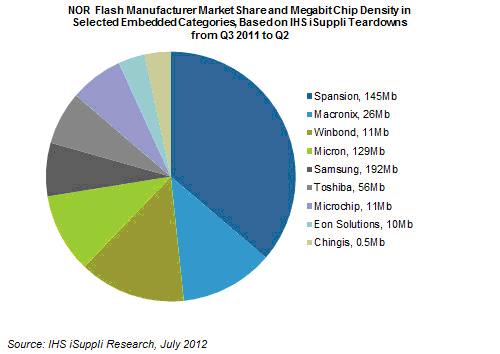
Based on a sample of 55 embedded products dissected by the IHS iSuppli Teardown Analysis Services over the course of three quarters, California-based Spansion Inc. led all NOR suppliers in terms of design wins. The company accounted for more than one-third of the NOR chips in the torn-down devices, as shown in the figure below.


Spansion, together with Samsung Electronics Co. Ltd. of South Korea and Micron Technology Inc. from Idaho, offered NOR chips in densities averaging in the hundreds of megabits. The three companies accounted for 53.4 percent of NOR chips in the three subsegments during the period from the third quarter of 2011 to the second quarter this year.


The rest of the market, equivalent to 46.6 percent of the sample, is controlled by companies that produced low-density NOR memory below the 100-megabit level. This group included big players like Taiwan’s Macronix International Co. Ltd. and Winbond Electronics Corp., as well as smaller entities like fellow Taiwanese firms Chingis Technology Corp. and Eon Silicon Solution Inc.


“Used to store small amounts of executable code, NOR flash was traditionally employed in devices like cellphones for fast read operations and random access capabilities,” said Ryan Chien, analyst for memory and storage at IHS. “However, newer implementations of NAND-based Embedded MultiMedia Card (eMMC) solutions that emulate NOR capabilities have resulted in NOR falling out of favor. The percentage of handsets using NOR flash has fallen from 14 percent in 2010 teardowns to less than 7 percent since then, found mostly in Samsung smartphones. However, NOR manufacturers have been proactive in their diversification efforts, borne out by a study of recent teardowns in both wireless and embedded categories.”


Tablets Energize NOR Market

Among the most prominent applications for NOR are tablets. Despite the elimination of NOR in the new iPad from Apple Inc., NOR chips were found in several Android alternatives in the teardowns, including the Eee Slate and Transformer Prime from Asus; the Jetstream and Flyer from HTC; and the Galaxy Tab 10.1 LTE and 7.7 from Samsung. Tablet devices from Samsung tended to incorporate the company’s own brand, higher-density NOR flash in multi-chip packages, while other branded tablets preferred discrete low-density SPI parts.


In the automotive space, NOR flash plays an increasing role to address vehicle safety regulations and manage user-comfort expectations. Head units in vehicles from Ford, General Motors, Nissan and Honda each had more than 230 megabits of NOR flash. NOR suppliers include Microchip and Micron for Honda and Toyota cars; Toshiba Corp. for Nissan vehicles; and Spansion for GM and Ford autos.


The other high-potential market for NOR flash is the industrial space. Network-attached storage systems from QNAP Systems and Buffalo Technology use Micron chips, and routers from Ubee Interactive and Ruckus Wireless each include 128 megabits of NOR.


An emerging industrial segment for NOR is the smart grid space, where devices such as feeder protection relays require high-density NOR to help monitor substation power lines. All of the NOR flash in hardware made by Sweden’s ABB Group is from Spansion, while solutions for U.S.-based Schweitzer Engineering Laboratories make use of Samsung and Spansion NOR parts. Samsung NOR is rare in third-party products, whereas Spansion has been aggressive in addressing this growth segment.